If you think you’ve already filed for everything you’re entitled to and just have to accept the VA rating you have, recent VBA data says otherwise for most veterans.
Across the 6,338,253 veterans currently receiving VA disability compensation, the average combined claim file holds 7.34 separate service-connected VA disabilities — a number built from 46,496,235 total rated conditions on the VA’s books.
That’s not a typo, and it’s not an outlier driven by a handful of severely injured veterans.
It’s the system-wide average.
This article breaks down what the average number of VA disabilities per veteran means, including why so many veterans end up under-claimed, which categories of conditions are seeing the fastest growth in new claims, and how to check your own file against it.
Summary of Key Points
The average veteran receiving VA compensation has 7.34 service-connected disabilities, based on 46,496,235 total rated conditions across 6,338,253 veterans.
Post-9/11 (GWOT) veterans average 9.61 disabilities — the highest of any era — compared to 9.07 for Gulf War era and 4.67 for Vietnam era veterans.
New recipients in FY2025 filed with an average of 6.15 disabilities per veteran, lower than the system-wide average — meaning most veterans keep adding conditions over the life of their claim.
Total service-connected disabilities on file grew 11.6% year-over-year, nearly double the 5.8% growth rate of the veteran population itself.
Digestive conditions were the fastest-growing new-claim category in FY2025, up 21.8% — a sign that secondary conditions veterans previously overlooked are increasingly being recognized and claimed.
Table of Contents
According to VBA data, the average veteran receiving VA disability compensation has 7.34 service-connected disabilities on file — not one or two, but more than seven. Post-9/11 (GWOT) veterans average even higher, at 9.61. If your claim file lists fewer conditions than that, the data suggests you may have legitimate, ratable conditions you haven’t filed for yet.
-VA Claims Insider
What This Number Actually Means
Many veterans treat their VA claim as a one-time event: file for the conditions you know about, get a rating, move on.
The data shows that’s not how most successful claims actually work.
The system-wide average of 7.34 disabilities per veteran reflects claim files built over years, often through multiple rounds of filing — an initial claim, followed later by secondary conditions, increases, and newly diagnosed issues.
The gap between new claimants and the overall average makes this pattern visible in the data itself. Veterans filing as new recipients in FY2025 averaged 6.15 disabilities per claim — meaningfully lower than the 7.34 system-wide average.
That gap exists because the average keeps climbing as veterans revisit their claim file over time, adding secondary conditions and increases they didn’t know to file for initially.
PRO TIP: Easily see how much your other condition(s) could increase your monthly compensation with our Free VA Disability Calculator.
Disabilities Per Veteran, By Era
The average isn’t uniform across all veteran populations. More recently separated veterans — particularly those from the Gulf War and post-9/11 eras — carry meaningfully higher disability counts than older cohorts, reflecting both broader presumptive-condition coverage (like the PACT Act) and more aggressive, better-informed claims filing in recent years.
Source: FY2025 VBA Compensation Report. The Vietnam-era figure is lower in large part because that population filed most of its claims decades ago, before secondary-condition claiming and presumptive toxic-exposure conditions were as well understood or as widely available as they are today.
Where the Growth is Coming From: Fastest-Growing Claim Categories
One reason the system-wide average keeps climbing is that veterans are increasingly successful at claiming secondary conditions — conditions caused or worsened by an already-rated disability, not directly tied to a specific in-service event. The FY2025 data shows which categories of new disability claims grew fastest year-over-year:
Body System
FY2024 New Claims
FY2025 New Claims
YoY Change
Digestive
97,542
118,805
+21.8%
Mental Health
163,644
178,379
+9.0%
Musculoskeletal
1,176,817
1,287,268
+9.4%
Dental / Oral
19,983
21,720
+8.7%
The Eye
29,462
31,369
+6.5%
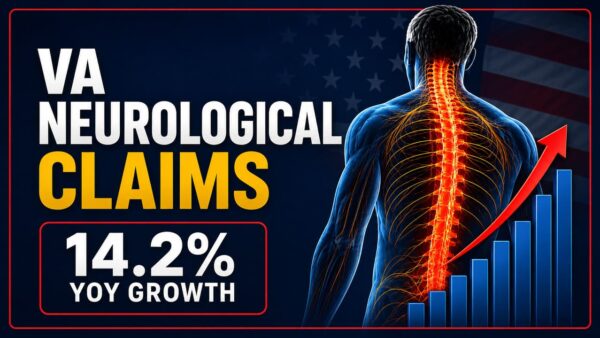
Neurological
291,292
308,494
+5.9%
Auditory
398,163
408,245
+2.5%
Digestive conditions grew faster than any other body system in FY2025 — a category that includes IBS, GERD, and hiatal hernia, all of which are well-documented secondary conditions to PTSD, chronic pain, and burn pit exposure.
That growth is a sign the gap is closing, not evidence it’s closed: with 1,791,192 total digestive-system disabilities currently on the VA’s books against a veteran population where digestive secondary conditions are common, there’s still real room for veterans to check whether their own PTSD, back condition, or toxic-exposure claim has an unclaimed digestive condition attached to it.
Common Cascades Veterans Miss
Secondary conditions tend to follow predictable patterns. If you’re already rated for one of the conditions below, the data and VA case history both suggest it’s worth checking whether a related condition belongs in your file too:
Lower back conditions → radiculopathy (nerve damage), gait-related joint problems, and depression from chronic pain are frequently claimed secondary to a service-connected back condition. See secondary conditions to lower back pain for the most common examples.
Sleep apnea, tinnitus, and chronic pain → each has its own well-documented list of secondary conditions, from cardiovascular issues to mental health impacts. The full list of VA secondary conditions is a useful starting point for checking your own file against known patterns.
Every approved secondary condition is rated independently, then folded into your combined rating using the VA’s combined ratings formula — a calculation that doesn’t simply add percentages together. A single well-documented secondary condition can move your combined rating meaningfully, especially if it’s rated 30% or higher.
An average of 7.34 service-connected disabilities per veteran isn’t a statistic to memorize — it’s a benchmark to check your own claim file against. If your file lists one or two conditions and you haven’t revisited it since your initial rating, the data says you’re likely in the minority, not the norm.
The fastest-growing claim categories are exactly the kind of secondary conditions that get missed the first time around and successfully claimed the second.
YOU SERVED. YOU DESERVE.
You served. You earned the right to file. You earned the right to be heard. And you earned the right to pursue every VA benefit you legally qualify for.
So here is the real question:
Do you have the VA rating you were given, or the VA rating you truly deserve?
Want Expert-Level VA Claim Help? WE GOT YOUR SIX!
VA Claims Insider helps educate and empower veterans to get the VA rating they deserve.
Work directly with a VA Claims Insider Coach who can help lead you to VA claim victory.
50,000+ disabled veterans served in our membership programs since 2016.
33% average rating increase for veterans who complete our Elite program.
What is the average number of VA disabilities per veteran?
According to FY2025 VBA data, the average veteran receiving VA disability compensation has 7.34 service-connected disabilities, based on 46,496,235 total rated conditions across 6,338,253 veterans.
Why do post-9/11 veterans have more disabilities on average than older veterans?
Post-9/11 (GWOT) veterans average 9.61 disabilities, the highest of any era, reflecting both broader presumptive-condition coverage under laws like the PACT Act and more complete, better-informed claims filing in recent years.
How do I know if I have more conditions to claim?
Start by reviewing your existing service-connected conditions and asking what they may have caused or worsened. Common cascades include PTSD leading to sleep apnea, GERD, or hypertension, and back conditions leading to radiculopathy. VACI’s full list of secondary conditions is a useful starting point.
Does the VA automatically identify secondary conditions for me?
No. The VA does not automatically add secondary conditions to your claim. Each one must be filed separately, with medical evidence connecting it to an already-rated disability.
Can filing additional claims lower my existing rating?
No. Filing a new claim for an additional condition does not put your existing rating at risk. Each condition is evaluated independently, and an approved claim can only add to or leave unchanged your combined rating.
Is there a limit to how many disabilities I can claim?
No. There is no limit on the number of service-connected disabilities a veteran can claim, as long as each is supported by a current diagnosis and medical evidence connecting it to service or to an already-rated condition.
If you haven’t reviewed your claim file for unclaimed secondary conditions in the last year or two, the data suggests that’s the single highest-leverage place to look next.
Content Reviewed By
Quality Assurance Team
The Quality Assurance (QA) team at VA Claims Insider has extensive experience researching, fact-checking, and ensuring accuracy in all produced content. The QA team consists of individuals with specialized knowledge in the VA disability claims adjudication processes, laws and regulations, and they understand the needs of our target audience. Any changes or suggestions the QA team makes are thoroughly reviewed and incorporated into the content by our writers and creators.
About the Author
Eric Webb
Eric has written and worked in the field of Veterans Disability since 2020 and enjoys writing educational content for the veteran population. His prior work has been published in the Official Journal of the American College of Sports Medicine (ACSM). He holds a Degree in Health and Exercise Science.
If you have a service-connected back, hip, or knee condition and you've never filed for nerve damage, you're not alone — and the newest VA data suggests you may be missing something real.... continue reading
Ask most veterans whether the VA covers dental, and you'll usually get one of two answers: “only if you're 100% disabled” or “no.” Neither is the full picture. Dental and oral conditions are... continue reading
Elite Membership
Dear Veteran, Here’s the brutal truth about VA disability claims:
According to our data, 8/10 (80%) of veterans reading this message right now are underrated by the VA…
This means you do NOT currently have the VA disability rating and compensation YOU deserve, and you could be missing out on thousands of dollars of tax-free compensation and benefits each month.
As a fellow disabled Veteran this is shameful and I’m on a mission to change it.
Brian Reese here, Air Force service-disabled Veteran and Founder @ VA Claims Insider.
Since 2016, VA Claims Insider has helped thousands of Veterans just like you get the VA rating and compensation they deserve in less time.
If accepted into our ELITE membership program, you’ll get up-front access and permission to use $13,119 worth of proprietary VA claim resources, including access to our network of independent medical professionals for medical examinations, disability evaluations, and credible Medical Nexus Letters, which could help you get a HIGHER VA rating in LESS time.
VA Claims Insider, LLC, and its affiliates ("we," "us", or "our") are not sponsored by, or affiliated with, the United States Department of Veterans Affairs, any state's Department of Veterans Affairs, or any other federally chartered veterans service organization. Other organizations, including, but not limited to, your state's Department of Veterans Affairs, your local county veterans service agency, and other federally chartered veterans service organizations, may be able to provide you with these services free of charge. Products or services offered by VA Claims Insider, LLC, and its affiliates are not necessarily endorsed by any of these organizations. You may qualify for other veterans' benefits beyond the services that VA Claims Insider, LLC and its affiliates offer.
None of our employees are accredited agents, VSOs, attorneys, or entities recognized by the United States Department of Veterans Affairs or any state's Department of Veterans Affairs, and none of our employees will assist you with the preparation, presentation, or prosecution of any claim for VA disability benefits. Before engaging with us, we strongly encourage you to discuss your disability claims matter with an accredited VSO, accredited attorney, or accredited claims agent, at www.va.gov/ogc/apps/accreditation/index.asp, all of whom are free to use. You are not required to use our website or services to submit a claim for VA disability benefits. You may receive a positive VA disability claim outcome without using our paid services. Furthermore, your use of our paid services does not and cannot affect the speed at which the VA processes your disability claims, as processing times are determined solely by the VA. VA CLAIMS INSIDER, LLC AND ITS AFFILIATES DO NOT GUARANTEE ANY SPECIFIC OUTCOMES OR RESULTS BY YOUR USE OF ITS WEBSITE OR SERVICES AND YOUR RESULTS MAY VARY FROM THE INFORMATION PROVIDED IN OUR ADVERTISEMENTS AND, ON THIS WEBSITE, INCLUDING BUT NOT LIMITED TO, SUCCESS PERCENTAGES, DISABILITY RATING INCREASES, AND PROCESSING TIMELINES ARE HISTORICAL AVERAGES ONLY, ARE NOT GUARANTEES OF FUTURE RESULTS, AND ARE NOT SPECIFIC TO ANY ONE CLAIM. SUCH INFORMATION VARIES OVER TIME, AND WE MAKE NO OBLIGATION TO KEEP SUCH INFORMATION CURRENT. The VA Claims Insider® name and logo are registered trademarks of VA Claims Insider, LLC.

 go.vaclaimsinsider.com