VA Secondary Conditions Guide
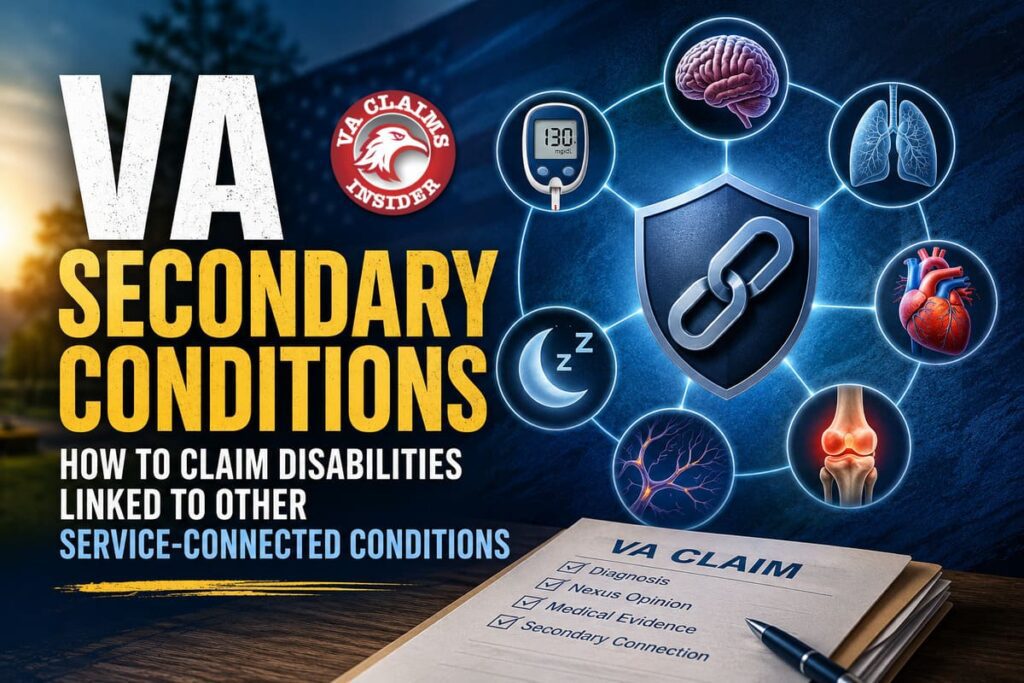
A VA secondary condition is a disability caused or worsened by a condition you’re already service-connected for. It doesn’t need a direct link to your military service — it needs a medical connection to an existing rated disability. Millions of veterans are living with secondary conditions they’ve never claimed, leaving significant compensation on the table.
Secondary service connection is one of the most effective and underused strategies for increasing your VA disability rating. Whether it’s sleep apnea caused by PTSD, peripheral neuropathy caused by Type 2 diabetes, or depression caused by chronic pain, the VA is required to rate these conditions as service-connected — if you document them properly.
This guide explains how secondary service connection works, which conditions commonly qualify, what evidence you need, and how to file. It connects to detailed resources on each topic so you can go deeper where it matters most for your VA claim.
Summary of Key Points
- A secondary condition is any disability caused or aggravated by a condition already rated service-connected — it does not require a direct in-service incident
- The legal authority for secondary service connection is 38 CFR § 3.310, which covers both the “proximately due to” and “aggravated by” standards
- You need a medical nexus opinion (e.g., nexus letter) connecting your secondary condition to another service-connected disability
- Secondary conditions are rated independently, then combined into your overall VA disability rating using the VA’s combined ratings formula
- A May 2026 VA policy update following the Spicer v. McDonough ruling clarified the “but-for” causation standard for aggravation claims — secondary service connection remains fully available under both legal paths
Table of Contents
What Are VA Secondary Conditions?
A secondary condition is a disability that develops because of a condition you’re already service-connected for. The connection isn’t to your military service directly — it’s to your primary rated disability. VA regulations under 38 CFR § 3.310 establish two paths: a condition that is “proximately due to” a service-connected disability, and a condition that is “aggravated by” a service-connected disability beyond its natural progression.
The distinction matters because it’s broader than most veterans realize. A condition doesn’t have to be caused entirely by your primary disability — it only needs to be made worse by it. A veteran with service-connected knee pain who develops back problems from compensating their gait has a valid secondary claim. A veteran with PTSD who develops a sleep disorder or cardiovascular condition has a valid secondary claim.
For a full breakdown of the legal framework and qualifying standards, see what secondary service connection means.
How Secondary Service Connection Works
Secondary service connection follows the same basic framework as direct service connection — you need a current diagnosis, a primary condition already rated service-connected, and a medical opinion linking the two. The legal standard is “at least as likely as not” that the secondary condition was caused or aggravated by the primary disability.
The VA does not require that the primary disability be the sole cause — only that it be a contributing factor. For aggravation claims, the veteran must show that the primary disability caused the secondary condition to worsen beyond its natural progression. The burden to disprove aggravation then shifts to the VA.
Recent case law has continued to refine these standards. Following the Federal Circuit’s ruling in Spicer v. McDonough, the VA updated its M21-1 adjudication manual in May 2026 to apply a “but-for” causation standard to aggravation claims. This update clarifies how raters evaluate evidence — but it does not eliminate or restrict either legal path under 38 CFR § 3.310.
For a plain-English explanation of how these claims are built and evaluated, see how secondary conditions work in practice. For the full story on the Spicer ruling and what it means for your claim, read why the VA did not eliminate secondary claims.
Common VA Secondary Conditions
Secondary conditions span nearly every diagnostic category. Some of the most frequently established connections include:
- PTSD → sleep apnea, hypertension, depression, anxiety disorders, cardiovascular disease, gastrointestinal conditions, erectile dysfunction
- Sleep apnea → hypertension, depression, cognitive impairment, pulmonary hypertension
- Type 2 diabetes → peripheral neuropathy, kidney disease, diabetic retinopathy, erectile dysfunction
- Knee or hip injury → lumbar spine condition (from gait compensation), contralateral joint condition
- Tinnitus or hearing loss → depression, anxiety, sleep disorders, migraines
- Chronic pain (any source) → depression, anxiety, sleep disorders
- TBI → depression, anxiety, PTSD, cognitive disorders, sleep disorders
This is not an exhaustive list — secondary connections are only limited by the medical evidence. For a comprehensive breakdown by primary condition and diagnostic category, see the full VA secondary conditions list.
How to Prove a Secondary Condition
The most important piece of evidence for a secondary claim is the nexus letter (nexus opinion) — a written statement from a qualifying medical professional connecting your secondary condition to your primary service-connected disability. Without it, the VA typically denies the claim for lack of medical nexus.
A strong nexus opinion includes: the physician’s relevant credentials, a review of your medical history and records, an explicit statement using the VA’s “at least as likely as not” standard, and a clear medical rationale explaining the mechanism of connection. Vague statements without supporting reasoning carry less weight than detailed opinions that cite your records and explain causation.
In addition to the nexus letter, submit:
- A current diagnosis of the secondary condition (from VA or private records)
- Your existing rating decision confirming the primary condition is service-connected
- Treating physician notes, specialist records, or imaging that supports the secondary connection
- A personal statement describing how your primary condition caused or worsened the secondary one
Private nexus opinions from independent physicians typically carry more weight than those generated through the VA’s examination process, particularly for complex or contested secondary connections.
VA Ratings for Secondary Conditions
Secondary conditions are rated using the same VA Schedule for Rating Disabilities diagnostic codes as directly service-connected conditions. The VA assigns a separate disability percentage for each secondary condition, then folds it into your combined rating using the VA’s combined ratings formula — often called “VA math.”
The combined ratings formula doesn’t add percentages together. It applies each successive rating to your remaining “able-bodied” capacity. This means the size and order of ratings matter — a single high-value secondary condition can significantly move your combined percentage, while several smaller ones may add less than expected.
For a detailed explanation of how secondary conditions interact with the combined ratings formula and what that means for your total rating, see how secondary conditions are calculated into your combined rating.
Some secondary conditions also trigger the VA bilateral factor — an additional 10% added to the combined value of paired extremity conditions rated on both sides of the body. And secondary conditions can contribute toward TDIU eligibility, helping a veteran cross the threshold for 100% compensation even when the combined schedular rating falls short.
How to Claim Disabilities Linked to Other Service-Connected Conditions
Filing a secondary claim uses the same form as any VA disability claim: VA Form 21-526EZ, available on VA.gov or through a Veterans Service Organization. In the conditions section, clearly identify each secondary condition and list the primary service-connected disability you’re connecting it to.
File your nexus opinion and supporting medical evidence with the claim. If you haven’t yet gathered a private nexus opinion, submit an Intent to File first — this preserves your effective date while you build your evidence package. The effective date for a secondary claim typically goes back to the date of your Intent to File or formal claim submission.
The VA will likely schedule a Compensation & Pension (C&P) exam to evaluate the secondary condition. Prepare the same way you would for any C&P exam: describe your worst days, be specific about functional limitations, and do not minimize symptoms. How you present during the exam directly affects the rating outcome.
Common Mistakes to Avoid
Not filing at all. Many veterans assume the VA identifies secondary conditions automatically. It doesn’t. You must file a separate claim for each secondary condition you want rated.
Weak nexus letters. A nexus letter that says “possibly related” or doesn’t explain the medical connection is often insufficient. The opinion needs to be explicit, specific, and supported by medical reasoning.
Filing without a current diagnosis. You need a formal diagnosis before you file. Claiming a condition “might be” secondary to something else without documented confirmation will typically result in denial.
Describing improvement at the C&P exam. Rate your condition based on how it affects you on your worst days, not how you feel on the day of the exam. Be honest and thorough.
Overlooking aggravation claims. Veterans often focus on causation (the primary caused the secondary) and overlook aggravation (the primary made an existing condition worse). Both paths are valid under 38 CFR § 3.310.
Conclusion
Secondary service connection is one of the most direct paths to a higher VA disability rating — and one of the most frequently overlooked. The framework is clear: if a condition is caused by or worsened by an already-rated disability, the VA is required to recognize it as service-connected.
Getting there requires the right evidence, especially a strong medical nexus opinion and a complete documentation package. The claims that succeed are the ones built before the filing date, not assembled afterward.
If you’re exploring secondary conditions for the first time, start with the full list of VA secondary conditions to see which of your existing rated disabilities might support additional claims.
FAQs | Frequently Asked Questions
Can I file a secondary claim if my primary condition is rated at 0%?
Yes. A 0% rating means the VA recognizes your condition as service-connected, even though it hasn’t reached the minimum threshold for compensation. A 0% service-connected condition can still serve as the basis for a secondary claim — the legal standard under 38 CFR § 3.310 requires only that the primary condition be service-connected, not that it carry a compensable rating. If the secondary condition is approved, it receives its own separate disability percentage.
How many secondary conditions can I claim?
There is no limit. You can file as many secondary conditions as you have medical evidence to support. Each approved condition is rated independently and folded into your combined rating using the VA’s combined ratings formula. Veterans with multiple primary service-connected disabilities may find that several secondary conditions stem from different sources — all of them can be claimed simultaneously or over time as evidence is developed.
Does the May 2026 VA policy update affect my pending or existing secondary claim?
No. The May 2026 M21-1 update, issued following the Spicer v. McDonough Federal Circuit ruling, clarified how raters apply the “but-for” causation standard to secondary aggravation claims. It does not eliminate or restrict secondary service connection — both the “proximately due to” path and the “aggravated by” path remain fully intact under 38 CFR § 3.310. Veterans with pending or previously denied secondary aggravation claims may want to review whether the updated standard affects their specific situation.
What if the VA denies my secondary claim?
Denial doesn’t mean the claim is over. You have three options after a denial: a Supplemental Claim (submitting new and relevant evidence), a Higher-Level Review (requesting a senior adjudicator review without new evidence), or a Board of Veterans’ Appeals appeal. In most cases, a denied secondary claim is strengthened by obtaining a more detailed nexus opinion or additional supporting medical records before refiling as a Supplemental Claim.
Do I need a private doctor for a nexus letter, or can a VA doctor write it?
In practice, private physicians and independent medical examiners are often preferred because their opinions tend to be more detailed and specific than those generated through the VA’s examination process. VA physicians can write nexus letters, but they aren’t required to and may decline. A private nexus opinion from a qualified specialist who has reviewed your full medical records is typically the strongest foundation for a secondary claim.
Can secondary conditions help me reach 100% or qualify for TDIU?
Yes — and this is one of the most important reasons to pursue secondary claims aggressively. Each approved secondary condition increases your combined rating. Veterans sitting at 70%–90% who identify one or two well-documented secondary conditions often find the combination pushes their overall VA rating into the 100% range. For veterans who can’t reach 100% schedularly, secondary conditions can contribute to TDIU eligibility if they help meet the 60% single-condition threshold or the 70% combined threshold with one condition at 40% or higher.
Related Resources
What is Secondary Service Connection?
VA Secondary Conditions Explained
Did the VA Eliminate Secondary Claims?
Full List of VA Secondary Conditions
How Are VA Secondary Conditions Calculated?
Top 10 Easiest Secondary VA Claims to Win
What We Believe
Our WHY
We believe millions of veterans feel overlooked, lowballed, denied, or lost in the VA claims process.
Our purpose is to help underrated disabled veterans rated 0% to 90% create real life change by pursuing the VA disability benefits they legally, morally, ethically, and medically deserve.
We are INSIDERS.
Our HOW
We make the VA disability process easier through expert-level education, proven resources, and veteran-to-veteran support.
You are never alone in this fight.
Our flagship program, VA Claims Insider Elite, connects each veteran with an expert-level Veteran Coach who guides them through our proprietary 8-step process.
That process is built around our SEM Method:
Strategy + Education + Medical Evidence = VA Rating You Deserve!
Our WHAT
We help underrated disabled veterans rated 0% to 90% win, service connect, and increase their VA rating through a smarter strategy, better education, and stronger medical evidence.
YOU SERVED. YOU DESERVE.

Do you have the VA rating you were given…or the VA rating you actually deserve?
Because getting a decision from the VA does not always mean you got the right decision from the VA.
If you are rated anywhere from 0% to 90% and feel stuck, frustrated, underrated, denied, or overlooked, I am speaking directly to you.
And if you have never filed because you thought other veterans deserved it more, because you got denied before, or because you assumed it was too late, do not let those myths make your decision for you.
At VA Claims Insider, we help underrated disabled veterans create real life change by getting the VA rating and compensation they deserve!
Here’s a sliver of what you get when you join us:
- A Veteran Coach by your side, so you never have to fight the VA alone.
- A smarter, personalized strategy for your claim.
- Better VA disability education, so you know what to do next.
- Stronger private medical evidence (DBQs, Nexus Letters, Mental Health Evaluations, and more) at members-only rates to support the rating you deserve.
- And a proven battle plan toward VA claim victory.
But maybe you’re wondering: Will this actually work for me?
That is a fair question.
- At VA Claims Insider, we have helped 50,000+ veterans fight for the VA disability benefits they earned.
- Our internal data shows an average *33% VA rating increase for veterans who complete our Elite program.
- Our internal data also shows veterans in our programs get their claims approved *25% faster on average than the VA’s published average claim-processing timelines.
- Veterans in our community have left 7,000+ total reviews, with a 4.6 out of 5 average rating.
- More than 5,500 reviews are 5 stars ⭐⭐⭐⭐⭐, and 92% of all veteran customer reviews are either 4 or 5 stars.
*Based on VA Claims Insider internal data for veterans who completed the Elite program. Average results shown; individual results vary. No guaranteed outcome or faster claim processing.
If you are ready for a better battle plan, a smarter strategy, and the right path to the VA rating and compensation you deserve, we’ve got your six.
📅 Schedule a Call or click the red button below to get started:
Content Reviewed By

Quality Assurance Team
The Quality Assurance (QA) team at VA Claims Insider has extensive experience researching, fact-checking, and ensuring accuracy in all produced content. The QA team consists of individuals with specialized knowledge in the VA disability claims adjudication processes, laws and regulations, and they understand the needs of our target audience. Any changes or suggestions the QA team makes are thoroughly reviewed and incorporated into the content by our writers and creators.
About the Author

Brian Reese
Brian Reese is a world-renowned VA disability benefits expert and the #1 bestselling author of VA Claim Secrets and You Deserve It. Motivated by his own frustration with the VA claim process, Brian founded VA Claims Insider to help disabled veterans secure their VA disability compensation faster, regardless of their past struggles with the VA. Since 2013, he has positively impacted the lives of over 10 million military, veterans, and their families.
A former active-duty Air Force officer, Brian has extensive experience leading diverse teams in challenging international environments, including a combat tour in Afghanistan in 2011 supporting Operation ENDURING FREEDOM.
Brian is a Distinguished Graduate of Management from the United States Air Force Academy and earned his MBA from Oklahoma State University’s Spears School of Business, where he was a National Honor Scholar, ranking in the top 1% of his class.
IMPORTANT LEGAL DISCLAIMER
VA Claims Insider, LLC, and its affiliates ("we," "us", or "our") are not sponsored by, or affiliated with, the United States Department of Veterans Affairs, any state's Department of Veterans Affairs, or any other federally chartered veterans service organization. Other organizations, including, but not limited to, your state's Department of Veterans Affairs, your local county veterans service agency, and other federally chartered veterans service organizations, may be able to provide you with these services free of charge. Products or services offered by VA Claims Insider, LLC, and its affiliates are not necessarily endorsed by any of these organizations. You may qualify for other veterans' benefits beyond the services that VA Claims Insider, LLC and its affiliates offer.
None of our employees are accredited agents, VSOs, attorneys, or entities recognized by the United States Department of Veterans Affairs or any state's Department of Veterans Affairs, and none of our employees will assist you with the preparation, presentation, or prosecution of any claim for VA disability benefits. Before engaging with us, we strongly encourage you to discuss your disability claims matter with an accredited VSO, accredited attorney, or accredited claims agent, at www.va.gov/ogc/apps/accreditation/index.asp, all of whom are free to use. You are not required to use our website or services to submit a claim for VA disability benefits. You may receive a positive VA disability claim outcome without using our paid services. Furthermore, your use of our paid services does not and cannot affect the speed at which the VA processes your disability claims, as processing times are determined solely by the VA. VA CLAIMS INSIDER, LLC AND ITS AFFILIATES DO NOT GUARANTEE ANY SPECIFIC OUTCOMES OR RESULTS BY YOUR USE OF ITS WEBSITE OR SERVICES AND YOUR RESULTS MAY VARY FROM THE INFORMATION PROVIDED IN OUR ADVERTISEMENTS AND, ON THIS WEBSITE, INCLUDING BUT NOT LIMITED TO, SUCCESS PERCENTAGES, DISABILITY RATING INCREASES, AND PROCESSING TIMELINES ARE HISTORICAL AVERAGES ONLY, ARE NOT GUARANTEES OF FUTURE RESULTS, AND ARE NOT SPECIFIC TO ANY ONE CLAIM. SUCH INFORMATION VARIES OVER TIME, AND WE MAKE NO OBLIGATION TO KEEP SUCH INFORMATION CURRENT. The VA Claims Insider® name and logo are registered trademarks of VA Claims Insider, LLC.