 go.vaclaimsinsider.com
Looking for Expert-Level VA Claim Answers? Schedule a Call
Hi fellow veterans, Brian Reese here with VA Claims Insider. In this Ultimate Guide, I’m going to reveal and explain the Top 100+ VA Disability Secondary Conditions List for 2026.
While this list is not exhaustive, we focused on some of the most common and high-value VA secondary claims veterans should know about.
You’ll also learn the key requirements for establishing secondary service connection, including what evidence you need to show that your new condition was caused or aggravated by an already service-connected disability.
You might also find these two high-value guides helpful: Secondary Service Connection and Secondary Service Connection Via Aggravation.
Let’s begin!
Summary of Key Points
- VA secondary service connection allows veterans to receive compensation for disabilities caused or aggravated by an already service-connected condition under 38 CFR § 3.310.
- The strongest secondary VA claims include three things: a current diagnosis, an existing service-connected disability, and a medical nexus connecting the two conditions.
- Common high-value secondary claims include migraines secondary to PTSD, sleep apnea secondary to sinusitis or PTSD, GERD secondary to mental health conditions, and radiculopathy secondary to back pain.
- A well-supported nexus letter and medical evidence can significantly improve your chances of winning a secondary VA disability claim, especially after denials or unfavorable C&P exams.
Table of Contents
What is VA Secondary Service Connection?

Under 38 C.F.R. § 3.310, VA secondary service connection means a new secondary disability is connected to an already service-connected disability because it is proximately due to, the result of, or aggravated by that service-connected condition.
There are two main paths for secondary claims: causation and aggravation. The service-connected condition can either “cause” the secondary condition, meaning the new disability is proximately due to or the result of the service-connected disease or injury, or it can “aggravate” a non-service-connected condition by causing an increase in severity beyond the natural progress of that condition. For aggravation, VA compares the veteran’s baseline level of severity to the current level of severity and determines how much worsening is due to the service-connected condition.
There’s a rumor going around that VA eliminated secondary claims, but that’s false. Secondary service connection is still alive under 38 C.F.R. § 3.310. But after Spicer v. McDonough, veterans need to think beyond simple direct causation and ask the bigger “but-for” question: Would this condition have happened — or would it be as severe today — BUT FOR my service-connected disability?
That connection does not always have to be a straight line. It can involve a medical chain reaction, medication side effects, altered movement, weight gain as an intermediate step, delayed treatment, blocked treatment, limited recovery, or aggravation beyond the natural progress of the condition. Spicer didn’t make secondary claims automatic, but it did give veterans a better and stronger way to identify and argue when a service-connected condition left them worse off than they otherwise would have been.
To win a secondary VA claim, you generally need three things: (#1) medical diagnosis of the new secondary condition, (#2) evidence of an existing service-connected primary disability rated at 0% or higher, and (#3) medical nexus evidence connecting the two.
Do I Need a Nexus Letter for a Secondary Claim?
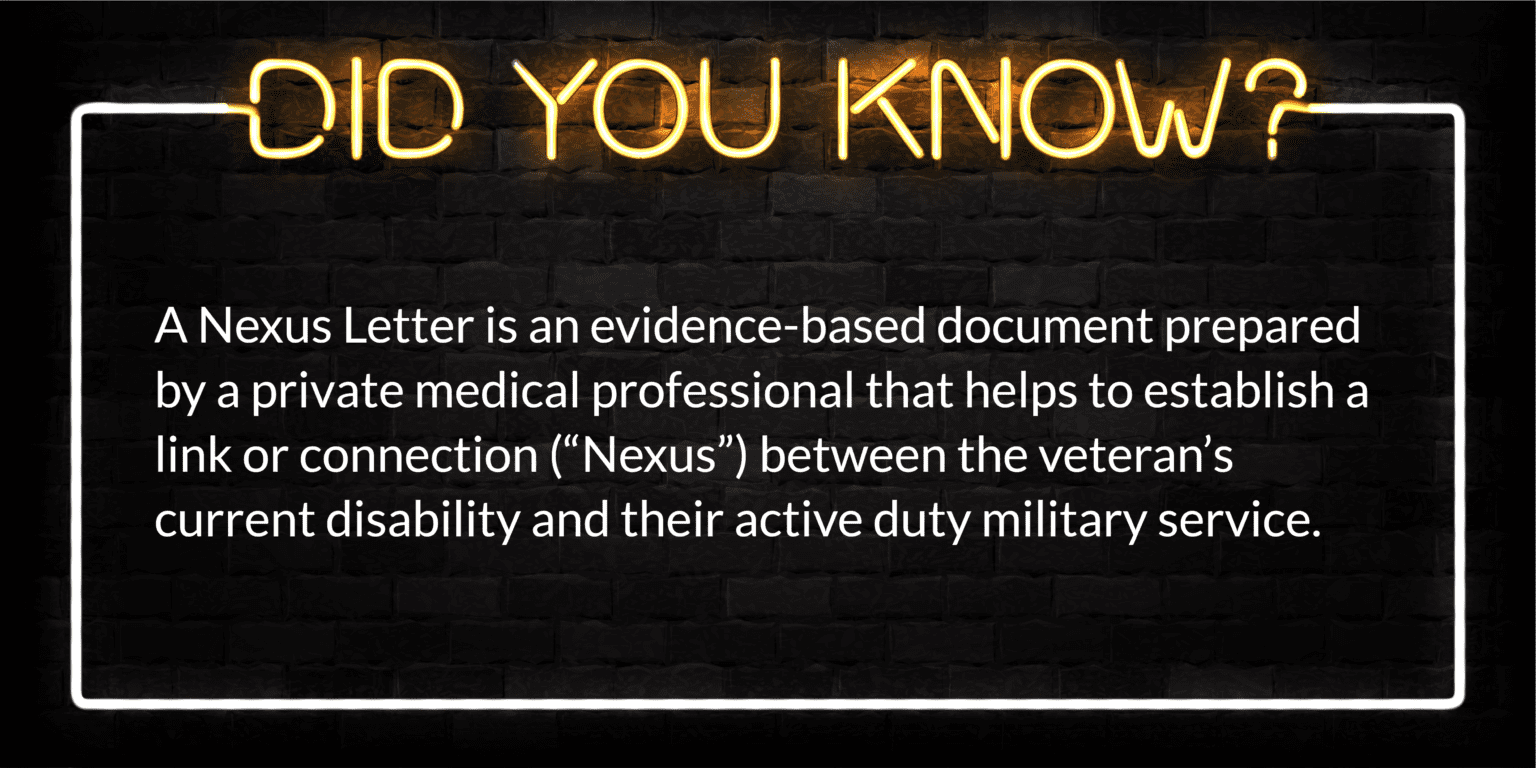
A nexus letter for a secondary VA claim is not required, but it’s highly recommended — especially if the connection between your conditions is not obvious.
Why? Because the key issue in most secondary claims is the medical nexus: how your already service-connected condition caused or aggravated the new secondary condition. VA may order a C&P exam and ask the examiner for a medical opinion, but you don’t control what that examiner says. Sometimes, you get a bad C&P exam, and the examiner fails to fully explain how your service-connected condition caused or aggravated your secondary condition.
A strong private nexus letter for a secondary condition can help connect the dots with evidence-based medical rationale. It should explain whether your secondary condition is at least as likely as not caused by, the result of, or aggravated by your service-connected disability. After Spicer, it can also address the bigger question: Would this condition have happened — or would it be as severe today — BUT FOR your service-connected disability?
Bottom line: A nexus letter does not guarantee approval, but it can help tip the scales in your favor and give you stronger evidence if you need to fight a wrongful denial on appeal.
Calculate your ratings with our VA Disability Calculator.
100+ Most Common VA Disability List of Secondary Conditions (Listed From A-Z)

- Asthma secondary to GERD (acid reflux or heartburn)
- Asthma secondary to Obstructive Sleep Apnea
- Asthma secondary to Depression
- Asthma secondary to Anxiety
- Asthma secondary to Allergies
- Asthma secondary to Nasal polyps
- Asthma secondary to Vocal Cord Dysfunction (Inducible Laryngeal Obstruction)
- Asthma secondary to Asthma-COPD overlap syndrome
- Asthma secondary to Bronchiectasis
- Asthma secondary to Diabetes
- Bruxism secondary to Depression
- Bruxism secondary to Anxiety
- Bruxism secondary to Tinnitus
- Depression secondary to Tinnitus
- Depression secondary to Migraines
- ED secondary to PTSD
- ED secondary to Depression
- ED secondary to Anxiety
- ED secondary to Medication Side Effects
- ED secondary to Heart Disease
- ED secondary to Atherosclerosis
- ED secondary to High Cholesterol
- ED secondary to Hypertension
- ED secondary to Diabetes
- ED secondary to Weight Gain Obesity as Interim Link
- ED secondary to Parkinson’s Disease
- ED secondary to Multiple Sclerosis
- ED secondary to Prostate Cancer
- ED secondary to Spinal Cord Injuries
- Female Sexual Arousal Disorder secondary to PTSD
- Female Sexual Arousal Disorder secondary to Depression
- Female Sexual Arousal Disorder secondary to Anxiety
- Female Sexual Arousal Disorder secondary to Heart Disease
- Female Sexual Arousal Disorder secondary to Neurological Conditions
- Female Sexual Arousal Disorder secondary to Gynecological conditions, such as Vulvovaginal Atrophy, Infections or Lichen Sclerosis
- Female Sexual Arousal Disorder secondary to Medication Side Effects
- Fibromyalgia secondary to IBS
- Fibromyalgia secondary to Migraines
- Fibromyalgia secondary to Interstitial Cystitis or Painful Bladder Syndrome
- Fibromyalgia secondary to Temporomandibular Joint Disorders
- Fibromyalgia secondary to Anxiety
- Fibromyalgia secondary to Depression
- Fibromyalgia secondary to Postural Tachycardia Syndrome
- GERD secondary to Asthma
- GERD secondary to PTSD
- GERD secondary to Depression
- GERD secondary to Anxiety
- GERD secondary to Medication Side Effects
- GERD secondary to Weight Gain Obesity as Interim Link
- Hypertension secondary to Sleep Apnea
- Hypertension secondary to PTSD
- Hypertension secondary to Weight Gain Obesity as Interim Link
- Hypertension secondary to Kidney Disease
- Hypertension secondary to Diabetes
- Hypertension secondary to Hyperthyroidism
- Hypertension secondary to Lupus
- Hypertension secondary to Scleroderma
- IBS secondary to PTSD
- IBS secondary to Depression
- IBS secondary to Anxiety
- IBS secondary to Medication Side Effects
- IBS secondary to Weight Gain Obesity as Interim Link
- Meniere’s Syndrome secondary to Tinnitus
- Meniere’s Syndrome secondary to Hearing Loss
- Meniere’s Syndrome secondary to Migraines
- Meniere’s Syndrome secondary to TBI
- Migraines secondary to Tinnitus
- Migraines secondary to Cervical Strain
- Migraines secondary to GERD
- Migraines secondary to IBS
- Migraines secondary to PTSD
- Migraines secondary to Insomnia
- Migraines secondary to Depression
- Migraines secondary to Anxiety
- Migraines secondary to TBI
- Migraines secondary to Medication Side Effects
- Migraines secondary to Meniere’s Disease
- Migraines secondary to Fibromyalgia
- Migraines secondary to Heart Disease
- Migraines secondary to Asthma
- Plantar Fasciitis secondary to Foot Condition
- Plantar Fasciitis secondary to Back Condition
- Plantar Fasciitis secondary to Knees, Hips, Joint Instability
- Plantar Fasciitis secondary to Weight Gain Obesity as Interim Link
- Radiculopathy secondary to Back Pain
- Radiculopathy secondary to Lumbosacral or Cervical Strain
- Radiculopathy secondary to Spinal Stenosis
- Radiculopathy secondary to Spondylolisthesis
- Radiculopathy secondary to Ankylosing Spondylitis
- Radiculopathy secondary to Spinal Fusion
- Radiculopathy secondary to Vertebral Fracture or Dislocation
- Restless Leg Syndrome secondary to Back Condition
- Restless Leg Syndrome secondary to Neck Condition
- Restless Leg Syndrome secondary to Medication Side Effects
- Restless Leg Syndrome secondary to Peripheral Neuropathy
- Sleep Apnea secondary to Sinusitis
- Sleep Apnea secondary to Rhinitis
- Sleep Apnea secondary to Deviated Septum
- Sleep Apnea secondary to Asthma
- Sleep Apnea secondary to Weight Gain Obesity as Interim Link
- Sleep Apnea secondary to GERD
- Somatic Symptom Disorder secondary to Tinnitus
- Somatic Symptom Disorder secondary to Back Condition
- Somatic Symptom Disorder secondary to Neck Condition
- Vertigo secondary to Tinnitus
- Vertigo secondary to Migraines
- Vertigo secondary to Medication Side Effects
- Vertigo secondary to Head or Neck Conditions
- Vertigo secondary to TBI
Do You Have the Disability Rating You Deserve or Just the One the VA Gave You?

A lot of veterans are being told a lie.
The lie is that “everyone” is on VA disability and scamming the system.
That is false.
The truth is, only about 1 in 3 veterans receives VA disability compensation.
But here’s the part that really matters:
In my experience, far too many veterans who already have a VA rating still do not have the rating they truly deserve.
That means the real problem is not that too many veterans are getting benefits.
The real problem is that too many deserving veterans are still being lowballed, underrated, denied, and left behind.
Maybe that’s you.
- Maybe you were denied once and assumed the fight was over.
- Maybe you got 10%, 30%, 50%, 70%, or 90% and thought that was the final answer (one and done).
- Maybe you’ve been telling yourself, “Other veterans have it worse than me so I don’t deserve it.”
- Maybe deep down, you know the VA decision never fully reflects what you live with every single day.
If that sounds like you, hear me clearly:
YOU SERVED. YOU DESERVE.
And getting a decision from the VA does not always mean you got the right decision from the VA.
If you’re rated 0% to 90%, there is a very real chance you may be underrated.
So ask yourself this question:
Do you have the rating the VA gave you…or the rating you actually deserve for serving our country?
We help underrated disabled veterans (0% – 90%) like you build stronger VA claims through the SEM Method—Strategy + Education + Medical Evidence—so they can pursue the VA rating and compensation they’ve earned with clarity and confidence.
No obligation to start. No win. No fee.
Get started now by click the red button below:
Need Expert-Level Help With Your Secondary Claim? WE GOT YOUR SIX!

- VA Claims Insider is the #1 most trusted name in VA disability claims.
- Work one-on-one with a VA claims coach who can help lead you to VA claim victory.
- 52,000+ disabled veterans served in our membership programs since 2016.
- 33% average rating increase for veterans who complete our top rated Elite program.
- 4.6/5.0 average rating out of 7,000+ total reviews; over 5,500 5-star reviews.
- 92% of all veteran customer reviews are either 4 or 5 stars.
FAQs | Frequently Asked Questions
What is a VA secondary disability claim?
A VA secondary disability claim is a claim for a new condition that was caused or aggravated by an already service-connected disability. Veterans can receive additional VA compensation when medical evidence shows the secondary condition is linked to the primary service-connected condition.
What evidence do I need for a secondary VA claim?
Most successful secondary VA claims require a current medical diagnosis, an existing service-connected disability rated at 0% or higher, and a medical nexus linking the two conditions.
Strong supporting evidence may include medical records, nexus letters, DBQs, medication history, imaging results, and expert medical opinions.
Do I need a nexus letter for a VA secondary claim?
A nexus letter is not legally required, but it is often one of the most important pieces of evidence in a secondary VA claim. A strong nexus letter explains how your service-connected condition caused or aggravated the secondary condition using medical rationale and supporting research.
What are the most common VA secondary claims?
Some of the most common secondary VA disability claims include:
Migraines secondary to PTSD
Sleep apnea secondary to PTSD or sinusitis
GERD secondary to anxiety or PTSD
Radiculopathy secondary to back conditions
Depression secondary to chronic pain
Erectile dysfunction secondary to PTSD or medication side effects
Hypertension secondary to sleep apnea
Can the VA deny a secondary claim even if I have both conditions?
Yes. Having both conditions alone is usually not enough. The VA may deny a secondary claim if there is insufficient medical nexus evidence connecting the primary and secondary conditions. This is why clear medical documentation and a strong nexus opinion are often critical to approval.
Content Reviewed By

Quality Assurance Team
The Quality Assurance (QA) team at VA Claims Insider has extensive experience researching, fact-checking, and ensuring accuracy in all produced content. The QA team consists of individuals with specialized knowledge in the VA disability claims adjudication processes, laws and regulations, and they understand the needs of our target audience. Any changes or suggestions the QA team makes are thoroughly reviewed and incorporated into the content by our writers and creators.
About the Author

Brian Reese
Brian Reese is a world-renowned VA disability benefits expert and the #1 bestselling author of VA Claim Secrets and You Deserve It. Motivated by his own frustration with the VA claim process, Brian founded VA Claims Insider to help disabled veterans secure their VA disability compensation faster, regardless of their past struggles with the VA. Since 2013, he has positively impacted the lives of over 10 million military, veterans, and their families.
A former active-duty Air Force officer, Brian has extensive experience leading diverse teams in challenging international environments, including a combat tour in Afghanistan in 2011 supporting Operation ENDURING FREEDOM.
Brian is a Distinguished Graduate of Management from the United States Air Force Academy and earned his MBA from Oklahoma State University’s Spears School of Business, where he was a National Honor Scholar, ranking in the top 1% of his class.