 go.vaclaimsinsider.com
Looking for Expert-Level VA Claim Answers? Schedule a Call
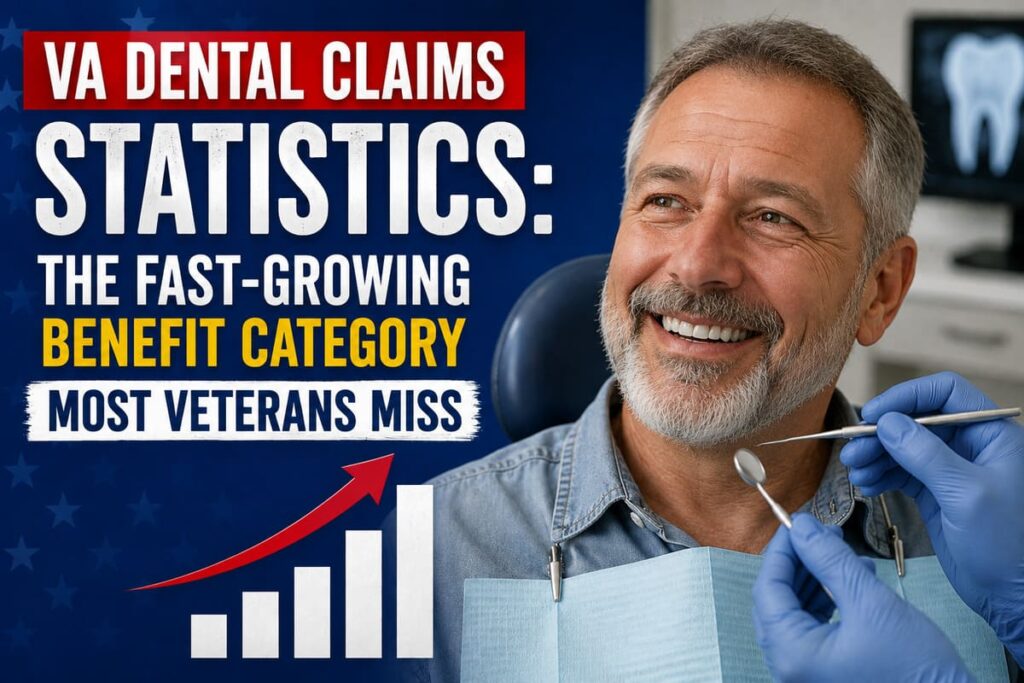
Ask most veterans whether the VA covers dental, and you’ll usually get one of two answers: “only if you’re 100% disabled” or “no.” Neither is the full picture. Dental and oral conditions are a real, ratable category of VA disability compensation — and according to VBA data, it’s one of the fastest-growing categories in the entire system.
Dental and oral service-connected disabilities grew 14.9% among all recipients in FY2025, and new dental claims grew 8.7% year-over-year. Behind both numbers is a single, specific, and rarely-discussed condition that makes up the overwhelming majority of every dental claim on the books.
This article breaks down what’s driving the growth, what limited jaw motion actually means as a VA claim, and how dental fits into the broader disability system most veterans never think to check.
Summary of Key Points
- Dental and oral service-connected disabilities grew 14.9% among all recipients in FY2025 — one of the fastest growth rates of any body system.
- New dental claims grew 8.7% year-over-year, from 19,983 to 21,720.
- Limited motion of the jaw (temporomandibular joint dysfunction and related conditions) accounts for 218,603 of the 252,697 total dental disabilities on the VA’s books — 86.5% of the entire category.
- Dental disability compensation is separate from VA dental healthcare eligibility, which is a common source of confusion.
- The VBA data shows this category is growing quickly. It does not explain why — this article treats the underlying cause as an open question, not a settled fact.
Table of Contents
VA dental and oral disabilities are one of the fastest-growing claim categories in the FY2025 data — up 14.9% among all recipients and 8.7% among new claims. One condition, limited motion of the jaw, accounts for 86.5% of every dental disability on the VA’s books (218,603 of 252,697 total). Most veterans assume VA dental benefits are limited to healthcare eligibility — the data says otherwise.
—VA disability expert Brian Reese
What the Data Shows
Dental and oral conditions cover a specific, narrower slice of the VA disability system than musculoskeletal or mental health, but the growth rate stands out. According to the FY2025 VBA Compensation Report:
| Metric | Figure |
|---|---|
| Total dental/oral service-connected disabilities | 252,697 |
| Growth among all recipients (YoY) | +14.9% |
| New dental/oral claims, FY2024 | 19,983 |
| New dental/oral claims, FY2025 | 21,720 |
| New-claims growth (YoY) | +8.7% |
Source: VBA Compensation Report, five-year body-system trend tables. Dental’s 14.9% all-recipient growth rate is among the highest of any body system in the FY2025 data.
One Condition Drives Almost the Entire Category
The dental and oral category includes a range of conditions — missing teeth, gum disease, jaw fractures — but one condition dominates the data by a wide margin: limited motion of the jaw, which covers temporomandibular joint (TMJ) dysfunction and related restrictions in how far the jaw can open or move.
At 218,603 veterans, limited jaw motion accounts for 86.5% of every dental and oral disability currently on the VA’s books. That’s not a close split between several common conditions — it’s one condition carrying the entire category.
What Counts as Limited Jaw Motion
The VA rates limited motion of the jaw based on how far the mouth can open, measured in millimeters of interincisal range, and on lateral motion. Common causes include jaw fractures from training or combat injuries, TMJ dysfunction from teeth grinding (bruxism) — itself frequently connected to PTSD and stress — and degenerative joint changes over time. It’s rated under its own diagnostic code, separate from the teeth and gum conditions most veterans associate with “dental.”
How the VA Rates Limited Jaw Motion
Limited motion of the jaw is rated under 38 CFR § 4.150, Diagnostic Code 9905, based on two separate measurements: interincisal range (how far the mouth opens, measured in millimeters between the upper and lower front teeth) and lateral excursion (how far the jaw moves side to side). The VA rates whichever measurement is more disabling — the two aren’t combined.
- 0–10mm interincisal range: 40%
- 11–20mm: 30%
- 21–30mm: 20%
- 31–40mm: 10%
- Lateral excursion limited to 0–4mm: 10%
Because the rating is based on an objective, measurable range of motion rather than a subjective symptom description, a thorough C&P exam — one that actually measures and records both interincisal range and lateral excursion — matters more for this condition than for many others.
Why This Category Gets Overlooked
VA dental benefits split into two entirely separate systems, and the confusion between them is likely a major reason dental disability claims are under-filed relative to their actual prevalence:
- VA dental healthcare eligibility — access to VA dental treatment itself, which has its own separate eligibility rules based on rating percentage, service-connected dental trauma, and other categories.
- VA dental disability compensation — a monthly, ratable disability payment for a service-connected dental or jaw condition, evaluated the same way as any other body system.
Most of the confusion lives in the first category. Veterans who look into VA dental care and find limited healthcare eligibility often assume the same limits apply to disability compensation — and stop looking. The FY2025 data suggests that assumption is leaving a real, growing, and specific condition unclaimed for some veterans who have it.
It doesn’t help that dental conditions rarely come up in the standard advice veterans hear about filing a claim. Guides on service connection tend to focus on the big, obvious categories — back pain, hearing loss, mental health — and dental gets treated as an afterthought, if it’s mentioned at all. That gap between how the data actually looks and how the topic gets discussed is exactly why this category is worth a dedicated look.
Dental Conditions Can Also Be Secondary Conditions
Like most body systems in the VA disability schedule, dental and oral conditions aren’t limited to direct service connection. Jaw clenching and teeth grinding (bruxism) are well-documented physical responses to chronic stress and PTSD, and veterans with a service-connected mental health condition sometimes develop TMJ symptoms as a downstream effect years after their primary diagnosis. Medications used to treat other service-connected conditions can also contribute to dental and jaw issues over time.
None of that means a dental condition is automatically secondary to something else. It means the same evidence standard applies here as anywhere else in the VA system: a current diagnosis, a service-connected primary condition, and a medical opinion connecting the two.
What This Means for Your VA Claim
If you have jaw pain, clicking, limited range of motion when opening your mouth, or a documented jaw injury or TMJ diagnosis connected to your service, it’s worth confirming whether that condition has ever been evaluated for disability compensation — separate from any conversation about VA dental treatment eligibility.
- A current diagnosis of TMJ dysfunction or limited jaw motion from a dentist or physician is the starting point.
- If the condition is connected to bruxism or teeth grinding, and you have a service-connected PTSD or anxiety diagnosis, ask your provider whether a secondary connection applies.
- Document a jaw injury from training, combat, or an in-service accident the same way you would any other service-connected event — with records, buddy statements, or continuity of symptoms since separation.
As with any claim, the strength of the outcome depends on the quality of the evidence, not just the existence of a diagnosis. A dentist’s note that simply says “limited opening” carries far less weight than one that records the actual interincisal measurement in millimeters — because that’s the exact figure the rating schedule uses.
For a full breakdown of VA dental healthcare eligibility versus disability compensation, see Does the VA Cover Dental?. For the specific rating criteria dental and oral conditions are evaluated under, see What VA Disability Rating Qualifies for Dental and VA Disability Rating for Dental Conditions. If TMJ or jaw-joint symptoms are your primary concern, see TMJ VA Rating.
Conclusion
Dental and oral conditions are growing faster than most veterans would expect, and the reason is concentrated almost entirely in one condition most people have never heard described as a VA disability: limited motion of the jaw.
If you’ve written off dental as a healthcare-only benefit, the recent data is a good reason to take a second look.
FAQs | Frequently Asked Questions
Does the VA pay disability compensation for dental conditions?
Yes. Dental and oral conditions can be rated as service-connected disabilities, separate from VA dental healthcare eligibility, which has its own rules. As of FY2025, 252,697 veterans have a service-connected dental or oral disability.
What is the most common VA dental claim?
Limited motion of the jaw, which covers TMJ dysfunction and related restrictions in jaw movement. It accounts for 218,603 of the 252,697 total dental disabilities in the 2025 data — 86.5% of the entire category.
Is VA dental disability compensation the same as VA dental healthcare?
No. VA dental healthcare eligibility (access to dental treatment) is governed by separate rules from VA dental disability compensation (a monthly payment for a rated dental condition). A veteran can qualify for one without the other.
How fast are VA dental claims growing?
Dental and oral service-connected disabilities grew 14.9% among all recipients in FY2025, and new dental claims grew 8.7% year-over-year — among the faster growth rates of any body system in the VBA data.
Can TMJ or jaw problems be connected to PTSD?
Bruxism (teeth grinding), a common contributor to TMJ dysfunction, is frequently associated with PTSD and chronic stress. Whether a secondary connection applies depends on the specific medical evidence in your case.
Does the VBA data explain why dental claims are growing?
No. The data confirms the growth rate but does not identify a specific cause. This article does not speculate beyond what the data shows.
Content Reviewed By

Quality Assurance Team
The Quality Assurance (QA) team at VA Claims Insider has extensive experience researching, fact-checking, and ensuring accuracy in all produced content. The QA team consists of individuals with specialized knowledge in the VA disability claims adjudication processes, laws and regulations, and they understand the needs of our target audience. Any changes or suggestions the QA team makes are thoroughly reviewed and incorporated into the content by our writers and creators.
About the Author

Brian Reese
Brian Reese is a world-renowned VA disability benefits expert and the #1 bestselling author of VA Claim Secrets and You Deserve It. Motivated by his own frustration with the VA claim process, Brian founded VA Claims Insider to help disabled veterans secure their VA disability compensation faster, regardless of their past struggles with the VA. Since 2013, he has positively impacted the lives of over 10 million military, veterans, and their families.
A former active-duty Air Force officer, Brian has extensive experience leading diverse teams in challenging international environments, including a combat tour in Afghanistan in 2011 supporting Operation ENDURING FREEDOM.
Brian is a Distinguished Graduate of Management from the United States Air Force Academy and earned his MBA from Oklahoma State University’s Spears School of Business, where he was a National Honor Scholar, ranking in the top 1% of his class.