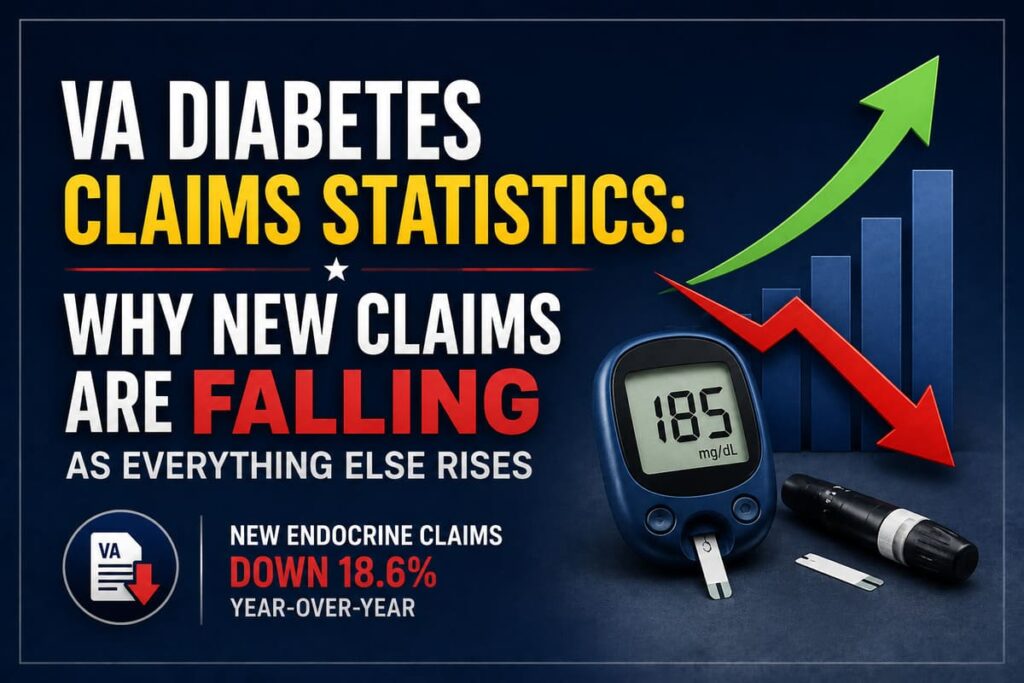
Almost every category of VA disability claim grew last year. Endocrine conditions didn’t. New endocrine claims (the body system that includes diabetes and thyroid conditions) fell 18.6% year-over-year, the steepest drop of any of the 13 body systems tracked in the annualVBA Compensation Report.
That’s worth pausing on. Total VA disability claims grew 11.6% system-wide in the same period. Digestive claims jumped 21.8%. Musculoskeletal, mental health, dental — all are up. Endocrine went the other direction, and diabetes is the largest condition inside that category.
In this article I’ll break down what the data shows, what it doesn’t explain, and what it means if you’re a veteran with diabetes, or a toxic-exposure condition that could be connected to it, weighing whether to file.
Table of Contents
Summary of Key Points
New endocrine-category VA claims fell 18.6% year-over-year in FY2025 — the steepest decline of any body system tracked.
That decline runs against the grain of the broader system, which grew 11.6% in total service-connected disabilities over the same period.
Diabetes mellitus is the largest condition inside the endocrine category, with 445,840 veterans currently receiving compensation.
Hypothyroidism, the second-largest endocrine condition, affects 105,601 veterans and is often connected to radiation exposure or certain medications.
The VBA data documents the decline. It doesn’t ID a cause — this article doesn’t speculate on VA scrutiny, policy changes, or filing behavior (beyond what the data supports).
New endocrine-category VA disability claims — the category that includes diabetes — fell 18.6% in FY2025, the steepest decline of any body system in the VBA data, even as total VA disability claims system-wide grew 11.6%. Diabetes is the largest condition in that category, with 445,840 veterans currently receiving compensation for it. The data shows this decline clearly; it doesn’t explain why it’s happening.
The latest VBA Compensation Report tracks new service-connected disabilities granted to new compensation recipients across 13 body systems, comparing FY2024 to FY2025. Twelve of those systems were flat or growing. Endocrine was the exception:
Body System
FY2024 New Claims
FY2025 New Claims
YoY Change
Digestive
97,542
118,805
+21.8%
Musculoskeletal
1,176,817
1,287,268
+9.4%
Mental Health
163,644
178,379
+9.0%
Dental/Oral
19,983
21,720
+8.7%
Neurological
291,292
308,494
+5.9%
Respiratory
159,192
159,648
+0.3%
Cardiovascular
87,505
77,178
-11.8%
Endocrine
22,943
18,676
-18.6%
Source: VBA Compensation Report, five-year new-recipient trend tables. Endocrine’s -18.6% is the largest single-category decline in the dataset — steeper than cardiovascular (-11.8%), the next-largest decline.
Diabetes is the Largest Condition in a Shrinking Category
The endocrine category covers a range of conditions, but diabetes mellitus dominates it by sheer population. As of FY2025, 445,840 veterans are currently receiving VA disability compensation for diabetes — by far the largest single condition inside the endocrine body system.
The VBA data doesn’t break diabetes out as its own line in the new-claims trend table — the -18.6% figure covers the entire endocrine category, not diabetes alone. But given how much of the category’s total population diabetes represents, a category-wide decline of this size is difficult to read as anything other than a signal that new diabetes claims specifically slowed in FY2025.
Hypothyroidism: The Category’s Other Major Condition
Hypothyroidism is the second-largest condition inside the endocrine category, affecting 105,601 veterans. It’s frequently connected to radiation exposure or as a side effect of medications used to treat other service-connected conditions — making it one of the more commonly overlooked secondary conditions in this category.
Diabetes mellitus is rated under 38 CFR § 4.119, Diagnostic Code 7913, on a scale that tracks how much the condition restricts your daily life and treatment regimen — not just whether you have a diagnosis:
10%: Manageable by restricted diet alone.
20%: Requires insulin or an oral hypoglycemic agent, plus a restricted diet.
40%: Requires insulin, restricted diet, and regulation of activities.
60%: Adds episodes of ketoacidosis or hypoglycemic reactions requiring at least one or two hospitalizations per year, or twice-monthly visits to a diabetic care provider, plus complications that wouldn’t independently qualify for a separate rating.
100%: More frequent ketoacidosis or hypoglycemic episodes, progressive loss of weight and strength, or complications that would render the veteran unable to maintain substantially gainful employment.
Complications of diabetes — including diabetic neuropathy, retinopathy, and kidney disease — are generally rated separately from the diabetes rating itself, which is one reason a thorough diabetes claim often ends up touching more than one body system.
It’s tempting to reach for an explanation here, and there isn’t a shortage of plausible ones — tighter VA review of diabetes claims, changes in how toxic-exposure diabetes claims are evaluated, or simply fewer new claims being filed in this category for reasons unrelated to the VA at all. The VBA data doesn’t establish any of these. It shows the trend; it doesn’t explain it.
What can be said with confidence: the decline is real, it’s the steepest of any body system in 2025, and it’s happening in a category where the largest single condition — diabetes — has a well-established connection to Agent Orange and other toxic exposures for many veterans. Those two facts sitting next to each other are worth a veteran’s attention even without a confirmed cause.
Diabetes and Presumptive Toxic Exposure
Type 2 diabetes mellitus has been a presumptive condition for veterans with qualifying Agent Orange exposure for years — meaning eligible veterans don’t have to individually prove their diabetes was caused by that exposure, only that they meet the exposure and service criteria. That presumptive status hasn’t changed.
What the data raises is a narrower question: even with a presumptive pathway available, new endocrine claims fell instead of rising alongside the rest of the toxic-exposure-driven growth the VA has seen since the PACT Act.
That’s worth sitting with rather than explaining away. A presumptive condition is still a claim that has to be filed, diagnosed, and documented — presumptive status removes the burden of proving causation, not the burden of proving you have the condition and that it’s currently rated at the correct severity.
What This Means for Your VA Claim
If you have diabetes and you believe it’s connected to your service — whether through Agent Orange exposure, another toxic exposure, or a documented in-service event — this data is not a reason to expect an easier or harder claim than before. It’s a reason to make sure your claim is built carefully rather than assumed to be a routine presumptive win.
Confirm your diagnosis is current and clearly documented in your medical records.
If you’re filing under a presumptive exposure category, make sure your service history and exposure evidence are documented as thoroughly as the diagnosis itself.
If diabetes developed or worsened after a service-connected condition — including medication side effects from treating another condition — ask your provider whether a secondary connection applies.
Every major body system in the FY2025 VBA data grew except one. Endocrine claims — led by diabetes, the largest condition in that category — fell 18.6% while the rest of the system grew 11.6%. The data doesn’t tell us why. It does tell us this is the year’s clearest outlier, in a category tied closely to toxic-exposure presumptives that affect a large and growing share of the veteran population. That combination is worth knowing about, whether or not it changes your next step.
YOU SERVED. YOU DESERVE.
You served. You earned the right to file. You earned the right to be heard. And you earned the right to pursue every VA benefit you legally qualify for.
So here is the real question:
Do you have the VA rating you were given, or the VA rating you truly deserve?
Want Expert-Level VA Claim Help? WE GOT YOUR SIX!
Work directly with a VA Claims Insider Coach who can help lead you to VA claim victory.
50,000+ disabled veterans served in our membership programs since 2016.
33% average rating increase for veterans who complete our Elite program.
The VBA data shows new claims in the broader endocrine category — which diabetes dominates by population — fell 18.6% year-over-year in FY2025. The data does not break out diabetes as a separate line item, so this figure reflects the endocrine category as a whole.
Why did endocrine claims fall while every other category rose?
The VBA data does not explain the cause. It confirms the trend — endocrine was the only body system with a double-digit decline in new claims — but does not attribute it to any specific policy, review process, or filing behavior.
How many veterans currently receive VA compensation for diabetes?
445,840 veterans were receiving VA disability compensation for diabetes mellitus as of the 2025 data, making it the largest condition in the endocrine category.
Is diabetes connected to Agent Orange or other toxic exposures?
Type 2 diabetes is a longstanding presumptive condition for veterans with qualifying Agent Orange exposure. This article does not assert that toxic exposure caused the 2025 decline — that connection isn’t established in the VBA data — but it’s relevant context for veterans in that population weighing whether to file.
What is hypothyroidism, and is it connected to VA disability claims?
Hypothyroidism is a thyroid condition affecting 105,601 veterans currently receiving VA compensation. It’s often linked to radiation exposure or as a secondary effect of medications used to treat other service-connected conditions.
Does a declining claims category mean claims are harder to win?
Not necessarily, and the VBA data doesn’t measure approval or denial rates at all. The decline reflects the number of new claims filed and granted, not the odds of any individual claim succeeding.
Content Reviewed By
Quality Assurance Team
The Quality Assurance (QA) team at VA Claims Insider has extensive experience researching, fact-checking, and ensuring accuracy in all produced content. The QA team consists of individuals with specialized knowledge in the VA disability claims adjudication processes, laws and regulations, and they understand the needs of our target audience. Any changes or suggestions the QA team makes are thoroughly reviewed and incorporated into the content by our writers and creators.
About the Author
Brian Reese
Brian Reese
Brian Reese is a world-renowned VA disability benefits expert and the #1 bestselling author of VA Claim Secrets and You Deserve It. Motivated by his own frustration with the VA claim process, Brian founded VA Claims Insider to help disabled veterans secure their VA disability compensation faster, regardless of their past struggles with the VA. Since 2013, he has positively impacted the lives of over 10 million military, veterans, and their families.
A former active-duty Air Force officer, Brian has extensive experience leading diverse teams in challenging international environments, including a combat tour in Afghanistan in 2011 supporting Operation ENDURING FREEDOM.
Brian is a Distinguished Graduate of Management from the United States Air Force Academy and earned his MBA from Oklahoma State University’s Spears School of Business, where he was a National Honor Scholar, ranking in the top 1% of his class.
If you have a service-connected back, hip, or knee condition and you've never filed for nerve damage, you're not alone — and the newest VA data suggests you may be missing something real.... continue reading
Ask most veterans whether the VA covers dental, and you'll usually get one of two answers: “only if you're 100% disabled” or “no.” Neither is the full picture. Dental and oral conditions are... continue reading
Elite Membership
Dear Veteran, Here’s the brutal truth about VA disability claims:
According to our data, 8/10 (80%) of veterans reading this message right now are underrated by the VA…
This means you do NOT currently have the VA disability rating and compensation YOU deserve, and you could be missing out on thousands of dollars of tax-free compensation and benefits each month.
As a fellow disabled Veteran this is shameful and I’m on a mission to change it.
Brian Reese here, Air Force service-disabled Veteran and Founder @ VA Claims Insider.
Since 2016, VA Claims Insider has helped thousands of Veterans just like you get the VA rating and compensation they deserve in less time.
If accepted into our ELITE membership program, you’ll get up-front access and permission to use $13,119 worth of proprietary VA claim resources, including access to our network of independent medical professionals for medical examinations, disability evaluations, and credible Medical Nexus Letters, which could help you get a HIGHER VA rating in LESS time.
VA Claims Insider, LLC, and its affiliates ("we," "us", or "our") are not sponsored by, or affiliated with, the United States Department of Veterans Affairs, any state's Department of Veterans Affairs, or any other federally chartered veterans service organization. Other organizations, including, but not limited to, your state's Department of Veterans Affairs, your local county veterans service agency, and other federally chartered veterans service organizations, may be able to provide you with these services free of charge. Products or services offered by VA Claims Insider, LLC, and its affiliates are not necessarily endorsed by any of these organizations. You may qualify for other veterans' benefits beyond the services that VA Claims Insider, LLC and its affiliates offer.
None of our employees are accredited agents, VSOs, attorneys, or entities recognized by the United States Department of Veterans Affairs or any state's Department of Veterans Affairs, and none of our employees will assist you with the preparation, presentation, or prosecution of any claim for VA disability benefits. Before engaging with us, we strongly encourage you to discuss your disability claims matter with an accredited VSO, accredited attorney, or accredited claims agent, at www.va.gov/ogc/apps/accreditation/index.asp, all of whom are free to use. You are not required to use our website or services to submit a claim for VA disability benefits. You may receive a positive VA disability claim outcome without using our paid services. Furthermore, your use of our paid services does not and cannot affect the speed at which the VA processes your disability claims, as processing times are determined solely by the VA. VA CLAIMS INSIDER, LLC AND ITS AFFILIATES DO NOT GUARANTEE ANY SPECIFIC OUTCOMES OR RESULTS BY YOUR USE OF ITS WEBSITE OR SERVICES AND YOUR RESULTS MAY VARY FROM THE INFORMATION PROVIDED IN OUR ADVERTISEMENTS AND, ON THIS WEBSITE, INCLUDING BUT NOT LIMITED TO, SUCCESS PERCENTAGES, DISABILITY RATING INCREASES, AND PROCESSING TIMELINES ARE HISTORICAL AVERAGES ONLY, ARE NOT GUARANTEES OF FUTURE RESULTS, AND ARE NOT SPECIFIC TO ANY ONE CLAIM. SUCH INFORMATION VARIES OVER TIME, AND WE MAKE NO OBLIGATION TO KEEP SUCH INFORMATION CURRENT. The VA Claims Insider® name and logo are registered trademarks of VA Claims Insider, LLC.

 go.vaclaimsinsider.com