 go.vaclaimsinsider.com
Looking for Expert-Level VA Claim Answers? Schedule a Call
According to the VBA Annual Benefits Report, the 10 most prevalent service-connected disabilities among the 6,338,253 veterans receiving VA disability compensation are:
- Tinnitus — 3,583,295 veterans (56.5% of the compensation population)
- Limitation of flexion, knee — 2,312,985 veterans (36.5%)
- Paralysis of the sciatic nerve — 2,026,583 veterans (32.0%)
- Lumbosacral or cervical strain — 1,791,869 veterans (28.3%)
- Post-traumatic stress disorder (PTSD) — 1,760,497 veterans (27.8%)
- Hearing loss — 1,690,837 veterans (26.7%)
- Limitation of motion of the arm — 1,385,549 veterans (21.9%)
- Scars, burns (2nd degree) — 1,323,340 veterans (20.9%)
- Migraine — 1,300,172 veterans (20.5%)
- Limitation of motion of the ankle — 1,273,110 veterans (20.1%)
Table of Contents
Summary of Key Points
- Tinnitus remains the single most common VA disability by a wide margin — affecting more than 56% of all veterans receiving compensation — but its schedular rating is capped at a flat 10%, so it rarely drives a veteran’s overall combined rating on its own.
- Musculoskeletal conditions dominate the list numerically (4 of the top 10), but PTSD is the only mental health condition present, and it grew faster year-over-year than every auditory condition on the list.
- The compensation population grew 5.8% from FY2024 to FY2025, but total claimed disabilities grew more than twice as fast (11.6%) — existing recipients are adding disabilities faster than new veterans are entering the system.
- “Most common” is not the same as “easiest to win” or “highest rated.” Several top-10 conditions (ankle motion, arm motion, scars) top out at modest schedular ratings, while far less common conditions can reach 100%.
- New first-time claims rank differently than the full recipient population — PTSD and sciatica sit lower on the new-claims list than the all-recipients list, suggesting many veterans pick these up later, often as secondary conditions.
- Only about one in three American veterans currently receives VA disability compensation at all, which puts the scale of this “top 10” list in useful perspective.
What Moved and Why? (And What That Means For Your Own Claim Strategy)
The FY2025 report matters because it’s the freshest snapshot of what military service actually does to the human body and mind, measured across 6.3 million veterans and 46.5 million individual rated disabilities. That’s not a survey or an estimate. It’s VBA’s own corporate database, current as of September 30, 2025.
Rankings like this matter for three reasons.
First, they tell veterans YOU aren’t alone — if you’re filing for tinnitus or a bad knee, you’re one of millions, and VA’s rating schedule for these conditions has been shaped by decades of exactly this kind of claim volume.
Second, they reveal where VA’s adjudication patterns are consistent and where they’re shifting, which is useful intelligence for anyone building a claim.
Third, and least appreciated, the year-over-year movement inside the top 10 is a leading indicator of where the broader claims environment is heading — before it shows up anywhere else.
Where This Data Comes From
The VBA Annual Benefits Report (ABR) is the Veterans Benefits Administration’s official yearly accounting of who received what benefits, in what amounts, for which conditions. It’s not a marketing document and it’s not modeled or estimated data — it’s pulled directly from VBA’s corporate database of adjudicated claims. The Compensation section covers veterans receiving monthly, tax-free disability compensation because of a disease, injury, or event connected to their military service.
FY2025 covers the federal fiscal year running October 1, 2024 through September 30, 2025. As of that date, 6,338,253 veterans were receiving compensation benefits, carrying a combined 46,496,235 individually rated service-connected disabilities — an average of 7.34 disabilities per veteran.
It’s worth being precise about what “top 10 most prevalent” actually measures, because it’s frequently confused with a different question. Prevalence counts how many veterans carry a given diagnostic code on their record, regardless of what percentage that code is rated at. It says nothing about severity, combined rating impact, or dollar value.
A condition can be extremely prevalent (tinnitus) while being rated at a flat 10% for nearly everyone who has it, and a condition can be rare (say, complete paralysis of a major nerve) while carrying an 80% or 100% rating on its own. Prevalence and rating severity are two different axes entirely, and confusing them is the single most common mistake made when people talk about “the biggest VA claims.”
One more note: The VBA’s own tables report percentages a couple of different ways — sometimes as a share of total disability instances (46.5 million), sometimes as a share of a specific body system. Neither of those is the most intuitive number for a veteran trying to understand their own odds.
So throughout this report, our “% of Compensation Population” column is calculated as (veterans with the condition ÷ 6,338,253 total compensation recipients) — in other words, what share of all veterans receiving VA compensation carry that specific diagnosis. Because the average veteran has 7.34 rated disabilities, these percentages don’t (and shouldn’t) sum to 100%.
Top 10 VA Disability Claims Awarded in FY2025
| Rank | Condition | Veterans Receiving Compensation | % of Comp. Population | FY2024 Rank | Key Takeaway |
| 1 | Tinnitus | 3,583,295 | 56.5% | 1 (no change) | Grew 10.1% YoY; still #1 by a 1.27M-veteran margin over #2, but capped at a flat 10% rating |
| 2 | Limitation of flexion, knee | 2,312,985 | 36.5% | 2 (no change) | Grew 11.7% YoY; the anchor of VA’s musculoskeletal claims volume |
| 3 | Paralysis of the sciatic nerve | 2,026,583 | 32.0% | 3 (no change) | Grew 16.1% YoY — fastest of any top-4 condition, largely via secondary connection to back conditions |
| 4 | Lumbosacral or cervical strain | 1,791,869 | 28.3% | 4 (no change) | Grew 11.2% YoY; the base orthopedic diagnosis behind sciatica claims |
| 5 | Post-traumatic stress disorder | 1,760,497 | 27.8% | 6 (up 1) | The only mental health condition in the top 10; passed hearing loss this year |
| 6 | Hearing loss | 1,690,837 | 26.7% | 5 (down 1) | Slowest-growing top-10 condition (+6.1% YoY), which is why PTSD passed it |
| 7 | Limitation of motion of the arm | 1,385,549 | 21.9% | 7 (no change) | Grew 15.5% YoY, second-fastest in the top 10 |
| 8 | Scars, burns (2nd degree) | 1,323,340 | 20.9% | 9 (up 1) | Fastest-growing top-10 condition (+17.6% YoY); usually secondary to orthopedic surgery, not combat wounds |
| 9 | Migraine | 1,300,172 | 20.5% | 10 (up 1) | Grew 17.2% YoY; increasingly claimed as secondary to TBI, neck conditions, or PTSD |
| 10 | Limitation of motion of the ankle | 1,273,110 | 20.1% | 8 (down 2) | Fell two spots despite growing 11.4% YoY, simply because three other conditions grew faster |
Percentages and totals are drawn directly from the FY2025 and FY2024 VBA Annual Benefits Reports, Compensation section. Rankings reflect the “all compensation recipients” tables, not the new-recipient tables (see Section 4 for how those two views diverge).
A Closer Look at Each of the Top 10 Conditions
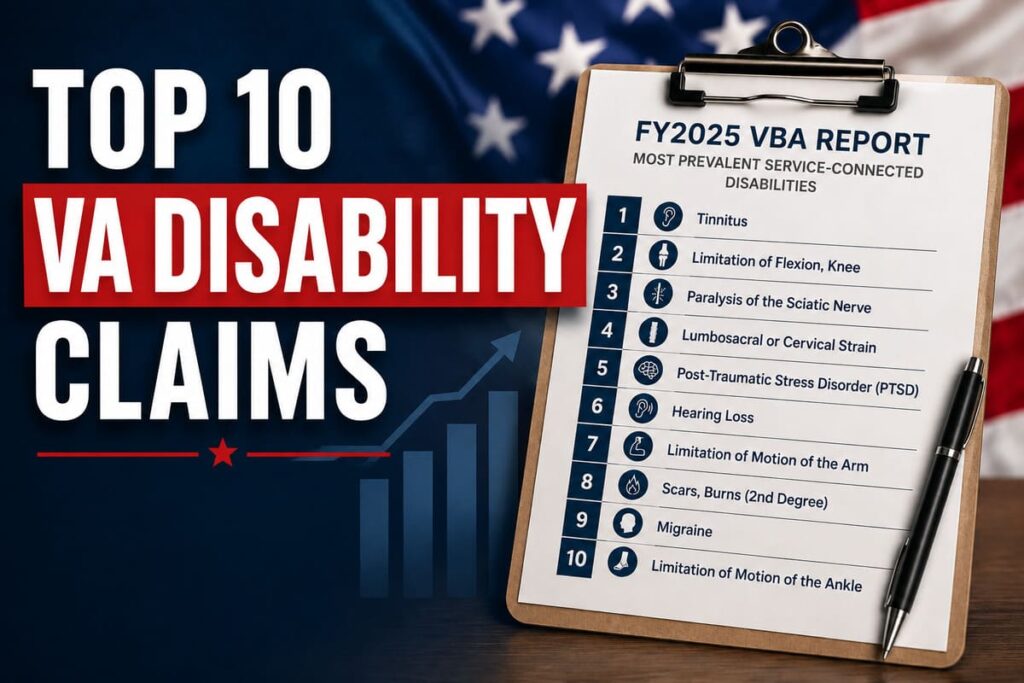
This ranking has barely changed at the top since FY2024 — tinnitus, knee flexion, sciatica, and back/neck strain remain locked in the same four spots.
But three positions shifted: PTSD passed hearing loss for the #5 spot, and scars and migraine both leapfrogged ankle motion.
Those movements aren’t noise.
They reflect real growth-rate differences between conditions, and they’re the story the raw rankings alone don’t tell. The rest of this report explains why the list looks the way it does, what’s changing underneath it, and what any of it actually means for a veteran filing or appealing a claim today.
1. Tinnitus
Tinnitus is the perception of ringing, buzzing, or hissing noise with no external source. It’s the most common VA disability claim by a wide margin because the exposure that causes it — gunfire, aircraft, generators, armored vehicles, explosions — is close to universal across military occupations, and because VA doesn’t require objective testing to establish it.
A veteran’s own credible report of ringing in the ears, tied to an in-service noise exposure event, is sufficient for service connection.
Tinnitus is rated under 38 CFR § 4.87, Diagnostic Code 6260, at a single flat rating: 10%. There’s no 20% or 30% tier. Because of that ceiling, tinnitus is common but rarely the disability doing the heavy lifting in a veteran’s combined rating — its real value is often as an entry point that establishes noise exposure, which supports secondary claims like hearing loss, Meniere’s disease, or vertigo.
The VA has also proposed rule changes that could affect how a standalone tinnitus rating interacts with hearing loss ratings going forward, which is worth monitoring rather than acting on prematurely.
Common mistake: Filing for tinnitus alone and treating it as “done” without pursuing the audiological workup that could support a hearing loss claim or the secondary conditions tinnitus commonly triggers.
>> Learn more: VA Rating for Tinnitus · Secondary Conditions to Tinnitus · Hearing Loss and Tinnitus Together
2. Limitation of Flexion, Knee
This condition measures how far a veteran can bend the knee before pain or mechanical limitation sets in. It’s rated under Diagnostic Code 5260, with the rating driven by degrees of flexion loss, though the “painful motion” doctrine means VA is supposed to award at least a minimal compensable rating even without measurable loss of motion.
Knee flexion limitation is common because the knee absorbs enormous repetitive load during service — rucking, jumping, repetitive impact — and because knee injuries frequently go untreated or under-treated in the field, allowing them to become chronic. It commonly travels with meniscus tears, instability, and arthritis, and frequently generates secondary claims for the opposite knee (from compensating gait) or the lower back.
Common mistake: Accepting a low rating based on flexion alone when painful motion, instability, or flare-ups aren’t fully documented at the C&P exam.
>> Learn more: Understanding the VA Knee Rating Chart · Knee Replacement VA Disability · VA Ratings for Joint Pain
3. Paralysis of the Sciatic Nerve (Sciatica)
Sciatica describes pain, numbness, or weakness radiating along the sciatic nerve, typically from a compressed nerve root in the lower back. It’s rated under 38 CFR § 4.124a, Diagnostic Code 8520, on a scale from 10% (mild, incomplete paralysis) to 80% (complete paralysis).
Sciatica’s prevalence is tied directly to back and neck conditions: VA is required to rate neurological residuals of a spine condition separately from the orthopedic rating itself, so a veteran who wins a back claim frequently receives a sciatica rating as an automatic companion, without filing a second claim.
That relationship explains why sciatica (#3) and lumbosacral/cervical strain (#4) sit next to each other in the rankings and why sciatica grew faster (16.1%) than the back condition that often causes it (11.2%) — veterans and raters are getting better at identifying and rating the neurological component.
Common mistake: Not requesting a separate neurological evaluation when filing a back claim, and missing the sciatica rating altogether.
>> Learn more: VA Rating for Sciatica Explained · VA Disability Rating for Radiculopathy
4. Lumbosacral or Cervical Strain
This is the baseline diagnostic code for chronic back and neck pain, rated under 38 CFR § 4.71a, Diagnostic Code 5237, primarily on range-of-motion measurements taken with a goniometer during a C&P exam.
Back and neck strain are common for the obvious reason — carrying combat loads, vehicle impacts, parachute landings, and repetitive lifting all stress the spine — but the rating outcome depends heavily on whether the C&P examiner properly accounts for pain on motion and flare-ups, not just the raw degrees measured that day. The 2017 Sharp v. Shulkin decision requires examiners to estimate functional loss during flare-ups even if the exam itself isn’t conducted during one; in practice, this is inconsistently applied.
Common mistake: A single C&P exam on a “good day” understates a fluctuating back condition, and the veteran doesn’t push back or submit a buddy statement or personal statement describing flare-up frequency.
>> Learn more: Back Pain VA Rating · How to Get a Neck Pain VA Rating
5. Post-Traumatic Stress Disorder (PTSD)
PTSD is a mental health condition arising from a stressor event during service, rated under 38 CFR § 4.130 on a 0–100% scale. Unlike physical conditions, PTSD requires three elements: a current diagnosis, a verified or credible in-service stressor, and a medical nexus linking the two.
PTSD is the only mental health condition in the top 10, and it moved up a spot this year — overtaking hearing loss as the #5 most prevalent condition — while growing 10.7% year-over-year. That’s faster growth than every auditory condition on the list, and it reflects both improved screening and a lower evidentiary bar for non-combat stressors, including military sexual trauma, which no longer requires the same level of corroboration as combat stressors.
Common mistake: Assuming a claim needs to be combat-related, or under-describing occupational and social impairment in personal statements, which is the primary driver of rating level under the general mental health formula.
>> Learn more: VA Rating for PTSD · Mental Health VA Ratings · Nexus Letters
6. Hearing Loss
Bilateral hearing loss is rated under Diagnostic Code 6100 using a combination of pure-tone threshold and speech discrimination testing performed at a C&P audiological exam. Unlike tinnitus, hearing loss ratings can range from 0% to 100%, though the large majority of veterans land at 0% or 10% because VA’s rating tables require fairly significant measured loss before compensable levels kick in.
Hearing loss shares its root cause with tinnitus — sustained exposure to hazardous noise — but it grew the slowest of any top-10 condition this year (6.1%), which is the direct reason PTSD passed it in the rankings. That slower growth likely reflects how difficult hearing loss claims remain to win at a compensable level, especially for veterans filing years after separation, when age-related hearing decline complicates the medical nexus.
Common mistake: Filing without documented in-service noise exposure tied to a specific MOS or duty assignment, or filing too long after separation without an audiologist’s opinion addressing the aging confound.
>> Learn more: 2026 VA Hearing Loss Compensation Tables Explained · How to Secure a Hearing Loss VA Rating
7. Limitation of Motion of the Arm
This condition covers shoulder and arm range-of-motion loss, rated under Diagnostic Code 5201 based on how far the arm can be raised (to shoulder level, midway, or 25 degrees from the side) and whether the dominant or non-dominant arm is affected.
Shoulder and arm injuries accumulate from repetitive overhead work, load-bearing equipment, and falls, and they frequently go unaddressed during service until they become chronic. This condition grew 15.5% year-over-year — the second-fastest rate in the top 10 — suggesting more veterans are successfully connecting shoulder conditions that were historically under-claimed relative to knees and backs.
Common mistake: Not documenting which arm is dominant, since VA rates the dominant and non-dominant arm on different scales and using the wrong one can understate the rating.
>> Learn more: Shoulder Pain VA Ratings · VA Secondary Conditions to Shoulder Pain · VA Ratings for Joint Pain
8. Scars, Burns (2nd Degree)
Scar claims are rated under 38 CFR § 4.118, Diagnostic Codes 7800–7805, based on size, location, pain, and whether the scar restricts movement or causes disfigurement. Ratings range from 10% to 80%, though the average scar rating is closer to 10%.
Scars were the fastest-growing condition in the entire top 10 this year, up 17.6% year-over-year and jumping from #9 to #8. The instinct is to assume this reflects combat wounds, but the far more common driver is secondary connection: a veteran with a service-connected knee or back condition who undergoes surgery develops a surgical scar that is itself eligible for a separate rating. As orthopedic surgery rates rise among an aging compensation population, scar claims rise with them.
Common mistake: Not filing for the surgical scar at all, assuming it’s “too minor” to matter, when a painful or unstable scar can add a separate, stackable rating.
>> Learn more: How to Get a VA Rating for Scars
9. Migraine Headaches
Migraines are rated under Diagnostic Code 8100 based on the frequency and severity of “prostrating” attacks — a specific term of art meaning the veteran must lie down due to the severity of the episode. Ratings range from 0% to 50%.
Migraines climbed from #10 to #9 this year, growing 17.2% year-over-year — nearly matching scars as the fastest-growing top-10 condition. Much of this growth is secondary: migraines are increasingly claimed as a downstream consequence of TBI, cervical strain, or PTSD, rather than as a standalone primary condition, which means their rise partly reflects better secondary-connection strategy across the veteran population, not a sudden spike in headache incidence.
Common mistake: Failing to use the word “prostrating” — or accurately describe what it means for the veteran’s function — when the migraine rating criteria hinge directly on that term.
>> Learn more: VA Rating for Migraines
10. Limitation of Motion of the Ankle
Ankle motion limitation is rated under Diagnostic Code 5271, with ratings generally split between 10% (moderate limitation) and 20% (marked limitation) — one of the narrowest rating bands of any top-10 condition.
Ankle conditions typically stem from repeated sprains that never fully healed or were inadequately rehabilitated during service, compounding into chronic instability. Despite growing a healthy 11.4% year-over-year, ankle motion fell from #8 to #10 simply because scars and migraines grew faster — a reminder that a condition can be growing in absolute terms and still lose ground in the rankings.
Common mistake: Accepting the default 10% rating without documenting marked (versus moderate) limitation, since the difference between the two tiers is poorly defined in the regulation and often under-assessed at C&P exams.
>> Learn more: Ankle VA Disability Ratings
Biggest Trends From FY2025
Musculoskeletal conditions dominate by design, not coincidence. Musculoskeletal disabilities account for 17,838,998 of the 46,496,235 total rated disabilities in FY2025 — roughly 38% of everything the VA rates. Within that category, a single functional pattern (limitation of motion of a joint or appendage, spanning knees, ankles, shoulders, elbows, and more) makes up 51.93% of all musculoskeletal claims.
That’s not really ten different problems — it’s one problem, joint motion loss, showing up in different body parts and getting counted as separate diagnostic codes. Any “top 10” list built around individual diagnostic codes will structurally over-represent musculoskeletal conditions for this reason alone.
PTSD’s rise says more about claims maturity than about rising trauma. PTSD passed hearing loss this year, not because PTSD prevalence spiked, but because hearing loss claims grew unusually slowly (6.1%) while PTSD grew at a normal-to-fast clip (10.7%).
Mental health claims have benefited from years of policy changes lowering the stressor-corroboration bar, especially for military sexual trauma and non-combat stressors, and from growing veteran willingness to file mental health claims at all — a cultural shift that shows up in the data as a ranking change, not a headline.
Hearing conditions are prevalent but structurally shallow. Tinnitus and hearing loss together account for 5,388,472 of 5,542,423 total auditory disabilities — 97.2% of the entire auditory category. Nearly the whole category is these two conditions. But tinnitus caps at 10% and roughly 94% of hearing loss ratings fall at 0% or 10%, meaning the auditory category, despite enormous prevalence, contributes disproportionately little to combined ratings compared to categories like mental health or neurological conditions.
The PACT Act‘s fingerprints are visible in the growth rate, even without a line-item breakout. The FY2025 ABR doesn’t isolate PACT Act claims within the top-10 table (VA publishes separate PACT-specific data at a dedicated reporting site), but the broader pattern is consistent with what PACT Act expansion would predict: new-recipient volume grew faster (+4.1%) than the historical baseline, and total disabilities grew far faster than the population receiving them (+11.6% vs. +5.8%), consistent with expanded presumptive eligibility making it easier to add conditions to existing claims rather than only opening new ones.
Aging veterans and younger veterans are both driving this list, for different reasons. About 55% of all compensation recipients are 55 or older, reflecting a large Vietnam and early Gulf War-era population still filing increased-rating and secondary claims decades after separation. At the same time, new FY2025 recipients skew younger — veterans under 55 make up roughly 60% of that year’s first-time filers — and Gulf War Era veterans, who make up 63.2% of the entire compensation population, average far more disabilities per capita among new claims (7.70) than Vietnam Era (2.93) or Peacetime (2.30) veterans did at their own point of first filing. Two very different generational patterns are converging on the same top-10 list.
Secondary conditions are quietly reshaping the rankings. Scars, migraines, and sciatica — three of the four fastest-growing top-10 conditions — are disproportionately claimed as secondary to another service-connected condition rather than as standalone primary claims. That’s a structural shift in how veterans and representatives are building claims: less “one condition, one form,” more building out the full web of conditions a single service-connected injury actually causes.
Multiple ratings, not single diagnoses, are now the normal claim profile. The average veteran receiving compensation carries 7.34 rated disabilities, up from 6.95 the year before. A “top 10 disabilities” list inevitably undersells how claims actually work today: most veterans on this list don’t have just one of these conditions, they have several, layered together into a combined rating.
What Veterans Can Learn From This Data
This data isn’t a checklist of conditions to go file for. It’s a map of how VA’s claims system actually behaves, and there are practical lessons in that map for how to build any claim, common or not.
Documentation habits matter more than diagnosis rarity. The conditions that dominate this list — knee flexion, back strain, ankle motion — are also some of the most frequently under-rated, precisely because their ratings hinge on subjective measurements (range of motion, pain on motion, flare-up severity) that vary by examiner and by the day of the exam. A veteran with a common condition and excellent documentation of functional loss will often out-rate a veteran with the identical diagnosis and a thin file.
Secondary service connection is not an afterthought — it’s where a lot of this year’s growth actually happened. Sciatica growing off the back of lumbosacral strain, scars growing off orthopedic surgery, migraines growing off TBI and neck conditions: the fastest-moving conditions in this year’s report are, structurally, secondary conditions. Veterans building a claim strategy should be mapping out the full downstream consequences of a primary condition, not stopping at the first diagnosis.
Medical evidence quality is the actual lever, not condition selection. Nothing in this data suggests veterans should chase “common” conditions because they’re common. What it does suggest is that VA’s own rating criteria for these high-volume conditions are well-worn and heavily litigated (Sharp v. Shulkin on flare-ups being one example), which means the standards for adequate evidence are, if anything, better established — a resource for building a stronger file, not a shortcut to approval.
Long-term claim planning beats one-and-done filing. The gap between the new-recipient rankings and the all-recipient rankings (PTSD and sciatica rank lower among first-time filers than among the full population) shows that many veterans are adding conditions years after their initial claim, often once they understand secondary connection or once a condition worsens enough to file an increase. Treating a first claim as the end of the process, rather than the start of an ongoing file, leaves value on the table for a large share of veterans.
The Biggest Misconceptions About the Top 10
Most common does not mean easiest to win. Hearing loss is the #6 most prevalent condition and one of the hardest to get rated above 0%, because the VA’s audiological thresholds are stricter than the general medical understanding of “hearing loss,” and claims filed years after separation face an uphill battle isolating military noise exposure from ordinary aging.
Most common does not mean highest rated. Tinnitus tops the list at 3.58 million veterans and caps at 10%. Complete paralysis of the sciatic nerve — a small fraction of the 2 million sciatica claims — can reach 80% on its own. Prevalence and severity are unrelated variables.
Most common does not mean automatic approval. Every condition on this list still requires the same three-part test for service connection: a current diagnosis, an in-service event or injury, and a medical nexus connecting the two. VA does not waive that standard because a condition is popular.
Most common does not mean everyone qualifies. These numbers describe veterans who successfully established service connection, not the universe of veterans who filed. A high prevalence count reflects millions of individually adjudicated claims, each requiring its own evidence — it is not a sign that VA is granting these conditions loosely.
A rising rank does not mean a condition is becoming more severe. PTSD’s move to #5 reflects hearing loss growing more slowly, not PTSD claims becoming more severe or more numerous in some alarming sense. Rank changes in a top-10 list are relative, and relative movement can be driven as much by another condition slowing down as by the condition in question speeding up.
What This Means for Your VA Claim
Read together, the FY2025 numbers tell a coherent story: VA’s compensation system is increasingly defined by multiple, interconnected ratings rather than single diagnoses, secondary connection is doing more of the work than it used to, and the conditions with the largest raw numbers are not necessarily the ones worth the most to a veteran’s bottom line.
The best way to use this report isn’t to see your own condition on the list and assume the path is well-trodden and therefore easy. It’s to recognize that these conditions are common precisely because the underlying causes — repetitive physical strain, noise exposure, traumatic stress — are common features of military service, and that VA has correspondingly well-developed (if imperfect) rating criteria for evaluating them.
That maturity cuts both ways: examiners and raters have seen thousands of these claims before, which means both the shortcuts they sometimes take and the standards they’re supposed to meet are well established. A veteran who understands the specific rating criteria for their condition, documents functional loss thoroughly, and maps out the secondary conditions their primary diagnosis is likely to cause, is working with the data rather than against it.
FAQs | Frequently Asked Questions
What is the #1 VA disability claim in FY2025?
Tinnitus, with 3,583,295 veterans receiving compensation for it, 56.5% of the entire compensation population.
Why is tinnitus still so common?
Because the noise exposure that causes it (gunfire, aircraft, heavy equipment, explosions) is close to universal across military service, and VA accepts a veteran’s own credible report of ringing in the ears without requiring objective testing to establish service connection.
Are mental health claims increasing?
PTSD is the only mental health condition in the FY2025 top 10, and it moved up from #6 to #5, growing 10.7% year-over-year — faster than every auditory condition on the list.
Does being a common disability make VA approval easier?
No. Every claim, regardless of how many other veterans share the same diagnosis, still requires a current diagnosis, an in-service event, and a medical nexus. Commonality reflects shared causes of military service, not a lower evidentiary bar.
What are the most common secondary VA claims tied to the top 10?
Sciatica and radiculopathy secondary to back conditions, migraines secondary to TBI or neck conditions, scars secondary to orthopedic surgery, and mental health or sleep conditions secondary to PTSD are among the most frequent secondary connections tied to this year’s top 10.
How does the FY2025 ranking compare to FY2024?
The top four conditions (tinnitus, knee flexion, sciatica, back/neck strain) didn’t move. PTSD passed hearing loss for #5, and scars and migraine both passed ankle motion, pushing ankle motion from #8 to #10.
What percentage of veterans receiving compensation have one of the top 10 conditions?
The percentages in this report don’t sum to a single figure, because the average veteran carries 7.34 rated disabilities and frequently has more than one top-10 condition simultaneously. Tinnitus alone covers 56.5% of the compensation population; a veteran could plausibly have five or more of these ten conditions at once.
Deserve a VA Rating Increase? WE GOT YOUR SIX!
- VA Claims Insider is a highly-rated, veteran-owned and operated business.
- 50,000+ disabled veterans served in our membership programs since 2016.
- 33% average VA rating increase for veterans who complete our Elite program.
- 4.7/5.0 average rating out of 7,000+ total reviews; over 5,500 5-star reviews.
About the Author

Brian Reese
Brian Reese is a world-renowned VA disability benefits expert and the #1 bestselling author of VA Claim Secrets and You Deserve It. Motivated by his own frustration with the VA claim process, Brian founded VA Claims Insider to help disabled veterans secure their VA disability compensation faster, regardless of their past struggles with the VA. Since 2013, he has positively impacted the lives of over 10 million military, veterans, and their families.
A former active-duty Air Force officer, Brian has extensive experience leading diverse teams in challenging international environments, including a combat tour in Afghanistan in 2011 supporting Operation ENDURING FREEDOM.
Brian is a Distinguished Graduate of Management from the United States Air Force Academy and earned his MBA from Oklahoma State University’s Spears School of Business, where he was a National Honor Scholar, ranking in the top 1% of his class.