
 go.vaclaimsinsider.com
Looking for Expert-Level VA Claim Answers? Schedule a Call
If you’ve ever said:
“But the VA has all my medical records. How did they still deny my claim?”
You’re not alone.
I hear this from Veterans all the time.
Brian Reese here, Air Force service-disabled Veteran and Founder of VA Claims Insider.
And here’s one of the biggest misunderstandings I see in the VA disability claims process:
Having medical records does NOT automatically mean you have the evidence needed to prove your VA claim.
Your medical records matter a lot.
But the real question is this:
Do those records actually prove the specific thing the VA needs to decide in your favor?
That could mean proving you have a current disability.
It could mean establishing a link (nexus) between your disability and military service.
It could mean proving that a service-connected condition caused or aggravated another disability.
Or, if you’re already service connected, it could mean showing that your condition has worsened enough to qualify for a higher VA rating.
In this guide, I’ll break down the difference between medical records and medical evidence for VA claims, what the VA is actually looking for, and why Veterans can have hundreds of pages of treatment records and still be missing the evidence that matters most.
Let’s get into it.
Summary of Key Points
- Medical records are medical evidence, but not every medical record proves the issue the VA needs to decide.
- Treatment records generally document things like your diagnoses, symptoms, medications, testing, and treatment history.
- For an original VA disability claim, the VA generally needs evidence of a current disability, an in-service event, injury, or disease, and a link between the two.
- For a secondary VA claim, the key issue is usually evidence connecting the new condition to an existing service-connected disability through causation or aggravation.
- For a VA disability increase, current evidence showing the severity of your symptoms and functional impairment becomes especially important.
- A strong medical opinion, Nexus Letter, DBQ, C&P exam, private evaluation, or other relevant evidence can sometimes address questions that routine treatment notes never answered.
- More evidence isn’t always better. Relevant, credible, and persuasive evidence is what matters.
Table of Contents
Medical Records vs. Medical Evidence: What’s the Difference?
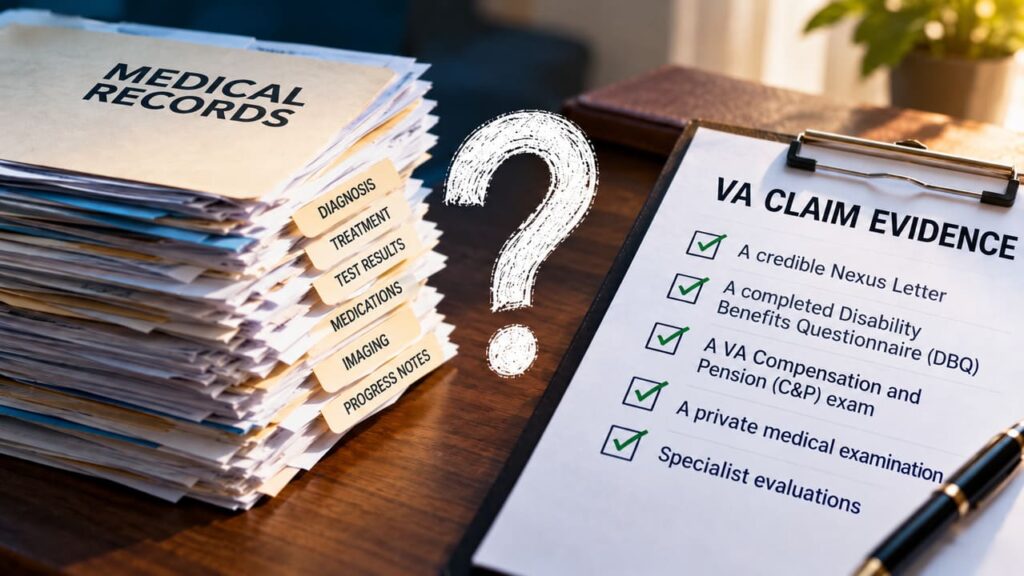
First, I want to clear up something important.
Technically, your medical records ARE medical evidence.
The VA specifically identifies VA medical records, private medical records, doctor reports, X-rays, medical test results, and other healthcare documentation as evidence that can support a disability claim.
So this isn’t really a legal distinction between two completely separate categories.
The practical difference is this:
Medical records document what happened.
Strong claim evidence helps prove what the VA needs to decide.
That distinction matters.
Your treatment records might show that you’ve been diagnosed with migraines for five years.
Great.
But if you’re trying to service connect those migraines secondary to tinnitus, your records might say absolutely nothing about whether your tinnitus caused or aggravated your migraines.
You can have a legitimate diagnosis.
You can have years of treatment.
You can be taking prescription medication.
And you can STILL be missing the medical link necessary to prove secondary service connection.
That’s the trap.
What Are Medical Records?
Medical records document your healthcare history.
Depending on your situation, they might include:
- Service Treatment Records (STRs)
- VA medical records
- Private medical records
- Doctor or specialist notes
- Hospital records
- Mental health treatment notes
- Imaging studies
- X-rays
- MRIs
- CT scans
- Laboratory results
- Sleep studies
- Prescription histories
- Physical therapy records
- Surgical records
- Diagnostic testing
These records can be incredibly valuable.
For example, your Service Treatment Records might show that you injured your back while on active duty.
Your post-service medical records might show that you were later diagnosed with degenerative disc disease.
Your VA treatment records might show years of continuing back pain, medication, physical therapy, and worsening symptoms.
Taken together, that can paint a powerful picture.
But sometimes there’s still a missing piece:
What medically connects your current disability to what happened during military service?
That’s where claim-specific medical evidence can become critical.
What Does the VA Consider Medical Evidence?
Medical evidence can include many of the same records I just listed.
But in the VA disability context, certain types of evidence can answer specific questions a routine treatment record may never address.
Examples include:
- A credible Nexus Letter
- A Disability Benefits Questionnaire (DBQ)
- A Compensation and Pension (C&P) exam
- A private medical examination
- A medical opinion addressing service connection
- Specialist evaluations
- Diagnostic testing
- Treatment records documenting symptom severity
- Medical evidence showing chronicity or continuity
- Medical literature when relevant to the provider’s rationale
- Evidence demonstrating that one disability caused or aggravated another
Here’s the key:
The strongest evidence speaks directly to the issue the VA must decide.
A 500-page medical file isn’t automatically more persuasive than a well-supported five-page medical opinion.
The VA weighs evidence based on factors such as credibility, competency, reasoning, consistency, and how well the opinion is supported by the facts.
That’s why I tell Veterans all the time:
Your VA claim isn’t about who has the biggest stack of paper.
It’s about whether the evidence proves your claim.
Medical Records vs. Medical Evidence: Quick Comparison
| Medical Records | Claim-Focused Medical Evidence |
| Document your medical history | Addresses an issue the VA must decide |
| Show diagnoses and treatment | May explain medical causation or aggravation |
| Document symptoms over time | May establish a medical nexus |
| Include labs, imaging, medications, and provider notes | May document severity using VA rating criteria |
| Primarily created for healthcare and treatment | May be prepared specifically to evaluate a disability claim |
| Can provide essential supporting evidence | Can help fill gaps your treatment records don’t address |
Again, the two categories overlap.
Your medical records can absolutely contain everything necessary to prove a claim.
But you shouldn’t ASSUME that they do.
What Does the VA Need to Approve a Disability Claim?
This depends on what type of VA claim you’re filing.
And this is where things get really important.
Original VA Disability Claim
For a direct service-connected disability claim, the VA generally looks for evidence showing three things:
- A current physical or mental disability
- An event, injury, illness, or disease during military service
- A link between your current disability and the in-service event
That third element is the medical nexus.
Sometimes the connection is already clear from the evidence.
Sometimes it isn’t.
And depending on the facts of your claim, that missing link could be the difference between service connection and denial.
Secondary VA Disability Claims
Secondary service connection works differently.
Let’s say you’re already service connected for tinnitus and later develop migraines.
The question isn’t necessarily whether your migraines started during military service.
Instead, the issue might be whether your migraines are:
- Proximately due to your service-connected tinnitus, or
- Aggravated by your service-connected tinnitus.
According to VA guidance, a secondary claim generally requires evidence of a new physical or mental condition and evidence of a link between that condition and an already service-connected disability.
That link often requires medical evidence.
This is exactly why a Veteran can have years of migraine treatment records and STILL lose a secondary claim.
The records prove the migraines exist.
They might not prove why they exist or whether the service-connected condition aggravated them.
>> Learn how secondary service connection works
VA Disability Increase Claim
Now let’s say you’re already service connected.
You aren’t trying to prove that your condition is related to military service anymore.
That’s already been established.
Instead, you’re saying:
“My condition has gotten worse, and my current VA rating no longer reflects the severity of my disability.”
Now the evidence needs to show worsening.
That could include:
- Recent medical records
- New diagnostic tests
- A private DBQ
- A VA C&P exam
- Changes in medication
- Increased treatment
- Hospitalizations
- Documentation of worsening symptoms
- Evidence of greater occupational or social impairment
- Lay statements describing how your disability affects daily life
The evidence should ideally address the current severity of your condition in terms that are relevant to the VA rating criteria.
Supplemental Claim After a VA Denial
If your claim was previously denied and you’re filing a Supplemental Claim, you need new and relevant evidence.
According to the VA:
New evidence is information that wasn’t previously part of your claim.
Relevant evidence is information that tends to prove or disprove an issue in your claim.
This is another area where Veterans get frustrated.
Simply submitting another copy of the same treatment records that the VA already reviewed generally doesn’t fix the underlying weakness in the claim.
First ask:
WHY did the VA deny me?
Then determine what evidence addresses that specific reason.
That might be:
- A missing diagnosis
- A missing nexus
- Insufficient evidence of an in-service event
- An unfavorable C&P medical opinion
- Insufficient evidence of severity
- No evidence establishing secondary causation or aggravation
Your VA Rating Decision tells you what went wrong.
READ IT.
Your strategy should address the actual reason for denial (not just add more paperwork).
Why Medical Records Alone Might Not Be Enough
Here’s a simple example.
Suppose you injured your knee during military service.
Your Service Treatment Records document the injury.
Twenty years later, you have a current diagnosis of chronic knee arthritis.
You’ve got treatment records.
You’ve got imaging.
You’ve got a diagnosis.
But there’s a 20-year gap between the in-service injury and your current condition.
The VA might ask:
Is the Veteran’s current knee disability actually related to that military injury?
Your orthopedic records might never answer that question.
Why?
Because your doctor was treating your knee—not writing a medical opinion for a VA disability claim.
There’s nothing wrong with that.
But it means you could potentially have plenty of medical RECORDS while still lacking sufficient medical EVIDENCE on the issue of nexus.
5 Common Evidence Gaps I See in VA Claims
After years of helping Veterans understand this process, these are five common problems that jump out at me.
#1. The Veteran Has Symptoms But No Current Diagnosis
You know something is wrong.
You’ve been dealing with the symptoms for years.
But there’s no clear medical diagnosis in your records.
Depending on the claimed disability and applicable law, that can create a major evidentiary problem.
The solution? Get your butt to the doctor to get a proper diagnosis.
#2. The Veteran Has a Diagnosis But No Nexus
This is probably the classic scenario.
You have the disability.
Nobody disputes it.
But the evidence doesn’t establish the connection between the disability and your military service.
A credible medical opinion may be able to address that gap.
#3. A Secondary Condition Exists But Nobody Addressed Causation or Aggravation
This is HUGE.
For secondary service connection, a medical opinion shouldn’t only consider whether your service-connected condition caused the new disability.
It may also need to address whether the service-connected disability aggravated it.
Those are two different theories of secondary service connection.
>> How One Disability Can Trigger Another — and Increase Your VA Rating
#4. Your Records Don’t Show the True Severity of Your Symptoms
Doctors often write short treatment notes.
“Stable.”
“Doing okay.”
“Continue medications.”
But those few words may not capture what your disability actually looks like on your worst days.
Maybe your migraines force you to lie down in a dark room multiple times per month.
Maybe your back condition makes sitting for extended periods impossible.
Maybe your mental health symptoms severely affect your work and relationships.
Treatment records aren’t always written around the VA Schedule for Rating Disabilities.
That’s one reason DBQs, C&P exams, credible lay evidence, and detailed evaluations can matter.
>> VA Claim Evidence Guide: What Evidence Do You Need for Your Claim?
#5. Your C&P Examiner Gave the VA a Negative Medical Opinion
You submitted records.
Then the VA sent you to a C&P exam.
The examiner concluded that your disability was less likely than not related to military service.
Now the VA has conflicting—or potentially one-sided—medical evidence.
At that point, the quality and probative value of the evidence matters tremendously.
A private medical opinion doesn’t automatically beat a C&P examiner.
And a C&P examiner doesn’t automatically beat a private medical opinion.
The question is which evidence is more persuasive, factually accurate, well-reasoned, and supported by the record.
>> Why the VA Rater Chose the C&P Exam Over Your Private Medical Evidence: How to Fight Back!
How Do You Strengthen the Medical Evidence in Your VA Claim?
Step #1: Identify Exactly What You Need to Prove
Don’t start by asking:
“What documents do I have?”
Start by asking:
“What does the VA need to see for THIS specific claim?”
Original claim?
Secondary claim?
Increase?
Supplemental Claim after a denial?
Different claims require different evidence.
Step #2: Review Your Existing Medical Records
Look for documentation of:
- Diagnosis
- Symptoms
- Treatment
- In-service injuries or illnesses
- Chronic symptoms
- Functional impairment
- Severity
- Medication
- Medical causation
- Aggravation
- Medical opinions
You may discover that your records already contain valuable evidence you didn’t realize was there.
Or you may find obvious gaps.
Step #3: Determine What’s Missing
Maybe you have:
Diagnosis? YES.
In-service event? YES.
Nexus? NO.
Now you know where the weakness is.
Don’t waste time trying to “prove” something that is already well documented.
Focus on the missing element.
Step #4: Consider Whether Additional Medical Evidence Is Appropriate
Depending on your circumstances, additional evidence could include:
- A medical opinion
- Nexus Letter
- Private DBQ
- Independent medical examination
- Specialist evaluation
- Diagnostic testing
- Updated treatment records
Any private medical evidence should be credible, accurate, based on the Veteran’s actual medical history, and supported by a clear medical rationale.
A Nexus Letter is not a magic piece of paper.
Neither is a DBQ.
Bad evidence is still bad evidence.
Step #5: Don’t Forget Lay Evidence
Medical evidence isn’t the only evidence that matters.
The VA also accepts lay evidence.
That could include a statement from:
- You
- Your spouse
- Family members
- Friends
- Fellow service members
- Coworkers
- Other people with firsthand knowledge of what happened or how your disability affects you
A buddy statement can’t diagnose a complex medical condition or magically create a medical nexus.
But it can provide powerful firsthand evidence about observable events, symptoms, changes in behavior, functional impairment, and continuity.
>> VA Buddy Letter Example: How to Write a Powerful Buddy Statement
Can Private Medical Evidence Help Your VA Claim?
Absolutely!
The VA itself encourages Veterans to submit relevant private medical evidence.
That might include records from your:
- Primary care physician
- Specialist
- Mental health provider
- Private hospital
- Urgent care facility
- Physical therapist
- Other qualified healthcare provider
Private medical evidence can be especially valuable when your provider has treated you for a long time and understands your medical history.
But here’s another big misconception:
The VA doesn’t have to accept a private doctor’s opinion just because you paid for it or submitted it.
The opinion still needs to be credible.
It should be based on accurate facts.
It should address the relevant medical question.
And when appropriate, it should explain WHY the provider reached the conclusion.
The rationale matters.
A LOT.
What Makes a Strong VA Nexus Letter?
A strong Nexus Letter generally includes:
- The Veteran’s identifying information
- The provider’s credentials
- The claimed disability
- Relevant medical history
- Relevant military history
- Records reviewed
- A clear medical opinion
- The appropriate medical probability language when applicable
- A detailed medical rationale explaining the conclusion
- Relevant medical research when appropriate
- The provider’s signature and contact information
What you DON’T want is a one-paragraph letter that basically says:
“I think this Veteran’s condition is related to service.”
Okay.
WHY?
What evidence supports that conclusion?
What’s the medical reasoning?
The VA evaluates the persuasive value of medical opinions, and a well-supported rationale can matter enormously.
More Medical Records Doesn’t Automatically Mean a Stronger VA Claim
This deserves its own section.
Veterans often think:
“I’ll just submit EVERYTHING.”
Not necessarily.
You want the VA to have the relevant evidence necessary to properly decide your claim.
Dumping thousands of pages of duplicate or unrelated medical records into your file isn’t a substitute for identifying the issue that actually needs to be proven.
Think QUALITY.
Think RELEVANCE.
Think CLARITY.
Your evidence should tell a coherent story.
For example:
What happened during service?
What disability do you have now?
How are the two connected?
What evidence proves that connection?
How severe is the disability today?
That is a much better way to think about your claim than:
“I have 800 pages of medical records, so the VA should approve me.”
The Bottom Line
Your medical records are important.
But don’t confuse the existence of medical records with automatically having all the evidence necessary to prove your VA disability claim.
Your records might prove your diagnosis.
They might document years of treatment.
They might show exactly when your symptoms started.
They might even contain the medical nexus you need.
But they also might not.
The right question isn’t:
“Do I have medical records?”
The right question is:
“Does my evidence prove every element the VA needs to decide THIS claim?”
That’s the shift.
Because when you understand what you’re actually trying to prove, the VA disability claims process becomes a whole lot less confusing.
And you can stop throwing evidence at the wall hoping something sticks.
You served. You deserve.
If you’re rated 0%-90% and stuck, frustrated, or underrated, you don’t have to figure out your next move alone.
(FAQs) Frequently Asked Questions
What is the difference between medical records and medical evidence for a VA claim?
Medical records are actually one form of medical evidence. They document information such as diagnoses, symptoms, treatments, testing, and medical history.
The practical distinction is whether those records prove the specific issue the VA must decide. Additional medical evidence—such as a medical opinion, Nexus Letter, DBQ, C&P examination, or private evaluation—may be useful when routine treatment records don’t address questions such as service connection, secondary causation or aggravation, or current severity.
Can the VA deny my claim even if I have medical records?
Yes. Having medical records does not guarantee service connection or a particular VA rating. For example, your records might clearly establish a current diagnosis but fail to establish a link between that disability and your military service. The exact evidence needed depends on the type of claim you’re filing.
What evidence does the VA need for an original disability claim?
For a direct service-connected VA disability claim, the evidence generally needs to establish:
- A current disability,
- An in-service event, injury, illness, or disease, and
- A link between the current disability and military service.
The VA may use both medical and lay evidence when deciding a claim.
What medical evidence is needed for a secondary VA claim?
For secondary service connection, the evidence generally needs to show that you have a new physical or mental condition and that it is linked to an existing service-connected disability. The link may involve the service-connected disability causing or aggravating the secondary condition. Medical records or medical opinions are commonly used to establish that relationship.
Can private medical records be used in a VA disability claim?
Yes. The VA accepts relevant private medical evidence and encourages Veterans to submit private treatment records that may help support their claims.
These could include physician reports, specialist records, diagnostic testing, imaging, hospital records, and other relevant healthcare documentation.
Can a private doctor provide a medical opinion for my VA claim?
Yes. A qualified private healthcare provider may provide medical evidence or a medical opinion relevant to a VA disability claim. However, the VA does not automatically accept a private opinion simply because a licensed provider wrote it. The credibility, factual accuracy, reasoning, supporting evidence, and overall probative value of the opinion can all matter.
Is a Nexus Letter required for a VA disability claim?
No. There is no rule saying a VA disability claim requires a private Nexus Letter. Some claims already contain sufficient evidence to establish the relationship between the Veteran’s disability and military service. A Nexus Letter may be especially useful when the existing evidence does not clearly establish service connection, when pursuing certain secondary claims, or when addressing an unfavorable medical opinion.
Are buddy statements considered evidence?
Yes. The VA accepts lay evidence, including statements from Veterans and people who have firsthand knowledge of relevant events, symptoms, or functional limitations. Lay witnesses generally cannot provide complex medical diagnoses or opinions requiring specialized medical knowledge, but they can provide important evidence about things they personally observed.
What should I do if the VA denied my claim because of insufficient evidence?
Start with your VA Rating Decision. Identify the exact reason the claim was denied and determine which element the VA found insufficient. Then focus your evidence on fixing that specific problem rather than simply resubmitting the same records. Depending on the circumstances, that could involve obtaining new medical evidence, a medical opinion, updated treatment documentation, relevant lay evidence, or other new and relevant evidence.
About the Author

Brian Reese
Brian Reese is a world-renowned VA disability benefits expert and the #1 bestselling author of VA Claim Secrets and You Deserve It. Motivated by his own frustration with the VA claim process, Brian founded VA Claims Insider to help disabled veterans secure their VA disability compensation faster, regardless of their past struggles with the VA. Since 2013, he has positively impacted the lives of over 10 million military, veterans, and their families.
A former active-duty Air Force officer, Brian has extensive experience leading diverse teams in challenging international environments, including a combat tour in Afghanistan in 2011 supporting Operation ENDURING FREEDOM.
Brian is a Distinguished Graduate of Management from the United States Air Force Academy and earned his MBA from Oklahoma State University’s Spears School of Business, where he was a National Honor Scholar, ranking in the top 1% of his class.