 go.vaclaimsinsider.com
Looking for Expert-Level VA Claim Answers? Schedule a Call
On June 10, 2026, VA announced it had processed more than 2 million disability benefits claims in fiscal year 2026 as of June 1. That’s a record, and to be fair, it’s a big deal. Or is it?
VA also reported that it has already awarded more than $124 billion in compensation and pension benefits to veterans and survivors this fiscal year. The average time to complete a claim decision is now 78.6 days, down from 141.5 days on January 20, 2025. That’s almost 2X faster.
I’ll give credit where credit is due: veterans deserve faster VA rating decisions. Nobody should have to wait months or years for benefits they earned through honorable service to our country. Faster claims processing is a good thing.
But faster doesn’t always mean better.
A fast approval with the correct rating and effective date is great. But a fast denial is still a denial. A fast lowball rating is still a lowball rating. A fast decision based on a bad C&P exam is still a bad decision. And a fast VA mistake can still cost a veteran and their family thousands of dollars in tax-free compensation and potentially years of struggle.
That’s the part that gets lost in the headline.
VA is celebrating speed, and I get it. Speed matters. But veterans don’t just need fast decisions. Veterans need accurate decisions. They need the correct rating percentage, the correct effective date, and the correct monthly compensation. That’s the real scoreboard.
Table of Contents
Summary of Key Points
- VA processing 2 million disability claims in record time is good news, but faster doesn’t always mean better. Veterans don’t just need quick decisions—they need accurate decisions with the correct rating, effective date, and monthly compensation.
- VA’s 94% accuracy claim lacks real-world context. Veterans deserve more transparency on denial rates, lowball ratings, bad C&P exams, effective date errors, and how many “completed” claims later get fixed on appeal.
- A faster VA system can deny or lowball weak claims faster. If your claim is missing medical evidence, lacks a clear nexus, has undocumented symptoms, or you’re unprepared for your C&P exam, speed can work against you.
- The best way to win your VA claim is to build it right before you file using the VA Claims Insider Golden Circle and SEM Method: current diagnosis, in-service event, nexus, severity of symptoms, plus Strategy, Education, and Medical Evidence.
The VA Announcement Lacks Context
VA says claims processing accuracy are currently above 94%. That would mean 94/100 VA rating decision were accurate. In my experience, there’s no way that’s correct. I’d love to see more context behind that number and what it actually means. Data can be fudged to tell the story one wants to tell.
So when VA says, “We processed 2 million claims,” my response is simple: Great. Now show us how many were correct. Not just your bumper sticker number.
I’d love to see VA publish more data on denial rates, lowball ratings, effective date errors, bad C&P exams that ruin a claim, and how many veterans win later on Higher-Level Review, Supplemental Claim, Board appeal, or Court appeal. I’d also love to know how many “completed” claims are really just the beginning of another fight. Tell us how many veterans are losing or getting lowballed.
While speed matters, accuracy matters more.
A Faster VA Can Deny Weak Claims In Record Time
Here’s what every veteran needs to understand: a faster VA system can help you if your claim is strong, but it can hurt you if your claim is weak.
Sadly, in my experience, even if your claim is strong, human error or a bad C&P exam can blow it all up.
And if your claim is missing medical evidence, VA can deny it faster. If your symptoms aren’t documented, VA can lowball you faster. If you walk into your C&P exam unprepared, VA can make a bad decision faster. If you file the wrong condition the wrong way, VA can close your claim and move on faster.
Most veterans know exactly what happened to them in the military. They know what they went through, what hurts, what changed after service, and how bad their symptoms really are. They know how their disabilities affect their marriage, family, work, sleep, mood, body, and daily life.
But VA does not rate what you know or say. VA rates what the evidence shows.
Just like in the military, if it’s not written down on paper, it might as well not exist. That’s not fair, but it is reality. And once you understand that you can do something about it.
Don’t File and Hope
One of the biggest mistakes veterans make is filing a claim and hoping VA figures it out.
Hope is not a strategy.
VA raters are not mind readers. C&P examiners are not your friend. Nobody should care more about your claim than you do.
You need to build your claim before you file it, and that starts with what we call the VA Claims Insider Golden Circle.
Every strong VA disability claim needs four things: (1) a current diagnosis, (2) an in-service event, injury, disease, or aggravation, (3) a clear nexus for service connection, and (4) documented severity of symptoms.
The VA Claims Insider Golden Circle
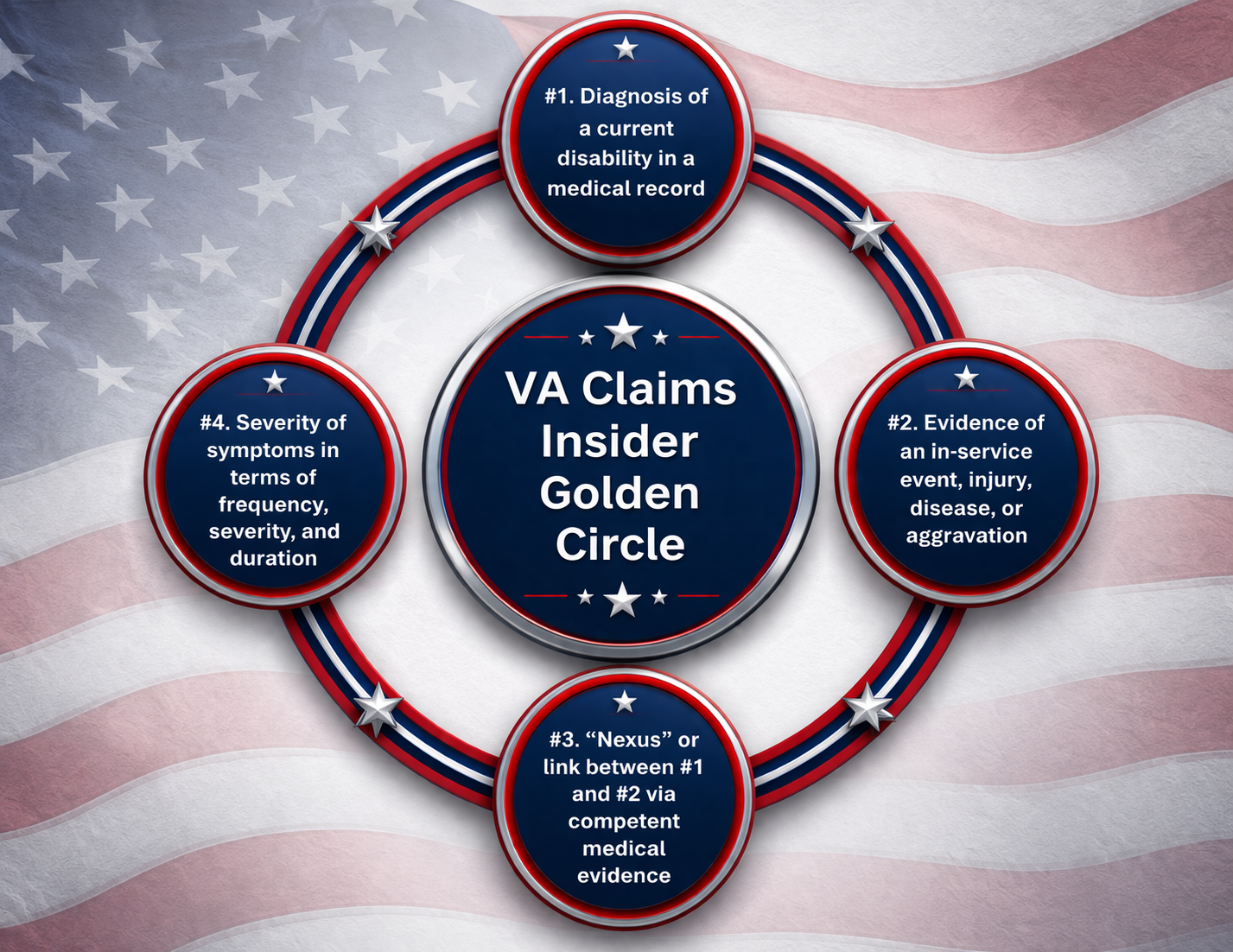
- The first thing you need is a current diagnosis in a medical record. Not just pain, not just symptoms, not just “I think I have it,” and not just because I wrote it in this personal statement. If you’re claiming migraines, PTSD, GERD, sleep apnea, depression, radiculopathy, sinusitis, IBS, or any other condition, where is it diagnosed in a medical record? Without a current diagnosis, VA has an easy reason to deny the claim. In fact, you might not even get scheduled for a C&P exam.
- The second thing you need is evidence of an in-service event, injury, disease, or aggravation. This could be an injury, deployment, toxic exposure, traumatic event, training accident, combat event, military sexual trauma, physical wear and tear, or a condition that started or got worse in service. Sometimes that evidence is in your Service Treatment Records. Sometimes it’s in your DD214, personnel records, deployment records, lay statements, personal statement, awards and decorations, performance reports, newspaper clippings, a journal, etc. The point is simple: you need to be able to point back to something that happened in-service.
- The third thing you need is a clear nexus, which simply means a link or connection. This is where a lot of veterans lose, especially those who have been out of the military for than 1 year. You can have a current diagnosis and something that happened in service, but if you can’t connect the two, VA can still deny your claim (and they probably will). For secondary claims, the nexus connects your new condition to a condition you’re already service connected for, such as migraines secondary to tinnitus, depression secondary to chronic pain, GERD secondary to PTSD medication, sleep apnea secondary to weight gain caused by a service-connected condition, or radiculopathy secondary to a back condition. This is why a strong private Nexus Letter can be a game changer when written correctly with high probative value.
- The fourth thing you need is documentation of your severity of symptoms. This is what drives your final VA rating percentage. VA doesn’t rate you just because you have a condition; VA rates how bad the condition is. How often does it happen? How severe is it? How long does it last? How does it affect your work, life, and social functioning? This is where veterans get crushed. They minimize symptoms, talk about their best day, leave out the ugly stuff, and fail to explain how bad it really gets. Don’t do that. Tell the truth for sure—not the tough-guy version, not the cleaned-up version, but the real version. Be honest, be specific, and be uncomfortably vulnerable at your C&P exam.
The SEM Method Explained
At VA Claims Insider, we teach veterans the SEM Method:
Strategy + Education + Medical Evidence = VA Rating You Deserve
That’s it. Simple, but not always easy.
- Strategy means you don’t throw 20 random conditions at VA and hope something sticks. That’s not a strategy; that’s a mess. More conditions can mean more exams, more confusion, more delays, more denials, and more chances for VA to get something wrong. A focused claim beats a messy claim. Before you file, ask yourself: What are my strongest claims? What conditions are diagnosed? What evidence do I already have? What evidence am I missing? Is this a direct, secondary, presumptive, aggravation, or increase claim? Will this condition actually move my combined rating? Do I need a DBQ or Nexus Letter? Is this claim ready to file?
- Education means you don’t need to become a lawyer or a doctor, but you do need to understand the basics. You need to know how VA service connection works, how your condition is rated, what a C&P exam is really for, what a DBQ is, when a Nexus Letter matters, and how to read your VA decision letter. Once you understand the game, you can play it better.
- Medical evidence is what wins VA claims. Period. Your evidence needs to prove the Golden Circle: diagnosis, in-service event, nexus, and severity. That evidence can include VA medical records, private medical records, Service Treatment Records, DBQs, Nexus Letters, Independent Medical Opinions, buddy statements, lay statements, sleep studies, imaging, labs, prescriptions, and mental health records. Do not make VA guess. Do not assume the rater will connect the dots. Do not assume the C&P examiner will tell your story correctly. They won’t. Make the evidence obvious.
Conclusion & Wrap-Up
VA processing 2 million claims in record time is good news, and I’m glad claims are moving faster. But veterans need more than fast. Veterans need accurate.
They need the correct rating, correct effective date, correct monthly compensation, and correct benefits for themselves and their families.
So my message to VA is simple: keep getting faster, but don’t sacrifice accuracy.
Be transparent and publish the bad along with the good because veterans deserve to know what’s really going on.
And my message to veterans is even simpler: don’t file a weak claim into a faster system because you’ll likely get crushed.
Build and file your own VA claim online the right way. Get a current diagnosis. Document the in-service event, injury, disease, or aggravation. Prove a clear nexus. Document the true severity of your symptoms. Use strategy, get educated, gather medical evidence, and prepare to crush your VA C&P exam.
And if VA gets it wrong, don’t quit.
A denial is not the end. A lowball rating is not the end. A bad C&P exam is not the end.
You Served. You Deserve.
Looking for VA Claim Help Fast? WE GOT YOUR SIX!

- VA Claims Insider is the #1 most trusted name in VA disability claims.
- Work 1:1 with a VA claims expert coach who can help lead you to VA claim victory.
- 50,000+ disabled veterans served in our membership programs since 2016.
- 33% average rating increase for veterans who complete our Elite program.
- 4.6/5.0 average rating out of 7,000+ total reviews; over 5,500 5-star reviews.
- 92% of all customer reviews are either 4 or 5 stars.
Content Reviewed By

Quality Assurance Team
The Quality Assurance (QA) team at VA Claims Insider has extensive experience researching, fact-checking, and ensuring accuracy in all produced content. The QA team consists of individuals with specialized knowledge in the VA disability claims adjudication processes, laws and regulations, and they understand the needs of our target audience. Any changes or suggestions the QA team makes are thoroughly reviewed and incorporated into the content by our writers and creators.
About The Author

Brian Reese
Brian Reese is a world-renowned VA disability benefits expert and the #1 bestselling author of VA Claim Secrets and You Deserve It. Motivated by his own frustration with the VA claim process, Brian founded VA Claims Insider to help disabled veterans secure their VA disability compensation faster, regardless of their past struggles with the VA. Since 2013, he has positively impacted the lives of over 10 million military, veterans, and their families.
A former active-duty Air Force officer, Brian has extensive experience leading diverse teams in challenging international environments, including a combat tour in Afghanistan in 2011 supporting Operation ENDURING FREEDOM.
Brian is a Distinguished Graduate of Management from the United States Air Force Academy and earned his MBA from Oklahoma State University’s Spears School of Business, where he was a National Honor Scholar, ranking in the top 1% of his class.