One of the smartest VA disability claim strategies is simple: Build your claim with the right medical evidence BEFORE you file the claim.
Regardless of what anyone else tells you, medical evidence wins VA claims. Full stop.
A privateDisability Benefits Questionnaire (DBQ) with high probative value can help establish your current diagnosis and ICD code, document the severity of your symptoms, show functional impairment, and—in some cases—help the VA decide your claim without ordering another Compensation & Pension (C&P) exam.
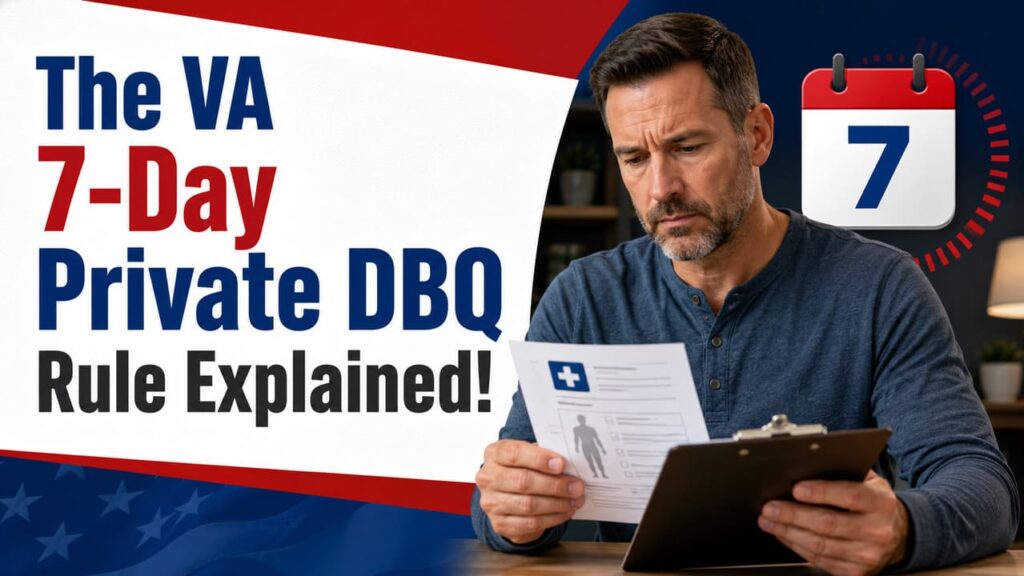
But there’s an even bigger strategy most Veterans don’t know about: what I call the VA 7-Day Private DBQ Rule.
Let’s begin!
Summary of Key Points
A strong private DBQ can help document your diagnosis, symptoms, severity, and functional impairment using the same standardized medical information VA relies on to rate disabilities.
Submit a complete private DBQ with your claim whenever possible. VBA automation materials show that a relevant private DBQ found within seven days of claim creation can be part of the logic used to route a claim toward Ready for Decision.
The “7-Day Private DBQ Rule” is a strategy—not a VA guarantee. The VA can still order a C&P exam if additional evidence or clarification is needed.
Know what evidence your claim actually needs. A DBQ generally supports diagnosis and severity, while a Nexus Letter or IMO may be needed to establish the medical connection to military service.
Table of Contents
What is a Private Disability Benefits Questionnaire (DBQ)?
A Disability Benefits Questionnaire is the VA’s standardized medical form for collecting the information needed to evaluate a disability.
The VA expressly tells Veterans they can have their own healthcare provider complete publicly available DBQs and submit them as medical evidence. The VA currently publishes DBQs for dozens of conditions, including Sleep Apnea and PTSD Review.
This isn’t some loophole.
Under 38 C.F.R. § 3.326(b) and (c), an otherwise adequate private examination report or physician statement may be accepted for rating purposes without further examination.
M21-1 goes even further. It instructs VA claims processors reviewing privately completed DBQs to evaluate their authenticity and evidentiary value and says they should generally be accepted at face value unless there is reason to doubt or question them. If something material is missing, the VA can seek clarification or obtain only the missing examination component.
That is important.
A private DBQ should not be discounted simply because it came from a non-VA provider.
Why Private DBQs Can Tip the Scales in Your Favor
Think of a strong VA claim as one that answers three major medical questions:
1. What do you have? Current diagnosis.
2. Why is it connected to service? Medical nexus to service, a service-connected disability, or aggravation. Sometimes a separate nexus letter is needed (in addition to your DBQ).
3. How bad is it? Current symptoms, severity, and functional impairment.
A DBQ is particularly powerful for Questions #1 and #3.
A Nexus Letter or Independent Medical Opinion (IMO) is usually designed to answer Question #2.
That distinction matters. VA Claims Insider has long taught this same evidence framework: DBQs generally document diagnosis and severity, while Nexus Letters and IMOs provide medical reasoning connecting the disability to service.
The VA 7-Day Private DBQ Rule Explained
Here is where this strategy gets really interesting.
According to VBA’s own automation presentation, if sufficient relevant evidence is found within the defined review period, the claim can be marked Ready for Decision (RFD) and routed to a Rating Specialist. If the evidence does not meet the threshold, automation can instead order a medical examination.
The VA then gives an actual RFD example where the stated reason was:
“Private DBQ Found within 7 Days of Claim Creation.”
That is the basis for what I call the 7-Day Private DBQ Rule.
Important distinction: this is not a regulation guaranteeing an RFD outcome simply because you upload a DBQ by Day 7. It is documented VBA automation logic.
The strategy is this:
Whenever appropriate, submit a complete private DBQ WITH your claim—or within seven days of claim creation—so the VA has strong rating evidence before automation starts sending the claim down the examination and evidence-development path.
If the evidence is sufficient, the claim could potentially move toward a Rating Specialist without unnecessary additional development or a separate C&P exam.
That’s how a private DBQ can potentially help turn a claim that takes months into one that gets decided much faster.
Example #1: Sleep Apnea — Why DBQ + Nexus Letter Can Be the Winning Combination
Suppose a Veteran has Obstructive Sleep Apnea (OSA) and is seeking secondary service connection.
This is where Veterans often misunderstand DBQs.
The Sleep Apnea DBQ can document the diagnosis, sleep-study findings, symptoms, CPAP requirement, and occupational impact. In fact, the VA’s own Sleep Apnea DBQ states that a sleep apnea diagnosis must be confirmed by a sleep study.
Under the current 38 C.F.R. § 4.97, Diagnostic Code 6847, sleep apnea requiring a CPAP or similar breathing-assistance device warrants a 50% evaluation once service connection is established.
In a secondary claim, a qualified medical professional needs to explain—with supporting medical rationale—why the Veteran’s sleep apnea is at least as likely as not caused or aggravated by the service-connected condition.
In this example, both pieces matter:
DBQ = Diagnosis + Severity
Nexus Letter = Medical Connection
Without the DBQ, the VA may lack complete rating evidence.
Without the nexus, the VA may agree you have severe sleep apnea and still deny service connection.
Now imagine a Veteran who has been service connected for PTSD at 30% for five years.
Since the original VA exam, things have gotten worse.
The Veteran now has worsening anxiety, panic attacks, anger and irritability, concentration problems, social isolation, relationship difficulties, and significant problems functioning at work.
They don’t need to prove the original military stressor or service connection again.
The fight is over current severity.
A qualified psychologist or psychiatrist performs a comprehensive private psychological evaluation and completes the PTSD Review DBQ.
That’s the correct publicly available form for this situation. The VA makes the PTSD Review DBQ public while specifically listing the Initial PTSD DBQ as not available for public use.
Even better, the current PTSD Review DBQ specifically asks about the Veteran’s recent history since the prior exam, current symptoms, and current occupational and social impairment.
Under 38 C.F.R. § 4.130, 30% generally corresponds to occasional decreases in work efficiency; 50% reflects reduced reliability and productivity; and 70% reflects occupational and social impairment with deficiencies in most areas.
A thorough private evaluation can therefore give the VA rater a current, evidence-based picture of how much the Veteran’s PTSD has actually worsened.
Private DBQ Pro Tips
Identify the evidence gap first. Don’t buy a Nexus Letter when the real issue is severity—and don’t buy only a DBQ when nexus with evidence-based rationale is the missing element.
Use the most current VA DBQ for the condition.
Use a properly qualified provider and make sure every required provider-information field is completed.
Front-load the evidence. If a private DBQ is appropriate, get it completed before filing and submit it with the claim whenever possible.
Make the evidence consistent. Diagnosis, medical history, testing, symptoms, functional impact, and treatment records should tell the same truthful story.
If the VA schedules a C&P exam, attend it. A private DBQ can potentially eliminate the need for another examination, but the VA still has authority to request one.
Frequently Asked Questions
Is the VA 7-Day Private DBQ Rule actually a law?
No. There is no regulation saying, “Submit a private DBQ within seven days and the VA must immediately rate your claim.”
The seven-day concept comes from documented VBA automation logic showing an eligible contention receiving an RFD outcome because a private DBQ was found within seven days of claim creation.
What happens if I submit my DBQ on Day 8?
Your DBQ does not become invalid. It is still medical evidence the VA must consider. The seven-day issue relates to the timing of VA’s automated review process—not the legal validity of the DBQ.
Can a private DBQ eliminate a C&P exam?
Potentially, yes. 38 C.F.R. § 3.326 permits adequate private examination reports to be accepted without further examination, and M21-1 says an exam or opinion isn’t necessary when the evidence already on record is sufficient to decide the contention. The VA can still order another examination if additional information is required.
Can the VA simply ignore my private DBQ?
No private DBQ automatically controls the outcome, but the VA shouldn’t simply throw it out because it is private. M21-1 instructs claims processors to evaluate it and generally accept privately completed DBQs at face value unless there is a reason to question authenticity or sufficiency.
Do I need both a DBQ and a Nexus Letter?
Sometimes. For an already service-connected disability increase—such as PTSD from 30%—a DBQ may be the primary missing evidence because the nexus is already established. For a new or secondary condition such as sleep apnea, you may need both: the DBQ to establish diagnosis and severity and a Nexus Letter to establish the medical connection.
Are private telehealth DBQs acceptable?
Yes, when appropriate for the disability being evaluated. Current M21-1 guidance says private telehealth and telemental-health reports are assessed for adequacy using the same general standards applied to in-person examinations, while considering the provider’s knowledge of the Veteran’s history, records reviewed, and whether the condition is suitable for telehealth evaluation.
Conclusion & Wrap-Up
Fellow veterans: don’t just file a VA disability claim and hope the evidence eventually comes together.
Hope is not a strategy.
Know the gap. Build the right medical evidence. Then file your claim.
A strong private DBQ—submitted at the right time and for the right reason—can document your disability in VA’s own language, potentially reduce unnecessary development, and put stronger medical evidence in front of the VA rater.
Source List
VA Claims Insider — The POWER of Private Medical Evidence for Disability: Discussion of DBQs, Nexus Letters/IMOs, private psychological evaluations, and how the different forms of medical evidence solve different claim problems. Read the VA Claims Insider Article
VA — Public Disability Benefits Questionnaires: VA’s official list of DBQs available for completion by private healthcare providers, including Sleep Apnea and PTSD Review. List of Public Facing VA DBQ Forms
VBA M21-1 Adjudication Procedures Manual: See especially IV.i.2.A.3, use and acceptance of DBQs; IV.i.3.A.1.d-f, review and sufficiency of privately completed DBQs; and V.ii.1.A, principles for reviewing and weighing evidence. Official VA M21-1 Live Manual
38 C.F.R. § 3.326: Authority to accept adequate private examination reports and physician statements for rating without further examination. 38 CFR § 3.326 — Examinations
YOU SERVED. YOU DESERVE.
You served. You earned the right to file. You earned the right to be heard. And you earned the right to pursue every VA benefit you legally qualify for.
So here is the real question:
Do you have the VA rating you were given, or the VA rating you truly deserve?
Want Expert-Level VA Claim Help? WE GOT YOUR SIX!
VA Claims Insider helps educate and empower veterans to get the VA rating they deserve.
Work directly with a VA Claims Insider Coach who can help lead you to VA claim victory.
50,000+ disabled veterans served in our membership programs since 2016.
33% average rating increase for veterans who complete our Elite program.
The Quality Assurance (QA) team at VA Claims Insider has extensive experience researching, fact-checking, and ensuring accuracy in all produced content. The QA team consists of individuals with specialized knowledge in the VA disability claims adjudication processes, laws and regulations, and they understand the needs of our target audience. Any changes or suggestions the QA team makes are thoroughly reviewed and incorporated into the content by our writers and creators.
Brian Reese is a world-renowned VA disability benefits expert and the #1 bestselling author of VA Claim Secrets and You Deserve It. Motivated by his own frustration with the VA claim process, Brian founded VA Claims Insider to help disabled veterans secure their VA disability compensation faster, regardless of their past struggles with the VA. Since 2013, he has positively impacted the lives of over 10 million military, veterans, and their families.
A former active-duty Air Force officer, Brian has extensive experience leading diverse teams in challenging international environments, including a combat tour in Afghanistan in 2011 supporting Operation ENDURING FREEDOM.
Brian is a Distinguished Graduate of Management from the United States Air Force Academy and earned his MBA from Oklahoma State University’s Spears School of Business, where he was a National Honor Scholar, ranking in the top 1% of his class.
For nearly a decade, Army Veteran Geoff O’Neill fought to get his VA rating increased. His sleep apnea claim was denied 7 times, his claims paperwork grew to roughly 84 pages, and despite years of... continue reading
On June 10, 2026, VA announced it had processed more than 2 million disability benefits claims in fiscal year 2026 as of June 1. That’s a record, and to be fair, it’s a big deal. Or is it? VA... continue reading
Elite Membership
Dear Veteran, Here’s the brutal truth about VA disability claims:
According to our data, 8/10 (80%) of veterans reading this message right now are underrated by the VA…
This means you do NOT currently have the VA disability rating and compensation YOU deserve, and you could be missing out on thousands of dollars of tax-free compensation and benefits each month.
As a fellow disabled Veteran this is shameful and I’m on a mission to change it.
Brian Reese here, Air Force service-disabled Veteran and Founder @ VA Claims Insider.
Since 2016, VA Claims Insider has helped thousands of Veterans just like you get the VA rating and compensation they deserve in less time.
If accepted into our ELITE membership program, you’ll get up-front access and permission to use $13,119 worth of proprietary VA claim resources, including access to our network of independent medical professionals for medical examinations, disability evaluations, and credible Medical Nexus Letters, which could help you get a HIGHER VA rating in LESS time.
VA Claims Insider, LLC, and its affiliates ("we," "us", or "our") are not sponsored by, or affiliated with, the United States Department of Veterans Affairs, any state's Department of Veterans Affairs, or any other federally chartered veterans service organization. Other organizations, including, but not limited to, your state's Department of Veterans Affairs, your local county veterans service agency, and other federally chartered veterans service organizations, may be able to provide you with these services free of charge. Products or services offered by VA Claims Insider, LLC, and its affiliates are not necessarily endorsed by any of these organizations. You may qualify for other veterans' benefits beyond the services that VA Claims Insider, LLC and its affiliates offer.
None of our employees are accredited agents, VSOs, attorneys, or entities recognized by the United States Department of Veterans Affairs or any state's Department of Veterans Affairs, and none of our employees will assist you with the preparation, presentation, or prosecution of any claim for VA disability benefits. Before engaging with us, we strongly encourage you to discuss your disability claims matter with an accredited VSO, accredited attorney, or accredited claims agent, at www.va.gov/ogc/apps/accreditation/index.asp, all of whom are free to use. You are not required to use our website or services to submit a claim for VA disability benefits. You may receive a positive VA disability claim outcome without using our paid services. Furthermore, your use of our paid services does not and cannot affect the speed at which the VA processes your disability claims, as processing times are determined solely by the VA. VA CLAIMS INSIDER, LLC AND ITS AFFILIATES DO NOT GUARANTEE ANY SPECIFIC OUTCOMES OR RESULTS BY YOUR USE OF ITS WEBSITE OR SERVICES AND YOUR RESULTS MAY VARY FROM THE INFORMATION PROVIDED IN OUR ADVERTISEMENTS AND, ON THIS WEBSITE, INCLUDING BUT NOT LIMITED TO, SUCCESS PERCENTAGES, DISABILITY RATING INCREASES, AND PROCESSING TIMELINES ARE HISTORICAL AVERAGES ONLY, ARE NOT GUARANTEES OF FUTURE RESULTS, AND ARE NOT SPECIFIC TO ANY ONE CLAIM. SUCH INFORMATION VARIES OVER TIME, AND WE MAKE NO OBLIGATION TO KEEP SUCH INFORMATION CURRENT. The VA Claims Insider® name and logo are registered trademarks of VA Claims Insider, LLC.

 go.vaclaimsinsider.com