 go.vaclaimsinsider.com
Looking for Expert-Level VA Claim Answers? Schedule a Call
If your VA claim was denied, filing a Supplemental Claim may allow you to continue your case and submit additional evidence in support of your claim.
Many veterans aren’t sure what evidence qualifies or whether their records are strong enough to reopen a denied claim.
This guide explains what qualifies as new and relevant evidence, what won’t move your claim forward, and how to build stronger supplemental claim.
Summary of Key Points
- A Supplemental Claim requires new and relevant evidence that the VA didn’t previously consider when deciding on your claim.
- Strong supplemental claim evidence directly addresses why the VA denied your claim, such as missing service connection, diagnosis, severity, or nexus evidence.
- Updated medical records, nexus letters, DBQs, lay statements, and newly discovered service records are common examples of new and relevant evidence that VA reviewers may consider.
Table of Contents
What is a VA Supplemental Claim?
A Supplemental Claim is a VA appeal option that allows you to submit additional evidence after a denial.
Under the Appeals Modernization Act (AMA), you can file a Supplemental Claim when you have new and relevant evidence that may change the outcome of the decision.
This is different from a Higher-Level Review, which doesn’t allow new evidence.
Did you know? If your Supplemental Claim is successful, you may also qualify for retroactive VA back pay tied to your effective date.
What Does ‘New and Relevant’ Mean?
To file a Supplemental Claim, you need to submit evidence that is both new and relevant.
- New evidence is information that the VA hasn’t previously reviewed.
- Relevant evidence is information that relates to an issue tied to your claim and could affect the outcome.
You can submit evidence yourself or identify records for the VA to obtain on your behalf.
Note: You can also file a Supplemental Claim based on a change in law without submitting new and relevant evidence.
What is Considered New and Relevant Evidence?
Examples of new evidence VA reviewers may consider include:
- Updated medical records
- A new current diagnosis
- A DBQ
- Newly discovered service treatment records
- Buddy statements or lay statements
- Medical opinions linking your condition to service
- Evidence showing worsening symptoms
The strongest supplemental claim evidence directly addresses the missing element identified in your VA decision letter.
What Doesn’t Count as New and Relevant Evidence?
The VA is looking for evidence that adds new information to the claim, not just more paperwork.
Evidence may not help reopen a claim if it:
- Repeats information already reviewed
- Duplicates prior records
- Doesn’t relate to the denied issue
- Fails to address the reason for denial
For example, resubmitting the same medical records without new information usually won’t satisfy the new and relevant evidence standard.
Check out our guide on How to File a Winning VA Supplemental Claim to ensure you get the benefits you rightfully deserve.
Examples of Strong VA Supplemental Claim Evidence
Example 1: New Medical Evidence
Your VA claim for a mental health condition was previously denied because the VA didn’t find a connection to service. You later obtain a medical opinion stating that your service-connected back injury contributed to your depression or anxiety.
That medical opinion may qualify as new and relevant evidence because the VA hadn’t previously reviewed it, and it addresses the missing nexus in your claim.
Example 2: Buddy Statement
Your VA claim for back pain was denied because there wasn’t enough evidence showing the in-service injury occurred. A fellow service member then submits a statement describing the incident they witnessed and how your condition affected you afterward.
That buddy statement may qualify as new and relevant evidence because it provides information the VA didn’t previously consider that relates directly to the reason for denial.
Example 3: Evidence Showing Worsening Symptoms
You were granted service connection for migraines but received a lower rating than expected. Since the decision, your symptoms worsened and your doctor documented more frequent migraine attacks affecting your ability to work.
Those updated treatment records or a new DBQ may qualify as new and relevant evidence because they relate directly to the severity of your condition.
Strengthen Your Supplemental Claim
The strongest Supplemental Claims directly address the reason the VA denied the claim. Evidence that targets the missing piece in your decision letter is far more effective than submitting duplicate or unrelated records.
The right evidence strategy can make the difference between another denial and a successful outcome.
VA Claims Insider is the #1 most trusted name in VA disability claims, with a proven system designed to strengthen claims with the right medical evidence and strategy.
FAQs | Frequently Asked Questions
What is considered new evidence for a VA supplemental claim?
New evidence is information the VA hasn’t previously reviewed when deciding your claim, including updated medical records, nexus letters, DBQs, new diagnoses, lay statements, or newly discovered service records.
Can I add more evidence to my supplemental claim?
Yes. A Supplemental Claim is specifically designed for submitting new and relevant evidence that could affect the outcome of your claim.
Can updated medical records count as new and relevant evidence?
Yes. Updated treatment records may qualify if they provide new information about diagnosis, severity, symptoms, or service connection.
Does a nexus letter count as supplemental claim evidence?
Yes. A nexus letter may qualify as new and relevant evidence if it provides a medical opinion linking your condition to military service.
Why did the VA say my evidence wasn’t relevant?
The VA may reject evidence as not relevant if it doesn’t address the specific reason your claim was denied. For example, if you submit treatment records that don’t discuss service connection.
How long do I have to submit new evidence after a denial?
You generally have 1 year from the date of the VA decision to file a Supplemental Claim and preserve your effective date.
What We Believe
Our WHY
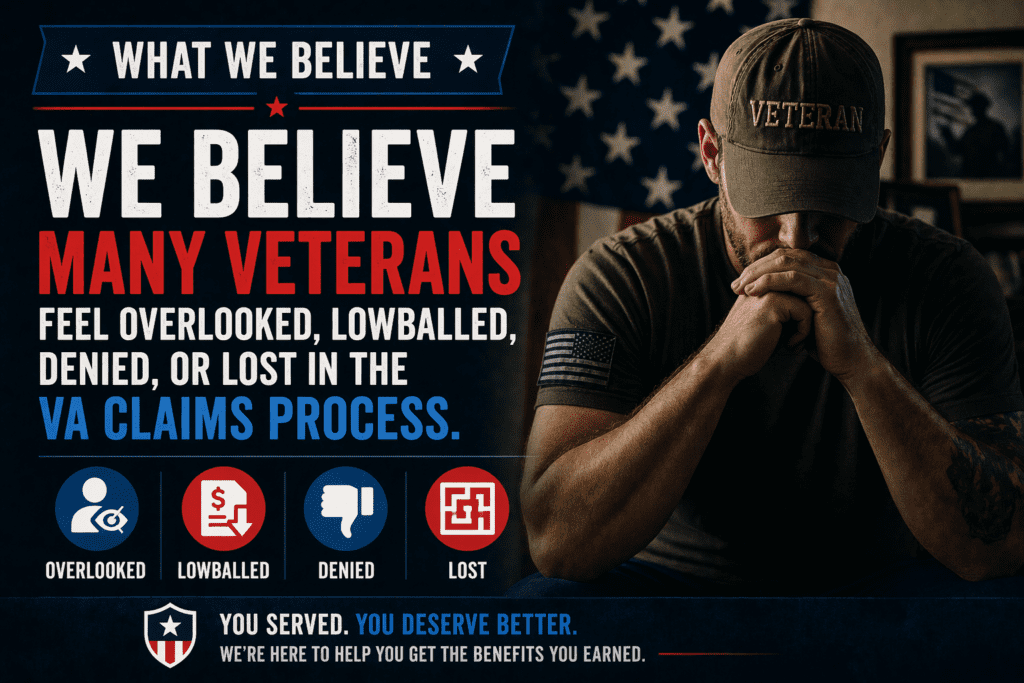
We believe millions of veterans feel overlooked, lowballed, denied, or lost in the VA claims process.
Our purpose is to help underrated disabled veterans rated 0% to 90% create real life change by pursuing the VA disability benefits they legally, morally, ethically, and medically deserve.
We are INSIDERS.
Our HOW
We make the VA disability process easier through expert-level education, proven resources, and veteran-to-veteran support.
You are never alone in this fight.
Our flagship program, VA Claims Insider Elite, connects each veteran with an expert-level Veteran Coach who guides them through our proprietary 8-step process.
That process is built around our SEM Method:
Strategy + Education + Medical Evidence = VA Rating You Deserve!
Our WHAT
We help underrated disabled veterans rated 0% to 90% win, service connect, and increase their VA rating through a smarter strategy, better education, and stronger medical evidence.
YOU SERVED. YOU DESERVE.

Do you have the VA rating you were given…or the VA rating you actually deserve?
Because getting a decision from the VA does not always mean you got the right decision from the VA.
If you are rated anywhere from 0% to 90% and feel stuck, frustrated, underrated, denied, or overlooked, I am speaking directly to you.
And if you have never filed because you thought other veterans deserved it more, because you got denied before, or because you assumed it was too late, do not let those myths make your decision for you.
At VA Claims Insider, we help underrated disabled veterans create real life change by getting the VA rating and compensation they deserve!
Here’s a sliver of what you get when you join us:
- A Veteran Coach by your side, so you never have to fight the VA alone.
- A smarter, personalized strategy for your claim.
- Better VA disability education, so you know what to do next.
- Stronger private medical evidence (DBQs, Nexus Letters, Mental Health Evaluations, and more) at members-only rates to support the rating you deserve.
- And a proven battle plan toward VA claim victory.
But maybe you’re wondering: Will this actually work for me?
That is a fair question.
- At VA Claims Insider, we have helped 50,000+ veterans fight for the VA disability benefits they earned.
- Our internal data shows an average *33% VA rating increase for veterans who complete our Elite program.
- Our internal data also shows veterans in our programs get their claims approved *25% faster on average than the VA’s published average claim-processing timelines.
- Veterans in our community have left 7,000+ total reviews, with a 4.6 out of 5 average rating.
- More than 5,500 reviews are 5 stars ⭐⭐⭐⭐⭐, and 92% of all veteran customer reviews are either 4 or 5 stars.
*Based on VA Claims Insider internal data for veterans who completed the Elite program. Average results shown; individual results vary. No guaranteed outcome or faster claim processing.
If you are ready for a better battle plan, a smarter strategy, and the right path to the VA rating and compensation you deserve, we’ve got your six.
📅 Schedule a Call or click the red button below to get started:
About the Author

Brian Reese
Brian Reese is a world-renowned VA disability benefits expert and the #1 bestselling author of VA Claim Secrets and You Deserve It. Motivated by his own frustration with the VA claim process, Brian founded VA Claims Insider to help disabled veterans secure their VA disability compensation faster, regardless of their past struggles with the VA. Since 2013, he has positively impacted the lives of over 10 million military, veterans, and their families.
A former active-duty Air Force officer, Brian has extensive experience leading diverse teams in challenging international environments, including a combat tour in Afghanistan in 2011 supporting Operation ENDURING FREEDOM.
Brian is a Distinguished Graduate of Management from the United States Air Force Academy and earned his MBA from Oklahoma State University’s Spears School of Business, where he was a National Honor Scholar, ranking in the top 1% of his class.