 go.vaclaimsinsider.com
Looking for Expert-Level VA Claim Answers? Schedule a Call
Getting your VA claim denied a second time can feel like a punch to the gut.
You submitted evidence, waited months, and still got another denial. At that point, many veterans start wondering if it’s even worth continuing the fight.
A denial isn’t always a reflection of whether your condition is legitimate. Often, it comes down to evidence, medical opinions, or how the claim was developed.
This guide explains what to do after a second VA claim denial, what appeal options may still be available, and how to build a stronger strategy moving forward.
Summary of Key Points
- A second denial doesn’t mean your VA claim is over. Many veterans eventually win benefits after strengthening medical evidence or changing their appeal strategy.
- Your decision letter usually explains why the VA denied your claim again, which can help you target the missing piece more effectively.
- Strong nexus letters, DBQs, independent medical opinions, and focused evidence often make the biggest difference after repeated denials.
Table of Contents
Why the VA Denied Your Claim Again
Many second denials happen because the VA still believes one of the three key elements is missing:
- A current diagnosis
- An in-service event, illness, or injury
- A medical nexus connecting your condition to service
The VA may also deny your claim if:
- The medical opinion was unfavorable
- Your new evidence didn’t address the original denial
- The VA believes your symptoms don’t meet the criteria for a compensable rating
- The C&P examiner minimized your symptoms or limitations
- There isn’t enough “new and relevant evidence” in a Supplemental Claim
This is why your latest decision letter matters. In most cases, the denial explanation tells you what issue still needs stronger evidence.
What To Do After Your VA Claim Gets Denied a Second Time
1. Review the Favorable Findings Section
Under the Appeals Modernization Act (AMA), VA decision letters often include a favorable findings section.
These findings are important because the VA has already conceded certain parts of your claim. That means you usually don’t need to prove those facts again unless clear evidence shows otherwise.
Examples of favorable findings may include:
- A confirmed diagnosis
- Proof of military service in a qualifying location
- Conceded toxic exposure
- Evidence of an in-service injury or event
If the VA already conceded one element, your next appeal could focus entirely on the missing piece.
2. Understand Which Appeal Option You’ve Already Used
Your options after a second denial depend partly on which review lane you previously selected.
If you already filed a Supplemental Claim, you can usually:
- File another Supplemental Claim with stronger evidence
- Request a Higher-Level Review if the denial involved a VA error
- Appeal directly to the Board of Veterans’ Appeals
If you have already used a Higher-Level Review, you can’t request another Higher-Level Review for the same issue. However, you can still:
- File a Supplemental Claim with new and relevant evidence
- Appeal to the Board of Veterans’ Appeals
If the Board denied your appeal, you may still have options, including:
- Filing a Supplemental Claim with new and relevant evidence
- Appealing to the Court of Appeals for Veterans Claims (CAVC)
At this stage, many veterans choose to work with an accredited representative or experienced claims professional.
3. Strengthen the Weakest Part of Your Claim
After a second denial, submitting random medical records is usually not enough. Your evidence should directly target the reason the VA denied the claim.
For example:
| VA Says | Evidence That May Strengthen Your Claim |
| No current diagnosis | Updated medical records or specialist diagnosis |
| No nexus | Strong nexus letter using “at least as likely as not” language |
| Symptoms not severe enough | DBQ, treatment records, lay statements, work impact evidence |
| Condition not connected to service | Buddy or personal statements, STRs, exposure evidence, private medical opinion |
4. Consider an Independent Medical Opinion
A strong independent medical opinion can sometimes outweigh an unfavorable VA opinion, especially when the provider explains:
- Your current diagnosis
- Your symptoms and functional limitations
- Your service history
- Why your condition is connected to military service
A weak one-sentence nexus letter often carries little weight. A detailed opinion backed by medical reasoning is usually far more persuasive.
Don’t Miss Your Appeal Deadlines
In most cases, you have one year from the date of your decision letter to continue pursuing your claim while protecting your effective date.
If you miss that deadline, your effective date may reset, which could cost you months or even years of retroactive VA back pay.
This is why acting quickly after a second denial matters.
Need a Better Strategy After a Second VA Claim Denial?
After a second denial, you may feel stuck or unsure whether continuing the appeal is even worth it.
In many cases, stronger medical evidence, better nexus opinions, and a more focused strategy can completely change the outcome.
VA Claims Insider works with veterans to build fully developed claims designed to strengthen service connection, clarify medical evidence, and pursue the highest rating supported by law.
Have you been denied?
We’ve helped thousands of veterans like David Barry overcome years of VA claim denials and get the rating increase they deserve.
Are YOU next?
FAQs | Frequently Asked Questions
Is it normal to be denied by the VA multiple times?
Yes. Many veterans receive multiple denials before eventually winning benefits. Complex conditions, weak nexus opinions, missing evidence, or unfavorable C&P exams can all lead to repeated denials even when the condition is legitimate.
How many times can a VA claim be appealed?
There is no set limit to how many times you can appeal a VA disability claim. If you meet VA deadlines and submit new and relevant evidence when required, you can continue pursuing benefits.
How long after a VA claim is denied can you apply again?
Yes. You can file a Supplemental Claim with new and relevant evidence at any time. However, filing within one year of your denial may preserve your effective date and protect potential back pay.
Can I file another appeal after being denied twice?
Yes. In many cases, you can still file a Supplemental Claim, appeal to the Board of Veterans’ Appeals, or pursue additional review options depending on your situation.
Should I submit the same evidence again after a second denial?
Usually, no. Repeating the same evidence without addressing the reason for denial often leads to another denial. Your best approach is to present evidence that directly addresses the issue identified in your decision letter.
What We Believe
Our WHY
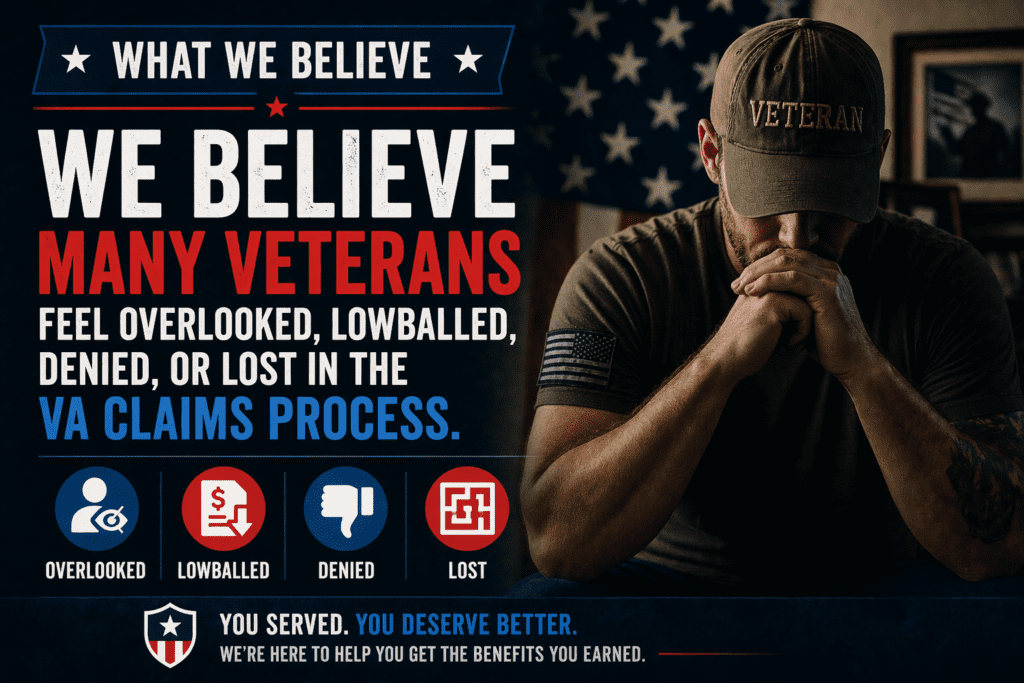
We believe millions of veterans feel overlooked, lowballed, denied, or lost in the VA claims process.
Our purpose is to help underrated disabled veterans rated 0% to 90% create real life change by pursuing the VA disability benefits they legally, morally, ethically, and medically deserve.
We are INSIDERS.
Our HOW
We make the VA disability process easier through expert-level education, proven resources, and veteran-to-veteran support.
You are never alone in this fight.
Our flagship program, VA Claims Insider Elite, connects each veteran with an expert-level Veteran Coach who guides them through our proprietary 8-step process.
That process is built around our SEM Method:
Strategy + Education + Medical Evidence = VA Rating You Deserve!
Our WHAT
We help underrated disabled veterans rated 0% to 90% win, service connect, and increase their VA rating through a smarter strategy, better education, and stronger medical evidence.
YOU SERVED. YOU DESERVE.

Do you have the VA rating you were given…or the VA rating you actually deserve?
Because getting a decision from the VA does not always mean you got the right decision from the VA.
If you are rated anywhere from 0% to 90% and feel stuck, frustrated, underrated, denied, or overlooked, I am speaking directly to you.
And if you have never filed because you thought other veterans deserved it more, because you got denied before, or because you assumed it was too late, do not let those myths make your decision for you.
At VA Claims Insider, we help underrated disabled veterans create real life change by getting the VA rating and compensation they deserve!
Here’s a sliver of what you get when you join us:
- A Veteran Coach by your side, so you never have to fight the VA alone.
- A smarter, personalized strategy for your claim.
- Better VA disability education, so you know what to do next.
- Stronger private medical evidence (DBQs, Nexus Letters, Mental Health Evaluations, and more) at members-only rates to support the rating you deserve.
- And a proven battle plan toward VA claim victory.
But maybe you’re wondering: Will this actually work for me?
That is a fair question.
- At VA Claims Insider, we have helped 50,000+ veterans fight for the VA disability benefits they earned.
- Our internal data shows an average *33% VA rating increase for veterans who complete our Elite program.
- Our internal data also shows veterans in our programs get their claims approved *25% faster on average than the VA’s published average claim-processing timelines.
- Veterans in our community have left 7,000+ total reviews, with a 4.6 out of 5 average rating.
- More than 5,500 reviews are 5 stars ⭐⭐⭐⭐⭐, and 92% of all veteran customer reviews are either 4 or 5 stars.
*Based on VA Claims Insider internal data for veterans who completed the Elite program. Average results shown; individual results vary. No guaranteed outcome or faster claim processing.
If you are ready for a better battle plan, a smarter strategy, and the right path to the VA rating and compensation you deserve, we’ve got your six.
📅 Schedule a Call or click the red button below to get started:
About the Author

Brian Reese
Brian Reese is a world-renowned VA disability benefits expert and the #1 bestselling author of VA Claim Secrets and You Deserve It. Motivated by his own frustration with the VA claim process, Brian founded VA Claims Insider to help disabled veterans secure their VA disability compensation faster, regardless of their past struggles with the VA. Since 2013, he has positively impacted the lives of over 10 million military, veterans, and their families.
A former active-duty Air Force officer, Brian has extensive experience leading diverse teams in challenging international environments, including a combat tour in Afghanistan in 2011 supporting Operation ENDURING FREEDOM.
Brian is a Distinguished Graduate of Management from the United States Air Force Academy and earned his MBA from Oklahoma State University’s Spears School of Business, where he was a National Honor Scholar, ranking in the top 1% of his class.