Looking for Expert-Level VA Claim Answers?📱Call Us Now! 737-295-2226
If you’re a veteran filing a VA disability claim for a respiratory condition, the VA will almost certainly rely on a pulmonary function test (PFT) to determine your rating. For many lung-related claims, your PFT results are the single most important piece of medical evidence used to decide how much VA monthly compensation you receive.
Pulmonary function tests measure how well your lungs move air, how much air they can hold, and how effectively oxygen transfers into your bloodstream. The VA uses specific PFT values — such as FEV-1, FEV-1/FVC ratio, and DLCO — to assign disability ratings ranging from 0% to 100% under its respiratory rating criteria.
In this guide, we’ll explain what a pulmonary function test is, how the VA uses PFT results to assign disability ratings, what it means to “fail” a PFT for VA disability purposes, and how to prepare for a VA pulmonary function test during a C&P exam.
Understanding how pulmonary function tests work and how the VA interprets them can make a huge difference in the outcome of your claim.
Summary of Key Points
- Pulmonary function tests provide objective medical evidence for VA respiratory disability ratings.
- The VA relies on key results, including FEV-1, FEV-1/FVC, and DLCO (SB) values.
- VA disability ratings are based on percent-predicted values from PFTs, not raw measurements.
- The VA generally uses post-bronchodilator results when assigning a disability rating.
- Abnormal PFT results tied to service-connected conditions may support higher VA disability ratings when they meet the applicable rating criteria.
Table of Contents
What is a Pulmonary Function Test (PFT)?
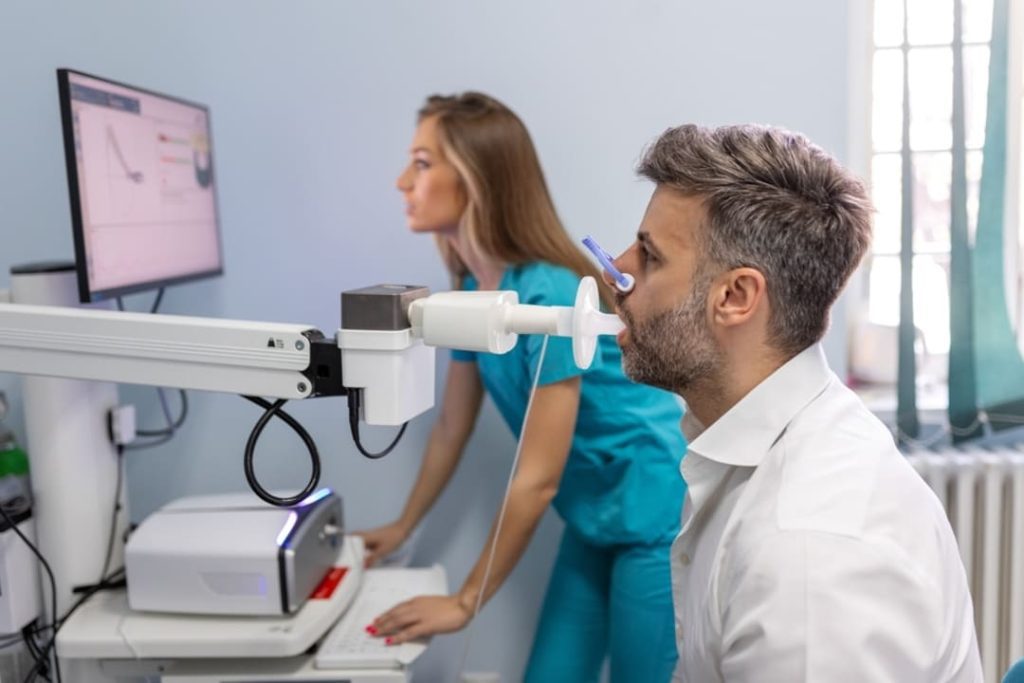
A pulmonary function test (PFT) is a non-invasive breathing test that evaluates how well your lungs function. According to the Cleveland Clinic, PFTs measure airflow, lung volumes, and gas exchange efficiency.
Specifically, PFTs measure:
- How much air you can inhale and exhale
- How quickly you can move air out of your lungs
- How effectively oxygen passes from your lungs into your bloodstream
PFTs are commonly used to diagnose and monitor conditions such as asthma, chronic obstructive pulmonary disease (COPD), pulmonary fibrosis, and other respiratory disorders.
Many veterans develop these conditions due to service-related exposures such as burn pits or asbestos, which are recognized by the VA as risk factors for chronic lung disease.
Types of Pulmonary Function Tests Used by the VA
Pulmonary function testing includes several components, depending on the condition being evaluated.
Spirometry (FEV-1 and FVC)
Spirometry is the most common part of a PFT, and it measures how much air and how quickly you can exhale.
Key spirometry values include:
- FEV-1 (Forced Expiratory Volume in one second): How much air you can forcefully exhale in one second
- FVC (Forced Vital Capacity): The total amount of air you can exhale after a deep breath
- FEV-1/FVC ratio: Used to identify obstructive lung diseases like asthma or COPD
Lung Volume Testing
Lung volume tests measure how much air your lungs can hold at various stages of breathing. These tests help identify restrictive lung diseases that limit lung expansion.
Diffusion Capacity Test (DLCO)
DLCO measures how efficiently oxygen moves from the lungs into the bloodstream. The National Library of Medicine notes that reduced DLCO values are common in interstitial lung diseases such as pulmonary fibrosis and asbestosis.
How Does the VA Use Pulmonary Function Tests to Assign Disability Ratings?
The VA uses pulmonary function test results as objective medical evidence when assigning most VA respiratory ratings.
According to the VA, PFTs are a primary tool for evaluating the severity of lung impairment.
Post-Bronchodilator vs. Pre-Bronchodilator Results
VA examiners typically measure lung function before and after administering an inhaler or bronchodilator. The VA generally relies on post-bronchodilator results to reflect the veteran’s best possible functioning with treatment.
However, VA medical guidance allows for the use of pre-bronchodilator results as well.
Predicted Values vs. Actual Results Explained
VA disability ratings are based on percent predicted values, not raw numbers. Predicted values account for factors such as age, height, sex, and ethnicity, as outlined by the NIH.
This explains why two veterans with similar test results may receive different VA ratings.
VA Rating Ranges for Pulmonary Function Tests
The VA assigns disability ratings based on how reduced a veteran’s pulmonary function is compared to predicted normal values. These ranges are consistent with VA medical evaluation practices used during C&P exams.
General Rating Formula for Restrictive Lung Disease (DC 6840–6845)
| VA Rating | FEV-1 (% Predicted) | FEV-1/FVC (% Predicted) | DLCO (SB) (% Predicted) | Other Medical Findings |
| 100% | < 40% | < 40% | < 40% | Oxygen therapy, pulmonary hypertension, cor pulmonale, or acute respiratory failure |
| 60% | 40%–55% | 40%–55% | 40%–55% | Severe limitation with exertion |
| 30% | 56–70% | 56–70% | 56–65% | Daily inhaler or bronchodilator use |
| 10% | 71–80% | 71–80% | 66–80% | Intermittent inhaler use |
| 0% | > 80% | > 80% | > 80% | Symptoms present without measurable impairment |
These are clinical observations often seen with the PFT thresholds listed, but they are not part of the official criteria in 38 CFR §4.97.
General Rating Formula for Chronic Obstructive Pulmonary Disease (DC 6604)
| VA Rating | Criteria |
| 100% | FEV-1 less than 40% of predicted value, or; the ratio of Forced Expiratory Volume in one second to Forced Vital Capacity (FEV-1/FVC) less than 40%, or; Diffusion Capacity of the Lung for Carbon Monoxide by the Single Breath Method (DLCO (SB)) less than 40% predicted, or; maximum exercise capacity less than 15 ml/kg/min oxygen consumption (with cardiac or respiratory limitation), or; cor pulmonale (right heart failure), or; right ventricular hypertrophy, or; pulmonary hypertension (shown by Echo or cardiac catheterization), or; episode(s) of acute respiratory failure, or; requires outpatient oxygen therapy. |
| 60% | FEV-1 of 40% to 55% predicted, or; FEV-1/FVC of 40% to 55%, or; DLCO (SB) of 40% to 55% predicted, or; maximum oxygen consumption of 15 to 20 ml/kg/min (with cardiorespiratory limit) |
| 30% | FEV-1 of 56% to 70% predicted, or; FEV-1/FVC of 56% to 70%, or; DLCO (SB) 56% to 65% predicted |
| 10% | FEV-1 of 71% to 80% predicted, or; FEV-1/FVC of 71% to 80%, or; DLCO (SB) 66% to 80% predicted |
VA Medical Guidance Notes:
- The VA uses the single test value that results in the highest rating
- Veterans only need to meet one qualifying metric
- Some severe respiratory conditions may qualify without PFTs
Related: Interstitial Lung Disease VA Ratings Explained
What Does it Mean to “Fail” a Pulmonary Function Test for VA Disability?

There is no official “pass” or “fail” score for pulmonary function tests. Abnormal PFT results simply show reduced lung function.
For VA disability purposes, abnormal results may show:
- Obstructive lung disease (low FEV-1 or FEV-1/FVC ratio)
- Restrictive lung disease (reduced FVC or DLCO)
- Severe impairment that may qualify for higher disability ratings
If these findings are linked to a service-connected condition, they can strengthen a VA claim.
What VA Respiratory Conditions Require a Pulmonary Function Test?
Most VA respiratory claims require PFTs as part of a VA compensation and pension (C&P) exam, according to VA medical evaluation guidance.
Common Service-Connected Conditions Evaluated with PFTs
- Emphysema
- Pulmonary fibrosis and other interstitial lung diseases
Related Resource: List of VA Ratings by Condition
When the VA May Not Require a PFT
According to VA medical standards, a PFT may not be required when:
- Continuous oxygen therapy is medically necessary
- Pulmonary hypertension or cor pulmonale is present
- There has been acute respiratory failure
How to Prepare for a VA Pulmonary Function Test (C&P Exam)
To ensure accurate results, the VA and Cleveland Clinic recommend:
- Avoid smoking before the test
- Avoid heavy meals
- Wear loose-fitting clothing
- Inform the examiner of medications or recent illnesses
Always give your best effort — VA ratings rely heavily on test accuracy.
What to Expect During and After Your VA PFT
Pulmonary function tests usually take 15 to 45 minutes. You’ll wear a nose clip and breathe into a mouthpiece while following instructions from a trained technician.
Results are typically available immediately, but must be interpreted by a medical professional. Abnormal findings may directly support a higher VA disability rating.
Conclusion
Pulmonary function tests play a vital role in VA disability claims for respiratory conditions.
Understanding how the VA evaluates PFT results through specific PFT values, such as FEV-1, FEV-1/FVC ratio, and DLCO, to assign disability ratings ranging from 0% to 100% gives you an advantage when preparing for exams and building medical evidence.
For a complete breakdown of respiratory VA claims and how exposure-related illnesses are evaluated, read VA Respiratory Ratings: The Complete Guide for Veterans.
Want Expert-Level Support for Your VA Disability Claim? WE GOT YOUR SIX!
- VA Claims Insider is the #1 most trusted name in VA disability claims.
- Work directly with a VA claims coach who can educate you through the claims process.
- 25,000+ disabled veterans have served in our membership programs since 2016.
- 30% average rating increase for veterans who complete our #1-rated Elite program.
- 4.7/5.0 average rating out of 6,000+ total reviews; over 5,000 5-star reviews.
FAQs | Frequently Asked Questions
What is the purpose of a pulmonary function test in VA claims?
The purpose of a PFT for VA disability claims is to provide objective medical evidence of lung impairment, which the VA uses to assign disability ratings.
Do all VA respiratory disability claims require a PFT?
No, not all VA respiratory disability claims require a pulmonary function test. Some veterans qualify for higher ratings based on severe complications and symptoms without completing PFTs.
Does the VA use pre- or post-bronchodilator results for PFTs?
While both pre- and post-bronchodilator (inhaler) results are recorded during a pulmonary function test, the VA generally uses post-bronchodilator results unless medical guidance indicates otherwise.
Can abnormal PFT results increase my VA rating?
Yes. If your PFT results show lower FEV-1, FEV-1/FVC, or DLCO values, you may qualify for a higher VA disability rating.
Content Reviewed By

Quality Assurance Team
The Quality Assurance (QA) team at VA Claims Insider has extensive experience researching, fact-checking, and ensuring accuracy in all produced content. The QA team consists of individuals with specialized knowledge in the VA disability claims adjudication processes, laws and regulations, and they understand the needs of our target audience. Any changes or suggestions the QA team makes are thoroughly reviewed and incorporated into the content by our writers and creators.
About the Author

Katie McCarthy
Katie McCarthy is a writer and editor with experience in daily news and digital and print magazine publishing. She honed her editorial (and firearms) skills at Guns & Ammo before helping launch Black Rifle Coffee Company’s Coffee or Die Magazine as the managing editor. She holds degrees in English (BA) and public administration (MPA). Katie is a military spouse and word nerd who enjoys reading, hiking, camping, gardening, and spending time with her family.