 go.vaclaimsinsider.com
Looking for Expert-Level VA Claim Answers? Schedule a Call
The history of VA is really the history of America learning a hard truth: when a nation sends men and women to war, the cost does not end when the shooting stops.
It continues in the body.
It continues in the mind.
It continues in the family.
It continues in the veteran’s ability to work, sleep, think, move, breathe, connect, and live.
That is why VA exists.
Not as charity.
Not as welfare.
Not as a government handout.
VA exists because veterans earned care, compensation, and support through military service and sacrifice.
Today, VA provides health care, disability compensation, education benefits, home loan support, pensions, burial benefits, and other services for veterans and their families. But the system we know today took nearly 400 years to build.
And if you’re a veteran, this history matters.
Because it proves something important:
You are not asking for special treatment. You are pursuing the benefits you earned because service changed your life—and America made a promise to honor that sacrifice.
Table of Contents
Summary of Key Points
- VA exists because military service has lifelong consequences. America built VA to provide earned care, compensation, benefits, and support for veterans whose service affected their health, family, work, and future.
- The promise to serve veterans developed over centuries. From colonial-era support in 1636, to Revolutionary War pensions, Civil War soldiers’ homes, the 1930 Veterans Administration, and the 1989 cabinet-level Department of Veterans Affairs, the system evolved war by war.
- Major wars forced major expansions in veteran care. The Civil War helped create veteran homes and national cemeteries, World War I shaped modern benefits and medical care, World War II produced the GI Bill®, and Vietnam pushed VA to better address Agent Orange, Vet Centers, PTSD, and invisible wounds.
- VA benefits are earned, not handouts. Disability compensation, health care, education, home loans, burial benefits, and survivor support exist because generations of veterans served, sacrificed, and fought to make America keep its promise.
Veterans Benefits Started Before America Was Even America
The roots of VA go all the way back to 1636, when the Pilgrims of Plymouth Colony passed a law to support disabled soldiers. VA has described this as one of the earliest roots of today’s veteran support system.
That means the idea of caring for disabled veterans is older than the United States itself.
Before there was a Constitution, before there was a federal government, and long before there was a Department of Veterans Affairs, Americans understood a simple truth: military service could leave a person wounded, disabled, or unable to provide for themselves and their family.
Early America did not yet have a clean system.
There was no VA regional office.
No VA.gov.
No Veterans Benefits Administration.
No C&P exams.
No disability rating schedule.
But the principle was already there: if a person was wounded in service, the community had some responsibility to help.
That responsibility first fell to colonies, then states, and eventually the federal government.
Revolutionary War Veterans Had to Fight for What They Were Promised
During the Revolutionary War, the Continental Congress promised pensions to disabled soldiers. VA history notes that, in 1776, the Continental Congress passed the first national pension law for soldiers permanently disabled during the Revolutionary War.
That sounds good.
But here’s the problem: promises are easy to make during war.
They are harder to keep after the war is over.
The new nation was broke. The federal government was weak. And many Revolutionary War veterans struggled to receive what they had been promised.
This created bitterness.
And it created a debate that still echoes today.
Some people believed veterans deserved support because they had sacrificed for the nation.
Others saw pensions as a government handout.
That fight over how America should care for veterans started at the beginning of the republic.
It has never fully gone away.
Even today, some people, including veterans, misunderstand VA disability compensation. They act like veterans are getting something they did not earn.
That is false.
VA disability compensation exists because military service can cause or worsen conditions of the body or mind that limit a veteran’s ability to function in everyday work and life. The VA rating system is built to compensate for the average impairment in civilian earning capacity caused by service-connected disabilities.
The 1800s: America Slowly Builds a Veterans Benefits System
After the Constitution was formally adopted, the federal government began taking more responsibility for veteran pensions.
In the 1790s, the roots of what became the Veterans Benefits Administration began when the War Department created a small office to administer pensions awarded to Revolutionary War veterans. The Pension Bureau later became part of the Department of the Interior in 1849 and remained there until 1930.
That matters because it shows the benefits side of VA did not begin in the 20th century.
The modern VBA has deep roots.
It started with pensions.
Then it expanded to widows.
Then dependents.
Then disability compensation.
Then education.
Then home loans.
Then vocational rehabilitation.
Then insurance.
Then modern claims processing.
Step by step, America created a benefits system because veterans and their families kept paying the price of war long after the war ended.
The Civil War Changed Everything
The Civil War was one of the biggest turning points in the history of serving veterans. The scale of suffering was massive. Hundreds of thousands died. Many more came home wounded, disabled, sick, traumatized, or unable to work.
The federal government could no longer pretend veterans only needed a pension check.
They needed care.
They needed housing.
They needed burial.
They needed medical support.
The predecessors of both the Veterans Health Administration and the National Cemetery Administration grew out of the urgent need created by the Civil War. Congress authorized President Abraham Lincoln to purchase land for national cemeteries in 1862, and the large Army-run cemetery system was formalized in 1867.
Then, on March 3, 1865, President Lincoln signed legislation establishing a National Soldiers and Sailors Asylum. It was later renamed the National Home for Disabled Volunteer Soldiers. VA history describes it as the first government institution created specifically for honorably discharged volunteer soldiers. The first National Home opened in Togus, Maine, in 1866.
This was huge.
For the first time, the federal government created a large-scale system designed to house and care for disabled veterans.
These homes were not modern VA hospitals yet.
But they were the foundation.
They provided medical care.
They provided housing.
They provided community.
They provided structure.
And they helped shape what later became the Veterans Health Administration.
One important accuracy point: these homes initially served Union veterans, including U.S. Colored Troops. They did not serve all Civil War veterans equally at the beginning. Like much of American history, the history of veteran care includes both progress and exclusion.
Lincoln’s Promise: “To Care for Him Who Shall Have Borne the Battle”
No discussion of VA history is complete without President Abraham Lincoln’s famous words from his Second Inaugural Address: “To care for him who shall have borne the battle and for his widow, and his orphan.”
That line became one of the moral foundations of America’s duty to veterans.
It says something powerful.
The nation’s duty does not just end with the veteran.
It extends to the widow.
The orphan.
The family.
The survivors.
That is why VA benefits include more than disability compensation.
VA also includes survivor benefits, burial benefits, health care, education, home loan support, pensions, and other forms of assistance.
Because military service affects the entire family.
Civil War Pensions Became One of America’s Largest Benefit Systems
After the Civil War, the pension system exploded.
VA history notes that from 1863 to 1888, the Pension Bureau received an average of 40,000 applications per year from Union veterans or their survivors. An 1890 law expanded eligibility even further, and within a decade pension numbers more than tripled from 303,000 in 1883 to 966,000 in 1893. Pension spending routinely consumed more than 30% of the federal budget in the 1890s.
That is stunning.
Before Social Security.
Before Medicare.
Before the modern welfare state.
Veterans benefits were already one of the largest federal benefit systems in America.
And the same debates existed then that exist now:
- Who qualifies?
- What evidence is required?
- How much should be paid?
- How do you prevent fraud without punishing real veterans?
- How do you process claims fairly and quickly?
- How do you define disability?
- How do you care for visible and invisible wounds?
These are not new questions.
They are baked into the history of VA.
World War I Created the Modern Shape of VA
World War I pushed America into the modern era of veterans benefits because the war produced injuries and illnesses the old pension system was not built to handle: shell shock, chemical warfare exposure, amputations, tuberculosis, rehabilitation needs, and long-term disabilities that followed veterans home long after the battlefield.
Congress responded by expanding benefits to include disability compensation, insurance, and vocational rehabilitation. VA history explains that these programs were originally managed by multiple offices, including the Bureau of War Risk Insurance, the Federal Board of Vocational Education, and the Public Health Service.
But the system was fragmented.
So, on August 9, 1921, many of these programs were consolidated under the Veterans’ Bureau.
That was another major step toward modern VA.
The Veterans’ Bureau helped decentralize services, expand access, build hospitals, and provide more specialized care for veterans with conditions like tuberculosis and neuropsychiatric problems.
America was finally realizing veterans needed more than a check.
They needed a coordinated system.
1930: The Veterans Administration Is Born
The biggest structural turning point came on July 21, 1930.
That is when President Herbert Hoover signed Executive Order 5398, establishing the Veterans’ Administration, the forerunner of today’s Department of Veterans Affairs. Hoover’s order consolidated three separate organizations: the National Home for Disabled Volunteer Soldiers, the Bureau of Pensions, and the Veterans’ Bureau.
For the first time in American history, one independent federal agency became responsible for managing benefits and medical services for veterans of all wars.
That is the birth of the modern VA structure.
Not perfect.
Not simple.
Not free from controversy.
But centralized.
Before 1930, veteran services were scattered across multiple offices and departments.
After 1930, veterans had one federal agency responsible for benefits and medical care.
That was a major shift in how America viewed its obligation to those who served.
The Bonus Army: A Painful Reminder That Veterans Still Had to Fight
VA’s creation did not end veteran struggle.
During the Great Depression, many World War I veterans were unemployed, hungry, and desperate.
They had been promised bonus payments, but those payments were not scheduled to be paid until years later. So thousands of veterans marched on Washington, D.C., demanding early payment.
They became known as the Bonus Army.
VA history notes that President Hoover sent in the Army to restore order, leading to a confrontation in Washington captured in photos and newsreel footage.
The Bonus Army is one of the most painful chapters in veterans affairs history.
It reminds us that even after VA was created, veterans still had to push, organize, advocate, and fight to receive what they believed they had earned.
That is still true today.
Veterans should not have to fight the system.
But many still do.
World War II and the GI Bill® Changed America
World War II created another massive test.
More than 16 million Americans served in World War II and became eligible for benefits after discharge. The Servicemen’s Readjustment Act of 1944, better known as the GI Bill®, was signed by President Franklin D. Roosevelt on June 22, 1944. It expanded benefits to include education, home and business loans, and unemployment compensation.
The GI Bill® changed everything.
It helped veterans go to college.
It helped them buy homes.
It helped them start businesses.
It helped them transition back into civilian life.
It helped build the American middle class.
This is one of the clearest examples in history that serving veterans is not just morally right.
It is nationally smart.
When veterans win, America wins.
When veterans get education, they build careers.
When veterans buy homes, they build communities.
When veterans start businesses, they create jobs.
When veterans receive health care, they can live, lead, and contribute.
The GI Bill® proved that investing in veterans is one of the best investments America can make.
VA Health Care Becomes a Modern Medical System
After World War II, VA health care transformed again.
VA history states that Public Law 79-293, the Department of Medicine and Surgery Act, signed by President Harry Truman in 1946, drove further modernization and expansion of VA’s medical system and partnerships with research universities.
That helped VA become more than a hospital system.
It became a medical training, research, and innovation system.
VA history notes that, in the 1960s, VA medical professionals invented the first clinically successful implantable cardiac pacemaker, pioneered concepts that contributed to computerized axial tomography, commonly known as the CAT scan, and performed the first successful liver transplants.
That is something many Americans do not know.
The effort to care for veterans has advanced medicine for everyone.
Veterans helped drive innovations in rehabilitation, prosthetics, spinal cord injury treatment, mental health, cancer research, suicide prevention, and more.
America’s duty to veterans has made America better.
Vietnam Veterans Forced America to Confront Invisible Wounds
The Vietnam War changed the conversation again.
Many Vietnam veterans came home to a country that did not properly welcome them, understand them, or support them.
They carried visible wounds.
They carried invisible wounds.
They carried exposure concerns.
They carried moral injury, readjustment challenges, PTSD symptoms, and the weight of a war many Americans wanted to forget.
VA eventually adapted.
VA history notes that in 1978, VA began offering special access to medical care, including physical exams, for Vietnam veterans exposed to Agent Orange. In 1979, VA launched Operation Outreach to establish community-based Vet Centers for mental health and readjustment counseling. The National Center for PTSD was created within VA in 1989.
This matters.
Because Vietnam taught America something it should never forget:
Not all wounds bleed.
PTSD can be disabling.
Depression can be disabling.
Anxiety can be disabling.
Toxic exposure can be disabling.
Chronic pain can be disabling.
Moral injury can wreck a person’s life.
The Vietnam era forced the VA system to better recognize the mental, emotional, and toxic exposure consequences of service.
And that fight continues today.
1989: VA Becomes a Cabinet-Level Department
In 1988, President Ronald Reagan signed the Department of Veterans Affairs Act, elevating the Veterans Administration to a cabinet-level department and redesignating it as the Department of Veterans Affairs. The law took full effect in 1989 under President George H.W. Bush.
That was a major milestone.
Veterans issues now had a seat at the highest level of federal government.
The change also reflected how large and important the mission had become.
By then, VA was not just processing pensions.
It was managing health care, compensation, education, insurance, home loans, burial benefits, research, hospitals, cemeteries, and more.
Today, VA operates through three major administrations:
- The Veterans Health Administration
- The Veterans Benefits Administration
- The National Cemetery Administration
Each one has its own history.
Each one exists because veterans needed the country to keep its promise.
The Modern VA: Massive Mission, Massive Responsibility
Today’s VA is massive.
VA describes the Veterans Health Administration as the nation’s largest health care system, delivering care to more than 9.1 million enrolled veterans through 1,380 health care facilities, including 170 VA medical centers and 1,193 outpatient sites of care.
That scale is necessary.
But it also creates challenges.
- Long waits
- Complex rules
- Backlogs
- Bad exams
- Inconsistent decisions
- Denied claims
- Underrated conditions
- Confusing forms
- Veterans getting lost in the system
Let’s be honest: VA has done tremendous good.
And VA has also failed many veterans.
Both things are true.
The right answer is not to pretend the system is perfect.
The right answer is to understand the system, use the system, improve the system, and make sure veterans know how to fight for the benefits they’ve earned.
The PACT Act: The Promise Keeps Expanding
The PACT Act is one of the biggest modern chapters in VA history.
VA describes the PACT Act as a law that expands VA health care and benefits for veterans exposed to burn pits, Agent Orange, and other toxic substances. VA also calls it “perhaps the largest health care and benefit expansion in VA history.”
The PACT Act expanded eligibility for VA health care for many veterans with toxic exposures, added more than 20 presumptive conditions for burn pits, Agent Orange, and other toxic exposures, and requires toxic exposure screenings for veterans enrolled in VA health care.
This is the same pattern we have seen throughout VA history.
Veterans serve.
Veterans come home.
Symptoms show up.
The system resists.
Veterans fight to be believed.
Science catches up.
The law changes.
It happened with Civil War wounds.
It happened with World War I rehabilitation.
It happened with Agent Orange.
It happened with Gulf War illness.
It happened with burn pits.
And it will happen again.
Because every war creates its own signature wounds.
Why the History of VA Matters to Veterans Today
The history of VA matters because it gives veterans context.
You are not the first generation to fight for benefits.
You are not the first generation to deal with bureaucracy.
You are not the first generation to be told “no.”
You are not the first generation to need stronger evidence.
You are part of a long line of veterans who served, came home, and had to prove the cost of that service.
That should not discourage you.
It should strengthen you.
Because VA was built for one reason: to keep America’s promise to those who served.
It exists because veterans before you fought to build it.
If you have a disability caused or worsened by your military service, you deserve to understand your options.
You deserve to know what evidence matters and how VA decides claims.
You deserve to know the difference between symptoms, diagnosis, nexus, severity, and functional impairment.
You deserve to know that “denied” does not always mean “done.”
And you deserve to know that your rating should reflect the true severity of your condition and how it impacts your work, life, and social functioning.
Final Thoughts
The history of VA and serving veterans is not just a government timeline.
It is the story of America slowly learning how to care for the men and women who carried the burden of war.
From Plymouth Colony in 1636, to Revolutionary War pensions, to Civil War soldiers’ homes, to the Veterans Administration in 1930, to the GI Bill® in 1944, to cabinet-level VA in 1989, to the PACT Act today, the mission has continued to evolve.
But the core promise has not changed:
If you served this country, and your service changed your life, America has a duty to care for you.
That does not mean every claim gets approved.
It does not mean evidence does not matter.
It does not mean the VA process is easy.
But it does mean this:
VA benefits are not a handout.
They are earned.
They are part of the cost of war.
And they exist because generations of veterans refused to let America forget what service really costs.
You SERVED. You DESERVE.
Sources
- U.S. Department of Veterans Affairs — VA History Overview
- U.S. Department of Veterans Affairs — Veterans Administration Seal and 1930 Consolidation
- U.S. Department of Veterans Affairs — Veterans Benefits Administration History
- U.S. Department of Veterans Affairs — Creation of the Department of Veterans Affairs
- VA.gov — About the Veterans Health Administration
- VA.gov — The PACT Act and Your VA Benefits
- Pensions for Veterans Were Once Viewed as Government Handouts
No Veteran Should Have to Fight the VA Alone
Our WHY:
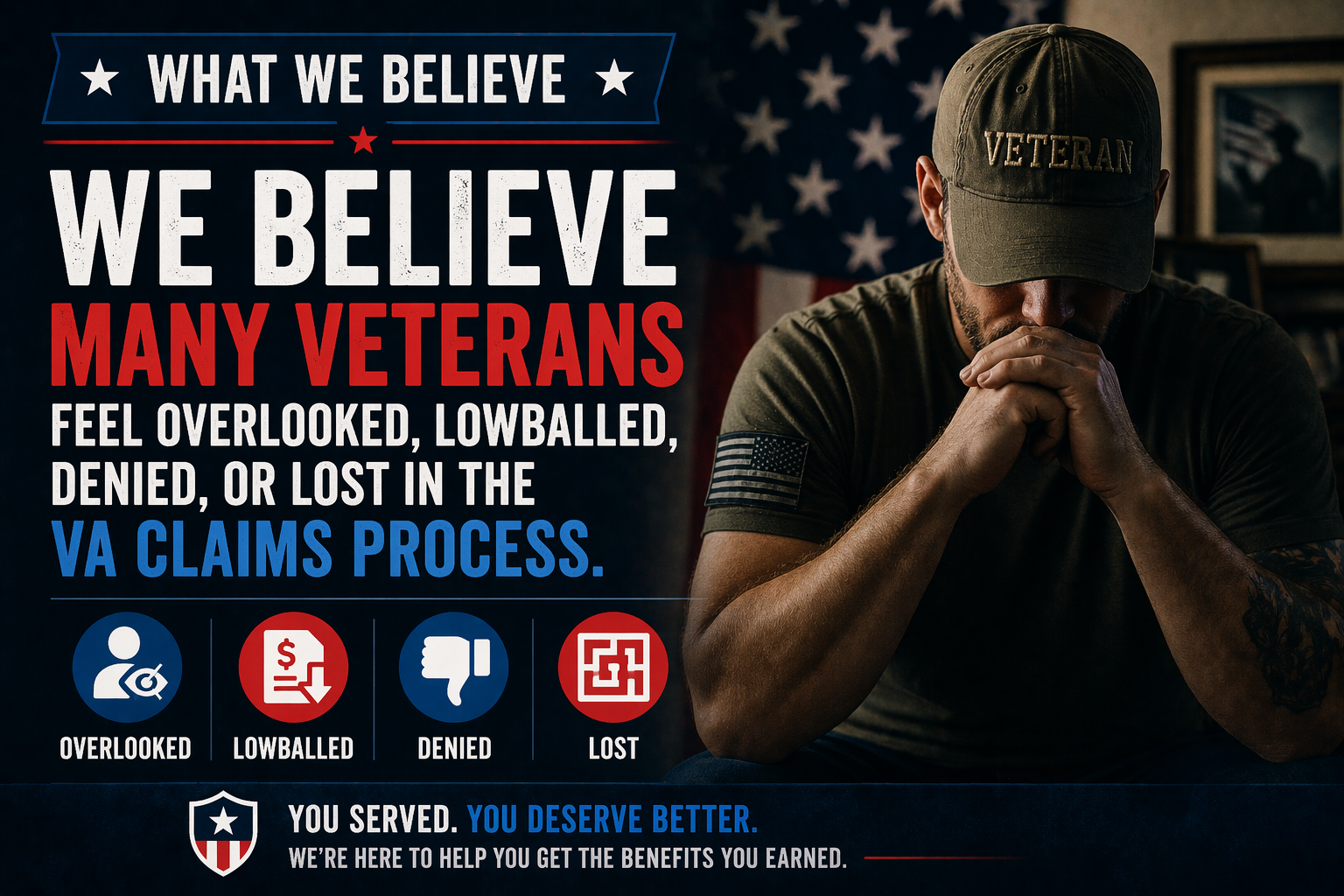
We believe millions of veterans feel overlooked, lowballed, denied, or lost in the VA claims process.
Our purpose is to help underrated disabled veterans rated 0% to 90% create real life change by pursuing the VA disability benefits they legally, morally, ethically, and medically deserve.
We are INSIDERS.
Our HOW:
We make the VA disability process easier through expert-level education, proven resources, and veteran-to-veteran support.
You are never alone in this fight.
Our flagship program, VA Claims Insider Elite, connects each veteran with an expert-level Veteran Coach who guides them through our proprietary 8-step process.
That process is built around our SEM Method:
Strategy + Education + Medical Evidence = VA Rating You Deserve!
Our WHAT:
We help underrated disabled veterans rated 0% to 90% win, service connect, and increase their VA rating through a smarter strategy, better education, and stronger medical evidence.
Veterans: Do You Have the VA Rating You Were Given—or the VA Rating You Deserve?

Do you have the VA rating you were given…or the VA rating you actually deserve?
Because getting a decision from the VA does not always mean you got the right decision from the VA.
If you are rated anywhere from 0% to 90% and feel stuck, frustrated, underrated, denied, or overlooked, I am speaking directly to you.
And if you have never filed because you thought other veterans deserved it more, because you got denied before, or because you assumed it was too late, do not let those myths make your decision for you.
At VA Claims Insider, we help underrated disabled veterans create real life change by getting the VA rating and compensation they deserve!
Here’s a sliver of what you get when you join us:
- A Veteran Coach by your side, so you never have to fight the VA alone.
- A smarter, personalized strategy for your claim.
- Better VA disability education, so you know what to do next.
- Stronger private medical evidence (DBQs, Nexus Letters, Mental Health Evaluations, and more) at members-only rates to support the rating you deserve.
- And a proven battle plan toward VA claim victory.
But maybe you’re wondering: Will this actually work for me?
That is a fair question.
- At VA Claims Insider, we have helped 50,000+ veterans fight for the VA disability benefits they earned.
- Our internal data shows an average *33% VA rating increase for veterans who complete our Elite program.
- Our internal data also shows veterans in our programs get their claims approved *25% faster on average than the VA’s published average claim-processing timelines.
- Veterans in our community have left 7,000+ total reviews, with a 4.6 out of 5 average rating.
- More than 5,500 reviews are 5 stars ⭐⭐⭐⭐⭐, and 92% of all veteran customer reviews are either 4 or 5 stars.
*Based on VA Claims Insider internal data for veterans who completed the Elite program. Average results shown; individual results vary. No guaranteed outcome or faster claim processing.
If you are ready for a better battle plan, a smarter strategy, and the right path to the VA rating and compensation you deserve, we’ve got your six.
📞 Click the red button below to get started:
Content Reviewed By

Quality Assurance Team
The Quality Assurance (QA) team at VA Claims Insider has extensive experience researching, fact-checking, and ensuring accuracy in all produced content. The QA team consists of individuals with specialized knowledge in the VA disability claims adjudication processes, laws and regulations, and they understand the needs of our target audience. Any changes or suggestions the QA team makes are thoroughly reviewed and incorporated into the content by our writers and creators.
About The Author

Brian Reese
Brian Reese is a world-renowned VA disability benefits expert and the #1 bestselling author of VA Claim Secrets and You Deserve It. Motivated by his own frustration with the VA claim process, Brian founded VA Claims Insider to help disabled veterans secure their VA disability compensation faster, regardless of their past struggles with the VA. Since 2013, he has positively impacted the lives of over 10 million military, veterans, and their families.
A former active-duty Air Force officer, Brian has extensive experience leading diverse teams in challenging international environments, including a combat tour in Afghanistan in 2011 supporting Operation ENDURING FREEDOM.
Brian is a Distinguished Graduate of Management from the United States Air Force Academy and earned his MBA from Oklahoma State University’s Spears School of Business, where he was a National Honor Scholar, ranking in the top 1% of his class.