 go.vaclaimsinsider.com
Looking for Expert-Level VA Claim Answers? Schedule a Call
VA does not currently give a separate disability rating for moral injury.
But moral injury can still matter a lot in your VA disability claim.
Here’s why:
VA does not rate “moral injury” by name. VA rates diagnosed mental health conditions such as PTSD, depression, anxiety, adjustment disorder, and other trauma-related mental health conditions.
But here’s the part most veterans miss:
Moral injury can increase the severity of symptoms in a ratable mental health condition, which may help support a higher VA rating percentage.
That’s the key.
Moral injury is not the separate VA rating. But it can help explain why your PTSD, depression, anxiety, anger, isolation, suicidal ideation, shame, guilt, or relationship problems are worse than VA realizes.
VA mental health ratings are based on occupational and social impairment, meaning how your symptoms negatively impact your work, relationships, judgment, thinking, mood, and daily life. VA also requires mental disorder diagnoses to conform to DSM-5 or be supported by exam findings.
Okay, let’s explore moral injury and veterans benefits in more detail.
Table of Contents
Summary of Key Points
- VA does not rate moral injury by itself. Moral injury is not a standalone VA mental health rating, but it can support a claim for a diagnosed condition such as PTSD, depression, anxiety, or adjustment disorder.
- Moral injury can increase symptom severity. Guilt, shame, betrayal, anger, isolation, suicidal ideation, and self-condemnation can make another ratable mental health condition worse and potentially support a higher VA rating. For example, moral injury symptoms could help support a 70% PTSD rating if they cause occupational and social impairment with deficiencies in most areas.
- VA rates functional impairment, not just the diagnosis. The key question is how your symptoms affect your work, relationships, judgment, mood, thinking, behavior, and daily life.
- Strong medical evidence wins VA claims. A current diagnosis, in-service event, medical nexus, symptom severity, and clear explanation of functional impairment are critical to getting properly service connected and rated.
What Is Moral Injury in Veterans?
Moral injury is the lasting wound to a veteran’s conscience, identity, and sense of meaning after military service forces them to witness, participate in, fail to prevent, or feel betrayed by events that violate what they believe is right, good, honorable, or human.
Put simply:
Moral injury is what happens when a veteran survives the mission, but comes home carrying the moral weight of what happened.
- It can come from what you did.
- What you saw.
- What you couldn’t stop.
- Who you couldn’t save.
- Or how you were betrayed by leaders, peers, or the institution you trusted.
It’s not just fear. It’s not just stress. It’s not just trauma.
It’s guilt. Shame. Betrayal. Anger. Self-condemnation. Loss of trust. Loss of meaning. Sometimes, it’s a spiritual crisis.
- A veteran with PTSD might think: “I’m not safe.”
- A veteran with moral injury might think: “I’m not good.”
That’s the difference.
VA explains that moral injury can occur when someone takes part in, fails to prevent, or witnesses something that violates deeply held morals or values. For veterans, the emotional, social, behavioral, and spiritual fallout can show up as guilt, shame, anger, isolation, self-sabotage, relationship problems, depression, PTSD symptoms, and trouble functioning in daily life.
What Moral Injury Feels Like for Veterans
Moral injury often feels like this:
- “I should have done more.”
- “I should have stopped it.”
- “I followed orders, but it still feels wrong.”
- “I survived, and they didn’t.”
- “I can’t forgive myself.”
- “Leadership failed us.”
- “I don’t deserve peace.”
- “I don’t know who I am anymore.”
For some veterans, moral injury comes from what they did.
For others, it comes from what they saw.
For others, it comes from what they could not prevent.
For many, it comes from betrayal by leaders, peers, or institutions they trusted.
Examples of Moral Injury in Veterans
Moral injury can come from what a veteran did, saw, couldn’t stop, couldn’t save, or how they were betrayed during service.
Example #1: The Veteran Who Couldn’t Save Someone
A veteran may carry deep guilt after being unable to save a fellow service member, civilian, child, patient, or friend.
They may think:
“I should have done more.”
“Why did I survive and they didn’t?”
Over time, that guilt can become shame, depression, isolation, anger, sleep problems, suicidal ideation, or feeling unworthy of peace.
Example #2: The Veteran Who Feels Betrayed
A veteran may experience moral injury after being ordered to do something that felt wrong, witnessing misconduct that was ignored, or feeling abandoned by leadership.
They may think:
“I followed orders, but it still feels wrong.”
“The people who were supposed to protect us failed us.”
That betrayal can lead to anger, loss of trust, relationship problems, isolation, self-sabotage, and trouble working with supervisors or coworkers.
For VA claims, these details matter because moral injury can worsen a ratable mental health condition like PTSD, depression, anxiety, or adjustment disorder.
Moral Injury vs. PTSD
Moral injury and PTSD can overlap, but they are not the same thing:
- PTSD is often fear-based.
- Moral injury is often guilt-, shame-, or betrayal-based.
PTSD often says: “I’m not safe.”
Moral injury often says: “I’m not good.”
This matters for VA claims because moral injury is not a diagnosis by itself. VA says moral injury can occur with PTSD and depression, and when moral injury exists with PTSD, symptoms may be more severe.
That is the rating angle.
Moral injury may not be ratable by itself, but it can help prove your ratable mental health condition is worse.
Does VA Rate Moral Injury as PTSD?
Not necessarily.
Sometimes moral injury shows up inside a PTSD claim.
But moral injury is not “just PTSD.”
A better way to say it is:
Moral injury is not a standalone VA rating, but it can support service connection and increased rating severity for a diagnosed mental health condition such as PTSD, depression, anxiety, or adjustment disorder.
VA’s mental health rating schedule lists PTSD under Diagnostic Code 9411. It also lists ratable conditions such as generalized anxiety disorder, panic disorder, major depressive disorder, unspecified depressive disorder, and chronic adjustment disorder. Moral injury is not listed as its own diagnostic code.
So don’t file a claim that only says:
“Moral injury.”
A stronger claim sounds like:
- “PTSD with moral injury symptoms.”
- “Major depressive disorder related to guilt, shame, and betrayal from military service.”
- “Anxiety disorder related to traumatic and morally injurious experiences during service.”
The diagnosis gives VA something to rate.
The moral injury helps explain the cause, severity, and impact.
VA Ratings for Moral Injury
VA uses the Mental Health Rating Chart under 38 CFR § 4.130 to rate mental health conditions from 0% to 100%, with other rating levels at 10%, 30%, 50%, and 70%. Moral injury is not rated separately, but it may show up as part of another ratable mental health condition, such as PTSD, depression, anxiety, or adjustment disorder, among others.
| Level of Occupational and Social Impairment and Approximate Severity of Symptoms | VA Rating |
|---|---|
| Total occupational and social impairment, due to such symptoms as: gross impairment in thought processes or communication; persistent delusions or hallucinations; grossly inappropriate behavior; persistent danger of hurting self or others; intermittent inability to perform activities of daily living (including maintenance of minimal personal hygiene); disorientation to time or place; memory loss for names of close relatives, own occupation, or own name. | 100% |
| Occupational and social impairment, with deficiencies in most areas, such as work, school, family relations, judgment, thinking, or mood, due to such symptoms as: suicidal ideation; obsessional rituals which interfere with routine activities; speech intermittently illogical, obscure, or irrelevant; near-continuous panic or depression affecting the ability to function independently, appropriately and effectively; impaired impulse control (such as unprovoked irritability with periods of violence); spatial disorientation; neglect of personal appearance and hygiene; difficulty in adapting to stressful circumstances (including work or a worklike setting); inability to establish and maintain effective relationships. | 70% |
| Occupational and social impairment with reduced reliability and productivity due to such symptoms as: flattened affect; circumstantial, circumlocutory, or stereotyped speech; panic attacks more than once a week; difficulty in understanding complex commands; impairment of short- and long-term memory (e.g., retention of only highly learned material, forgetting to complete tasks); impaired judgment; impaired abstract thinking; disturbances of motivation and mood; difficulty in establishing and maintaining effective work and social relationships. | 50% |
| Occupational and social impairment with occasional decrease in work efficiency and intermittent periods of inability to perform occupational tasks (although generally functioning satisfactorily, with routine behavior, self-care, and conversation normal), due to such symptoms as: depressed mood, anxiety, suspiciousness, panic attacks (weekly or less often), chronic sleep impairment, mild memory loss (such as forgetting names, directions, recent events). | 30% |
| Occupational and social impairment due to mild or transient symptoms which decrease work efficiency and ability to perform occupational tasks only during periods of significant stress, or symptoms controlled by continuous medication. | 10% |
| A mental condition has been formally diagnosed, but symptoms are not severe enough either to interfere with occupational and social functioning or to require continuous medication. | 0% |
How Moral Injury Can Affect Your VA Rating Percentage for Mental Health
This is where veterans need to pay attention.
VA mental health ratings are: 0%, 10%, 30%, 50%, 70%, or 100%.
The percentage is not based only on your diagnosis.
It is based on how severe your symptoms are and how much they impair your work and social life.
That means moral injury can matter if it makes your symptoms worse.
For example, if moral injury causes guilt, shame, and self-condemnation that leads to isolation, failed relationships, suicidal ideation, anger outbursts, depression, substance use, or inability to handle stress, that can affect your VA rating.
If moral injury makes your PTSD or depression more severe, tell VA exactly how.
The real question is not:
“How bad was the event?”
The real question is:
“How badly does this condition affect your life now?”
That’s what VA rates.
Not the label.
The impairment.
How to Get Service Connected for Moral Injury-Related Mental Health Conditions
To win service connection, you generally need three things:
1. A Current Diagnosis
You need a diagnosed mental health condition.
Examples include PTSD, depression, anxiety, adjustment disorder, or another trauma-related condition.
Moral injury explains the wound. The diagnosis gives VA the disability that can be rated.
2. An In-Service Event
You need to explain what happened in service.
- What did you see?
- What did you do?
- What could you not stop?
- Who did you lose?
- Who betrayed you?
- What moment still follows you?
Do not overcomplicate it.
Tell your true story even if it’s painful to talk about.
3. A Medical Nexus
You need a link between your current mental health diagnosis and your military service.
A strong nexus should explain:
- What condition you have
- What happened in service
- How the morally injurious event contributed to your symptoms
- How those symptoms affect your work, relationships, and daily life
No nexus. No service connection. No benefits.
Pro Tips for Veterans and Moral Injury Claims
Don’t File for “Moral Injury” Alone
File for the diagnosed mental health condition, but not moral injury on its own.
Use moral injury to explain why it started, why it got worse, and how severe it is today.
Write a Strong Personal Statement
Answer five questions:
- What happened?
- Where and when did it happen?
- How did it violate your values?
- What symptoms started afterward?
- How does it affect you today?
Don’t make VA guess.
Connect the dots.
Talk About the Hard Stuff
Many veterans minimize guilt and shame.
Don’t.
If you feel like you don’t deserve happiness, say that.
If you can’t forgive yourself, say that.
If you don’t trust leaders, people, God, or yourself anymore, say that.
If you isolate because you feel unworthy, say that.
If you push away people who love you, say that.
Those symptoms matter.
Focus on Severity and Impairment
Your VA mental health rating comes from the severity of symptoms that cause functional impairment.
So explain how moral injury makes your condition worse in real life:
- Work
- Marriage
- Parenting
- Friendships
- Sleep
- Anger
- Trust
- Faith
- Motivation
- Hygiene
- Safety
VA does not live with you.
VA does not see your worst days.
You have to explain them.
Be Uncomfortably Vulnerable at the C&P Exam
This is not the time to “suck it up.”
Tell the examiner what life is really like.
- How often do symptoms happen?
- How severe are they?
- How long do they last?
- How do they affect your job, marriage, family, and ability to function?
Final Thoughts
So, can you get a VA rating for moral injury?
Not directly.
But moral injury can absolutely matter in your VA disability claim.
Here’s the bottom line:
Moral injury may not be the VA rating—but it can be the hidden driver that makes your PTSD, depression, anxiety, anger, isolation, shame, suicidal ideation, or occupational and social impairment worse.
And if your symptoms are worse, your VA rating percentage could be higher.
Don’t just tell VA what happened.
Tell VA how it changed you.
Tell VA how it worsened your mental health.
Tell VA how it affects your work, relationships, and daily life.
Because you served.
You deserve to be seen, heard, and properly rated.
Official Sources
- VA National Center for PTSD: Moral Injury and PTSD
- VA AboutFace: Moral Injury and PTSD
- VA National Center for PTSD: Moral Injury and Distress Scale
- 38 CFR § 4.125: Diagnosis of Mental Disorders
- 38 CFR § 4.126: Evaluation of Disability from Mental Disorders
- 38 CFR § 4.130: Schedule of Ratings—Mental Disorders
- 38 CFR § 3.304: Direct Service Connection and PTSD Claims
What We Believe
Our WHY
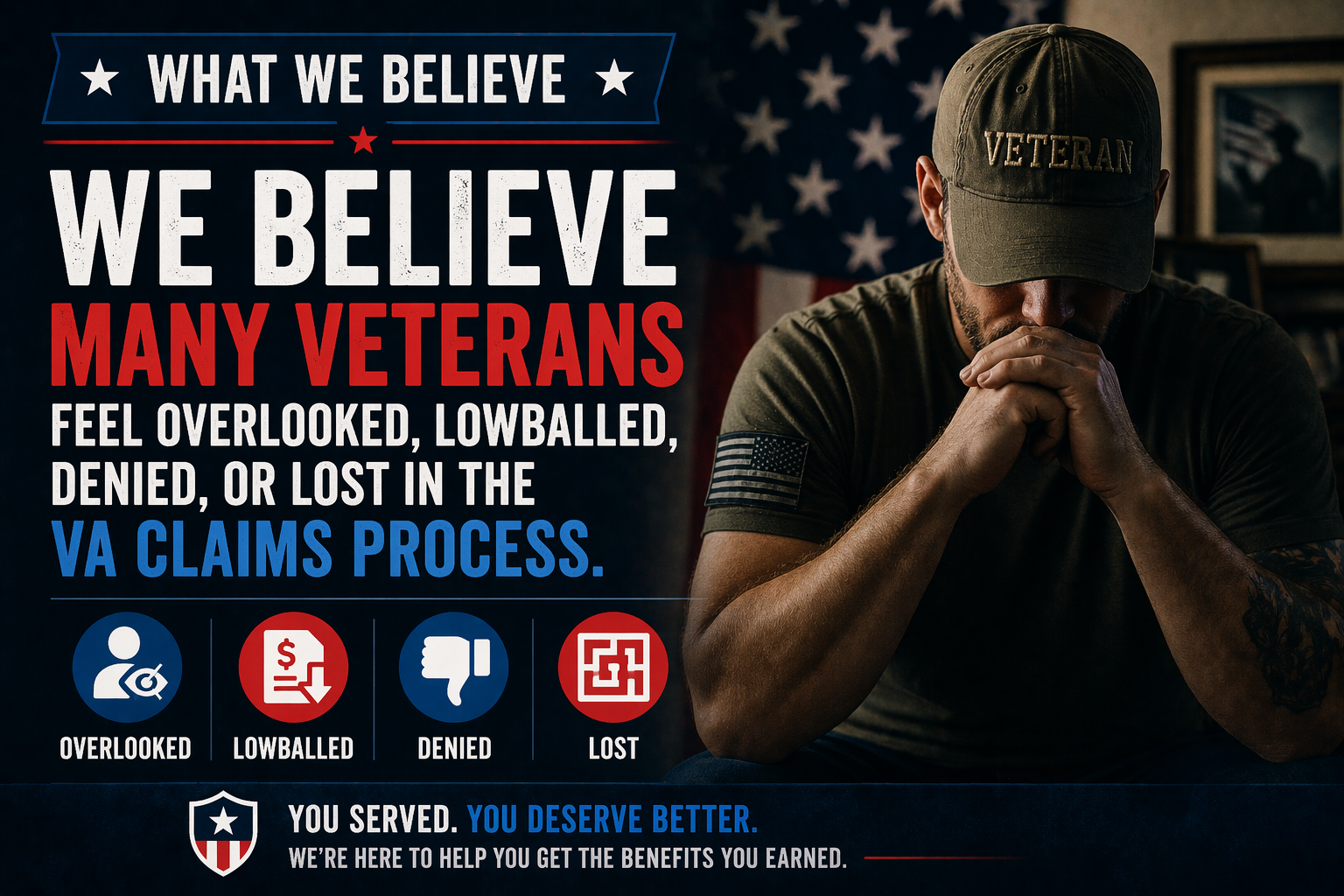
We believe millions of veterans feel overlooked, lowballed, denied, or lost in the VA claims process.
Our purpose is to help underrated disabled veterans rated 0% to 90% create real life change by pursuing the VA disability benefits they legally, morally, ethically, and medically deserve.
We are INSIDERS.
Our HOW
We make the VA disability process easier through expert-level education, proven resources, and veteran-to-veteran support.
You are never alone in this fight.
Our flagship program, VA Claims Insider Elite, connects each veteran with an expert-level Veteran Coach who guides them through our proprietary 8-step process.
That process is built around our SEM Method:
Strategy + Education + Medical Evidence = VA Rating You Deserve!
Our WHAT
We help underrated disabled veterans rated 0% to 90% win, service connect, and increase their VA rating through a smarter strategy, better education, and stronger medical evidence.
YOU SERVED. YOU DESERVE.

Do you have the VA rating you were given…or the VA rating you actually deserve?
Because getting a decision from the VA does not always mean you got the right decision from the VA.
If you are rated anywhere from 0% to 90% and feel stuck, frustrated, underrated, denied, or overlooked, I am speaking directly to you.
And if you have never filed because you thought other veterans deserved it more, because you got denied before, or because you assumed it was too late, do not let those myths make your decision for you.
At VA Claims Insider, we help underrated disabled veterans create real life change by getting the VA rating and compensation they deserve!
Here’s a sliver of what you get when you join us:
- A Veteran Coach by your side, so you never have to fight the VA alone.
- A smarter, personalized strategy for your claim.
- Better VA disability education, so you know what to do next.
- Stronger private medical evidence (DBQs, Nexus Letters, Mental Health Evaluations, and more) at members-only rates to support the rating you deserve.
- And a proven battle plan toward VA claim victory.
But maybe you’re wondering: Will this actually work for me?
That is a fair question.
- At VA Claims Insider, we have helped 50,000+ veterans fight for the VA disability benefits they earned.
- Our internal data shows an average *33% VA rating increase for veterans who complete our Elite program.
- Our internal data also shows veterans in our programs get their claims approved *25% faster on average than the VA’s published average claim-processing timelines.
- Veterans in our community have left 7,000+ total reviews, with a 4.6 out of 5 average rating.
- More than 5,500 reviews are 5 stars ⭐⭐⭐⭐⭐, and 92% of all veteran customer reviews are either 4 or 5 stars.
*Based on VA Claims Insider internal data for veterans who completed the Elite program. Average results shown; individual results vary. No guaranteed outcome or faster claim processing.
If you are ready for a better battle plan, a smarter strategy, and the right path to the VA rating and compensation you deserve, we’ve got your six.
📞 Click the red button below to get started:
Content Reviewed By

Quality Assurance Team
The Quality Assurance (QA) team at VA Claims Insider has extensive experience researching, fact-checking, and ensuring accuracy in all produced content. The QA team consists of individuals with specialized knowledge in the VA disability claims adjudication processes, laws and regulations, and they understand the needs of our target audience. Any changes or suggestions the QA team makes are thoroughly reviewed and incorporated into the content by our writers and creators.
About The Author
Brian Reese
Brian Reese is a world-renowned VA disability benefits expert and the #1 bestselling author of VA Claim Secrets and You Deserve It. Motivated by his own frustration with the VA claim process, Brian founded VA Claims Insider to help disabled veterans secure their VA disability compensation faster, regardless of their past struggles with the VA. Since 2013, he has positively impacted the lives of over 10 million military, veterans, and their families.
A former active-duty Air Force officer, Brian has extensive experience leading diverse teams in challenging international environments, including a combat tour in Afghanistan in 2011 supporting Operation ENDURING FREEDOM.
Brian is a Distinguished Graduate of Management from the United States Air Force Academy and earned his MBA from Oklahoma State University’s Spears School of Business, where he was a National Honor Scholar, ranking in the top 1% of his class.