 go.vaclaimsinsider.com
Looking for Expert-Level VA Claim Answers? Schedule a Call
Artificial Intelligence (AI) is here—and veterans are already using it for their VA claims.
Veterans are using AI tools like ChatGPT, Claude, Gemini, Llama, and other platforms for far more than basic writing help.
They’re using AI to research VA claim concepts, review medical records for symptoms that may align with 38 CFR Part 4 rating criteria, summarize lengthy documents, organize evidence, draft personal statements, outline buddy letters, prepare for C&P exams, identify possible evidence gaps, understand denial reasons or low ratings, compare possible next-step options, and create better questions for their doctors, VSOs, attorneys, or claims agents, among many other use cases.
So the big question is this:
Can I use AI for my VA disability claim?
The short answer is yes, you can use AI as a tool.
But here’s the truth every veteran needs to understand:
AI can help you get educated, organized, and prepared for your VA disability claim—but it cannot replace the evidence required to prove it to the VA.
AI can help you explain your symptoms, understand VA language, draft a clearer personal statement, prepare for a C&P exam, identify possible evidence gaps, and ask better questions.
But AI cannot replace the four pillars of a winning VA disability claim: a current diagnosis, an in-service event, injury, disease, illness, or exposure, a nexus connecting your condition to service, and evidence showing the severity of your symptoms.
In simple terms: AI can help you get educated, organized, and strategic—but it cannot create the proof your claim needs.
Remember this, fellow veterans: Medical evidence wins VA claims—not AI.
Okay, let’s explore this mission critical topic in more detail!
Table of Contents
Summary of Key Points
- Veterans can use AI tools like ChatGPT, Claude, Gemini, and Llama to research VA claim concepts, organize evidence, summarize records, draft statements, prepare for C&P exams, and better understand VA decision letters.
- AI can help veterans get educated, organized, and prepared, but it cannot replace the evidence required to prove a VA disability claim, including a current diagnosis, in-service event, nexus, and severity of symptoms.
- Veterans should use AI to organize and explain the truth—not to invent symptoms, exaggerate conditions, create fake service history, write fake nexus letters, or submit anything they have not personally reviewed.
- AI is not a doctor, medical provider, or VA-accredited representative; medical evidence still wins VA claims, and qualified professionals are needed for medical opinions, nexus letters, and formal representation when appropriate.
Is It Legal to Use AI for a VA Disability Claim?
As of this writing, there is no specific rule in 38 CFR or M21-1 that says, “veterans are prohibited from using AI for a VA disability claim.”
That means using AI to research VA claim concepts, organize your thoughts, draft a statement, understand a VA decision letter, or get educated about the VA disability claim process is not automatically prohibited.
But that does not mean everything AI creates is good evidence.
The VA still evaluates disability claims based on medical evidence—not fancy writing, not big words, and not whether your statement sounds professional.
For most VA disability claims, success usually comes down to one thing: proving these four key elements with strong, credible evidence:
- 1. A current diagnosis documented in a medical record.
- 2. Proof of an in-service event, injury, disease, illness, exposure, or aggravation that could have caused or aggravated the condition.
- 3. A nexus, or medical link, connecting your current disability to your military service or to an already service-connected condition for secondary service connection.
- 4. Evidence showing the severity of your symptoms, including how often they happen, how severe they are, how long they last, and how they impact your work, life, and daily functioning. This is called functional impairment.
For increase claims, VA wants evidence showing your service-connected condition has worsened, including the frequency, severity, duration, and functional impact of your symptoms.
For secondary claims, VA generally wants evidence showing a new condition was caused or aggravated by an already service-connected disability.
For presumptive claims, VA generally wants evidence showing you have a qualifying diagnosis and meet the required service, location, exposure, or time-period criteria—so VA can presume the condition is connected to your military service.
AI does not change the fundamentals.
You still need strong, competent, and credible evidence to prove your VA disability claim—not just AI-generated words on a page.
The Golden Rule of VA Claims AI: Organize the Truth, Don’t Invent It
Here’s the most important rule in this entire article:
Use AI to research, organize, and explain the truth. Never use AI to invent a story, symptom, diagnosis, event, or piece of evidence that didn’t happen.
AI can help you turn scattered notes, medical records, symptoms, and service history into a clearer statement or evidence checklist. That’s a smart use of AI.
For example, AI can help turn:
- “Back pain started after ruck marches.”
- “Pain shoots down my leg.”
- “Hard to sit, sleep, and work.”
Into:
- “My back pain began during service after repeated ruck marches and physical training.”
- “The pain has continued and now affects my sleep, work, sitting tolerance, and causes shooting pain down my leg.”
That’s helpful because the facts still come from the veteran.
But AI should never be used to:
- Make up symptoms
- Exaggerate your condition
- Create a fake service history
- Pretend you have a diagnosis you don’t have
- Invent medical treatment
- Write a fake nexus letter
- Copy another veteran’s story
- Submit anything you haven’t reviewed
AI is just a tool—not a witness, doctor, service record, or medical opinion.
Your VA claim should be built around your real service, real symptoms, real medical records, real limitations, and real evidence.
Remember this, fellow veterans: AI can help you get educated, organized, and prepared—but medical evidence wins VA claims.
Why Medical Evidence Still Wins VA Claims
AI is not evidence by itself.
This is where a lot of veterans get confused.
- If AI helps you write a personal statement, the statement can still be useful because you are describing what you personally experienced.
- If AI helps your spouse organize a buddy statement, that statement can still be useful because your spouse is describing what they personally observed.
- But if AI writes a nexus letter, that is not the same as a qualified doctor, psychologist, physician assistant, nurse practitioner, or other competent medical professional reviewing your records and providing a medical opinion.
Under 38 CFR § 3.159, VA defines competent medical evidence and competent lay evidence. That distinction matters.
Lay Evidence vs. Medical Evidence
This is where veterans need to understand the difference between what you can say and what a medical professional needs to say.
Lay evidence is evidence from someone with personal knowledge of facts or circumstances they can personally observe and describe.
Examples include:
- A veteran describing pain, sleep problems, panic attacks, flare-ups, migraines, or functional limitations
- A spouse describing what they see at home, such as mood changes, sleep issues, isolation, or physical limitations
- A coworker describing missed work, reduced performance, or visible limitations on the job
- A battle buddy describing an in-service event, injury, exposure, or behavior change they personally witnessed
Medical evidence is different. Medical evidence usually involves diagnosis, medical causation, clinical findings, treatment history, test results, or a professional medical opinion.
Examples include:
- A current diagnosis in your medical records
- A DBQ completed by a qualified provider
- VA or private treatment records
- Imaging, labs, sleep studies, or other medical tests
- A nexus letter with a clear medical rationale
AI can help organize lay evidence. AI can help summarize medical concepts. AI can help you prepare better questions for your doctor.
But AI is not a medical provider. It cannot diagnose you, examine you, review your records with clinical judgment, or provide a competent and credible medical opinion.
That’s why AI should be used to help you get organized—not to replace the medical evidence needed to prove your claim.
7 Smart Ways Veterans Can Use AI for a VA Disability Claim
1. Use AI to Understand a VA Decision Letter
VA decision letters can be wildly confusing.
They often include favorable findings, evidence lists, diagnostic codes, denial reasons, legal language, and medical conclusions that are hard to understand.
AI can help translate that decision letter so it makes sense to you.
Example AI prompt:
Explain this VA decision letter in simple terms. Tell me what VA conceded, what VA denied, what favorable findings were listed, and what evidence appears to be missing. Do not make assumptions. Only use the text I provide.
AI might help you spot that VA conceded a current diagnosis but denied the claim because there was no nexus. Or maybe VA conceded an in-service event but said there was no current disability. Or maybe your increased rating was denied because the evidence didn’t show worsening.
2. Use AI to Identify Evidence Gaps
In my opinion, this is one of the best uses of AI.
Many veterans don’t have a “bad claim.”
They have an underdeveloped claim.
They’re missing something.
Common evidence gaps include:
- No current diagnosis
- No medical nexus
- No evidence of worsening
- Weak personal statement
- Missing buddy statement
- Missing private treatment records
- Weak C&P exam
- No explanation of functional impact
- No secondary service connection theory
- No medical rationale connecting the dots
Example AI prompt:
I’m service-connected for tinnitus and I’m claiming migraines secondary to tinnitus. I have a current migraine diagnosis. What types of evidence could help support secondary service connection? Do not give legal advice. Give me an evidence checklist.
3. Use AI to Draft a Personal Statement
A VA personal statement can be powerful when it is truthful, specific, and tied to the claim.
AI can help you structure it.
But the facts must come from you.
A strong personal statement should usually explain:
- What condition you’re claiming
- What happened in service
- When symptoms started
- How symptoms continued or worsened
- What treatment you’ve received
- How often symptoms occur
- How severe they are
- How long they last
- How they affect work, family, sleep, social life, and daily functioning
Bad AI prompt:
Write me a winning PTSD statement.
Better AI prompt:
Help me organize the following truthful facts into a VA personal statement. Do not add facts. Do not exaggerate. Do not diagnose me. Use simple language and make it sound like a real veteran wrote it.
4. Use AI to Help With Buddy Statement Outlines
Buddy statements can come from people who personally know about your condition or personally observed what happened.
This could include:
- Spouse
- Parent
- Adult child
- Friend
- Coworker
- Supervisor
- Fellow service member
- Battle buddy
AI can help organize what the witness personally observed.
Example AI prompt:
My wife has watched me wake up gasping at night, avoid crowds, forget tasks, isolate from family, and miss work because of migraines. Help organize her observations into a buddy statement outline. Do not add medical conclusions.
That’s a good use of AI.
But the witness should only state what they actually saw, heard, or experienced.
A spouse can say, “I saw him wake up gasping for air.”
A spouse should not say, “I medically diagnose him with sleep apnea,” unless she is medically qualified to do so.
A coworker can say, “I saw him miss work because of migraines.”
A coworker should not say, “His migraines are caused by tinnitus,” unless they are qualified to give that medical opinion.
Lay evidence describes observable facts.
Medical evidence explains medical conclusions.
5. Use AI to Prepare for a C&P Exam
AI can be very helpful for C&P exam preparation, as long as you use it to get organized and not to rehearse fake answers.
Before a C&P exam, many veterans freeze up.
They forget important symptoms.
They minimize their bad days.
They fail to explain flare-ups.
They don’t describe functional loss.
They say “I’m fine” out of habit.
AI can help you create a symptom summary before the exam.
Example AI prompt:
Help me create a one-page C&P exam prep sheet for migraines using only the facts below. Organize symptoms by frequency, severity, duration, triggers, medications, work impact, and daily life impact.
6. Use AI to Research Secondary Service Connection Concepts
Secondary service connection is one of the most misunderstood areas of VA disability.
A secondary condition is a disability that is caused or aggravated by an already service-connected condition.
Examples might include:
- Migraines secondary to tinnitus
- Depression secondary to chronic pain
- Radiculopathy secondary to a back condition
- GERD secondary to medication side effects
- Sleep apnea secondary to a mental health condition
AI can help you understand possible theories of service connection.
But AI cannot prove them.
You still need evidence.
In many secondary claims, the missing link is a strong medical opinion explaining why the secondary condition is at least as likely as not caused or aggravated by the service-connected condition.
Here’s a list of the Top 100 VA Secondary Conditions From A-Z.
7. Use AI to Build a Claim Checklist
AI is great at turning confusion into a checklist.
For example, if you’re filing a new claim, AI can help you organize:
- Current diagnosis
- Service treatment records
- VA medical records
- Private medical records
- Personal statement
- Buddy statements
- Relevant service records
- Medical opinion, if needed
- Evidence of current severity
Can AI Write a Nexus Letter?
This is where veterans need to be very careful.
I’ve seen AI tools advertised with claims like, “We’ll write your nexus letter for you.”
That is a major red flag.
Why?
Because a nexus letter is not just a nicely worded statement. It is an independent medical opinion from a qualified, licensed healthcare provider that explains the medical connection between your current disability and your military service—or how a secondary condition was caused or aggravated by an already service-connected disability.
AI can help you understand what a nexus letter is. It can help you organize your medical timeline, prepare questions for your doctor, and create a checklist of records to bring to an appointment.
But AI should never be treated as the medical opinion itself.
And in my opinion, it is risky to use AI to write a full nexus letter and then simply take it to your doctor for a signature. Don’t put the cart before the horse.
The medical provider—not AI and not the veteran—must review the relevant records, apply medical judgment, and provide the actual opinion.
AI is not a licensed healthcare provider. It did not examine you. It did not review your records with clinical judgment. It does not have medical credentials. It cannot sign a credible medical opinion.
A strong nexus letter usually includes:
- The provider’s credentials
- The veteran’s current diagnosis
- Records reviewed
- Relevant service history
- A clear medical opinion
- “At least as likely as not” language, when appropriate
- A strong medical rationale
- Signature and date
Bottom line: AI can help with education, structure, organization, and preparation.
But a qualified medical professional must provide their independent medical opinion.
Should I Upload My VA Records Into AI?
This is one of the most important questions in this entire discussion.
Be extremely careful.
Your records may include:
- Social Security number
- Date of birth
- Address
- VA file number
- Medical diagnoses
- Mental health records
- Medication lists
- Service history
- Financial information
- Disability ratings
- Protected health information
VA’s own generative AI guidance warns that AI output may be outdated or incorrect and should be reviewed, verified, and used responsibly. VA has also stated in its AI compliance planning that publicly available web-based generative AI services have not been approved for VA-sensitive data.
Now, that guidance is written for VA use of AI, not necessarily for every private veteran at home. But the warning is still smart:
Protect your personal and medical information.
Before uploading sensitive documents into any AI tool, ask:
- Is this tool secure?
- Does it store my data?
- Can my data be used for training?
- Can I delete my data?
- Is the platform appropriate for sensitive medical information?
- Am I exposing private information unnecessarily?
A safer approach is to remove personally identifiable information before using AI.
You can also summarize the facts yourself and ask AI to help organize the summary instead of uploading full records.
For example, instead of uploading your entire rating decision, you could paste only the relevant denial language after removing your name, Social Security number, address, claim number, and other personal information.
When in doubt, protect your data and don’t upload it into AI tools.
Red Flags: When AI Can Hurt Your VA Claim
AI can help.
But AI can also hurt you if you use it carelessly.
Red Flag #1: AI Makes Up Facts
AI can hallucinate.
That means it can produce information that sounds confident but is wrong.
If AI adds deployments, symptoms, treatment, diagnoses, events, or medical opinions that aren’t true, delete them.
Do not submit anything unless you personally verify it.
Red Flag #2: AI Sounds Too Generic
If your statement sounds like it could belong to every veteran in America, it’s probably too generic.
Your claim needs your facts: your branch, your MOS, rate, or AFSC, your deployment or duty location, your injury, your symptoms, your limitations, and your evidence.
Specific beats fancy.
Every time.
Red Flag #3: AI Overstates Your Symptoms
This is dangerous.
If you tell AI, “I get anxious in crowds,” and it writes, “I am completely unable to function in society,” that could damage your credibility if it isn’t true.
Do not let AI turn your claim into something it’s not.
Red Flag #4: AI Pretends to Be a Doctor
AI might explain medical concepts, but it is not your doctor.
It cannot diagnose you.
It cannot examine you.
It cannot write a credible medical nexus opinion.
It cannot determine your actual VA rating.
It can educate.
It cannot replace competent medical evidence.
Red Flag #5: AI Gives Outdated or Wrong VA Information
VA rules, forms, rating criteria, and policies can change.
AI tools may not have current information.
Always verify important claim information through official VA sources, current regulations, or qualified professionals.
Red Flag #6: AI Encourages Fraud
If any tool, person, or company tells you to exaggerate, fake symptoms, copy someone else’s story, or submit something false, run.
That’s not strategy.
That’s a problem.
Under 38 U.S.C. § 6103, fraud in connection with VA benefits can lead to serious consequences, including forfeiture of benefits.
Don’t play games with your claim.
Tell the truth clearly and support it with evidence.
Best AI Prompts for Veterans and Their VA Claims
Here are a few safer AI prompts veterans can use to get educated, organized, and prepared—without asking AI to invent facts, exaggerate symptoms, or replace competent medical evidence.
Prompt #1: VA Decision Letter Review
“Review the VA decision letter text below and explain it in plain English. Identify the favorable findings, denial reasons, evidence VA considered, evidence that may be missing, and possible next-step options such as Supplemental Claim, Higher-Level Review, Board Appeal, increased rating claim, or secondary claim. Do not make assumptions beyond the text I provide. Do not give legal advice. Organize your answer in simple bullet points.”
Prompt #2: Personal Statement Draft
“Help me organize the facts below into a clear VA personal statement. Do not add facts. Do not exaggerate. Do not diagnose me. Use only the information I provide. Keep the tone honest, direct, and written like a real veteran. Organize the statement around what happened in service, when symptoms began, how the condition affects me today, treatment I’ve received, and how it impacts my work, life, and daily functioning.”
Prompt #3: Buddy Statement Outline
“Create a buddy statement outline based only on the observations below. Keep it focused on what the witness personally saw, heard, or experienced. Do not include medical diagnoses or medical opinions unless the witness is qualified to give them. Organize the statement by relationship to the veteran, how long the witness has known the veteran, what changes they observed, specific examples, and how the condition affects the veteran’s daily life.”
Prompt #4: Evidence Gap Checklist
“Based on the claim type and facts below, create an evidence gap checklist. Separate the checklist into current diagnosis, in-service event/injury/illness/exposure, nexus evidence, severity of symptoms, medical evidence, lay evidence, service records, private treatment records, and VA records. Identify what appears strong, what appears weak, and what may need more support. Do not invent evidence or assume facts not provided.”
Prompt #5: C&P Exam Prep
“Help me prepare a one-page C&P exam prep summary using only the facts below. Organize my symptoms by frequency, severity, duration, flare-ups, triggers, medications, treatment, functional limitations, work impact, social impact, and daily life impact. Do not coach me to exaggerate. Help me explain my symptoms honestly and clearly, including what my bad days look like.”
Prompt #6: Medical Records Summary
“Summarize the medical record notes below in plain English. Identify diagnoses, symptoms, medications, test results, treatment history, functional limitations, and any language that may relate to VA disability rating criteria. Do not make medical conclusions. Do not say something is service-connected unless the record says so. Create a clean summary I can review for accuracy.”
Prompt #7: Secondary Claim Research
“Help me understand possible secondary service connection theories based on the facts below. Identify what medical evidence may be needed to show that the claimed condition was caused or aggravated by an already service-connected disability. Do not claim that my condition is service-connected. Do not write a nexus opinion. Give me questions I could ask a qualified medical provider.”
Prompt #8: Doctor Appointment Prep
“Based on the symptoms and history below, help me prepare questions for my doctor. Focus on diagnosis, treatment options, functional limitations, whether additional testing may be needed, and whether my medical records clearly document my symptoms. Do not write a nexus letter. Do not tell the doctor what to say. Help me get organized for an honest medical conversation.”
Prompt #9: Rating Criteria Review
“Compare the symptoms I list below against the general VA rating criteria for this condition. Do not assign a guaranteed rating. Do not tell me what rating I will receive. Instead, explain what types of symptoms, frequency, severity, duration, and functional impact VA may consider when evaluating this condition.”
Prompt #10: Final Accuracy Check
“Review the draft below and identify anything that sounds exaggerated, unsupported, vague, generic, inconsistent, or not clearly based on personal knowledge. Do not add new facts. Help me make it more truthful, specific, and credible.”
Do I Still Need a VSO, Attorney, or Claims Agent?
AI is not an accredited representative.
AI cannot legally represent you before the VA. AI cannot be appointed on VA Form 21-22 or VA Form 21-22a. AI cannot communicate with VA on your behalf. AI cannot prosecute your claim.
If you need formal representation, you should consider working with a VA-accredited VSO, attorney, or claims agent. VA explains that accredited representatives can help veterans gather evidence, file a claim, request a decision review, and communicate with VA on the veteran’s behalf.
There’s nothing wrong with using AI for education and organization.
But don’t confuse AI assistance with VA-accredited representation.
They are not the same thing.
Bottom Line: Can Veterans Use AI for VA Claims?
Yes, veterans can use AI for VA disability claims.
But use it wisely.
Use AI to:
- Understand VA letters
- Organize symptoms
- Draft personal statements
- Prepare buddy statement outlines
- Build evidence checklists
- Prepare for C&P exams
- Research claim concepts
- Ask better questions
- Find possible gaps
Do not use AI to:
- Invent symptoms
- Fake evidence
- Replace medical opinions
- Write fraudulent statements
- Pretend to be a doctor
- Replace accredited representation
- Upload sensitive records without caution
- Submit anything you haven’t reviewed
AI is a tool.
Medical evidence wins VA claims.
What We Believe
Our WHY
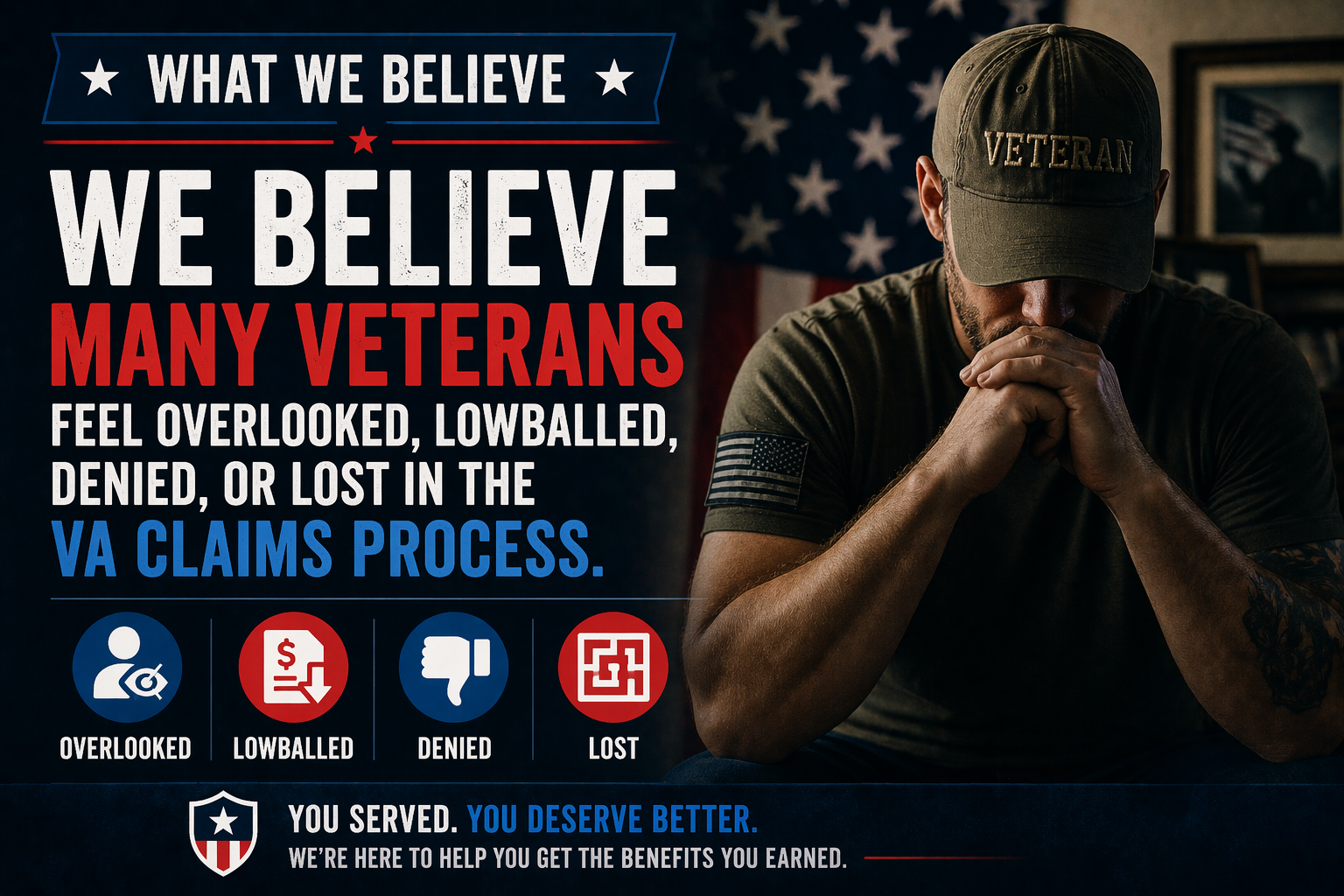
We believe millions of veterans feel overlooked, lowballed, denied, or lost in the VA claims process.
Our purpose is to help underrated disabled veterans rated 0% to 90% create real life change by pursuing the VA disability benefits they legally, morally, ethically, and medically deserve.
We are INSIDERS.
Our HOW
We make the VA disability process easier through expert-level education, proven resources, and veteran-to-veteran support.
You are never alone in this fight.
Our flagship program, VA Claims Insider Elite, connects each veteran with an expert-level Veteran Coach who guides them through our proprietary 8-step process.
That process is built around our SEM Method:
Strategy + Education + Medical Evidence = VA Rating You Deserve!
Our WHAT
We help underrated disabled veterans rated 0% to 90% win, service connect, and increase their VA rating through a smarter strategy, better education, and stronger medical evidence.
Veteran: Do You Have the VA Rating You Were Given…or the VA Rating You Actually Deserve?

Because getting a decision from the VA does not always mean you got the right decision from the VA.
If you are rated anywhere from 0% to 90% and feel stuck, frustrated, underrated, denied, or overlooked, I am speaking directly to you.
And if you have never filed because you thought other veterans deserved it more, because you got denied before, or because you assumed it was too late, do not let those myths make your decision for you.
At VA Claims Insider, we help underrated disabled veterans create real life change by getting the VA rating and compensation they deserve!
Here’s a sliver of what you get when you join us:
- A Veteran Coach by your side, so you never have to fight the VA alone.
- A smarter, personalized strategy for your claim.
- Better VA disability education, so you know what to do next.
- Stronger private medical evidence (DBQs, Nexus Letters, Mental Health Evaluations, and more) at members-only rates to support the rating you deserve.
- And a proven battle plan toward VA claim victory.
But maybe you’re wondering: Will this actually work for me?
That is a fair question.
- At VA Claims Insider, we have helped 50,000+ veterans fight for the VA disability benefits they earned.
- Our internal data shows an average *33% VA rating increase for veterans who complete our Elite program.
- Our internal data also shows veterans in our programs get their claims approved *25% faster on average than the VA’s published average claim-processing timelines.
- Veterans in our community have left 7,000+ total reviews, with a 4.6 out of 5 average rating.
- More than 5,500 reviews are 5 stars ⭐⭐⭐⭐⭐, and 92% of all veteran customer reviews are either 4 or 5 stars.
*Based on VA Claims Insider internal data for veterans who completed the Elite program. Average results shown; individual results vary. No guaranteed outcome or faster claim processing.
If you are ready for a better battle plan, a smarter strategy, and the right path to the VA rating and compensation you deserve, we’ve got your six.
📞 Click the red button below to get started:
Content Reviewed By

Quality Assurance Team
The Quality Assurance (QA) team at VA Claims Insider has extensive experience researching, fact-checking, and ensuring accuracy in all produced content. The QA team consists of individuals with specialized knowledge in the VA disability claims adjudication processes, laws and regulations, and they understand the needs of our target audience. Any changes or suggestions the QA team makes are thoroughly reviewed and incorporated into the content by our writers and creators.
About The Author

Brian Reese
Brian Reese is a world-renowned VA disability benefits expert and the #1 bestselling author of VA Claim Secrets and You Deserve It. Motivated by his own frustration with the VA claim process, Brian founded VA Claims Insider to help disabled veterans secure their VA disability compensation faster, regardless of their past struggles with the VA. Since 2013, he has positively impacted the lives of over 10 million military, veterans, and their families.
A former active-duty Air Force officer, Brian has extensive experience leading diverse teams in challenging international environments, including a combat tour in Afghanistan in 2011 supporting Operation ENDURING FREEDOM.
Brian is a Distinguished Graduate of Management from the United States Air Force Academy and earned his MBA from Oklahoma State University’s Spears School of Business, where he was a National Honor Scholar, ranking in the top 1% of his class.