Looking for Expert-Level VA Claim Answers?📱Call Us Now! 737-295-2226
Female veterans are one of the fastest-growing groups in the VA disability system — and they’re earning higher average compensation than men.
According to the latest VA data, 726,091 female veterans now receive disability pay, averaging $27,714 per year, which is approximately $2,463 more than their male counterparts. Nearly 29% are rated 100% disabled.
This isn’t about preference — it’s about recognition and support. Women veterans are finally seeing their physical and invisible wounds reflected in their VA ratings.
In this post, we’ll break down why female veteran VA disability numbers are rising, which conditions are driving the increase, and what this means for the future of female veterans in the VA system.
Summary of Key Points
- 726,091 female veterans receive VA disability compensation (12.1% of all recipients), with an average annual payment of $27,714; that’s $2,463 higher than the male average of $25,251, driven by higher disability ratings.
- Nearly 29% of female recipients have a 100% VA rating (compared to 25.6% of males), with higher proportions also at the 90%, 80%, and 70% levels, resulting in increased overall compensation.
- Conditions such as Military Sexual Trauma (MST)–related PTSD, migraines, gynecological conditions, and musculoskeletal injuries are more common among women veterans and may contribute to higher disability ratings.
- Female veterans continue to face barriers such as invisibility, MST stigma, and equipment issues, but their numbers are rising rapidly (57,921 new recipients in FY2024), with benefits reflecting the full toll of their service.
Table of Contents
By The Numbers: Female Veterans in the VA Disability Data
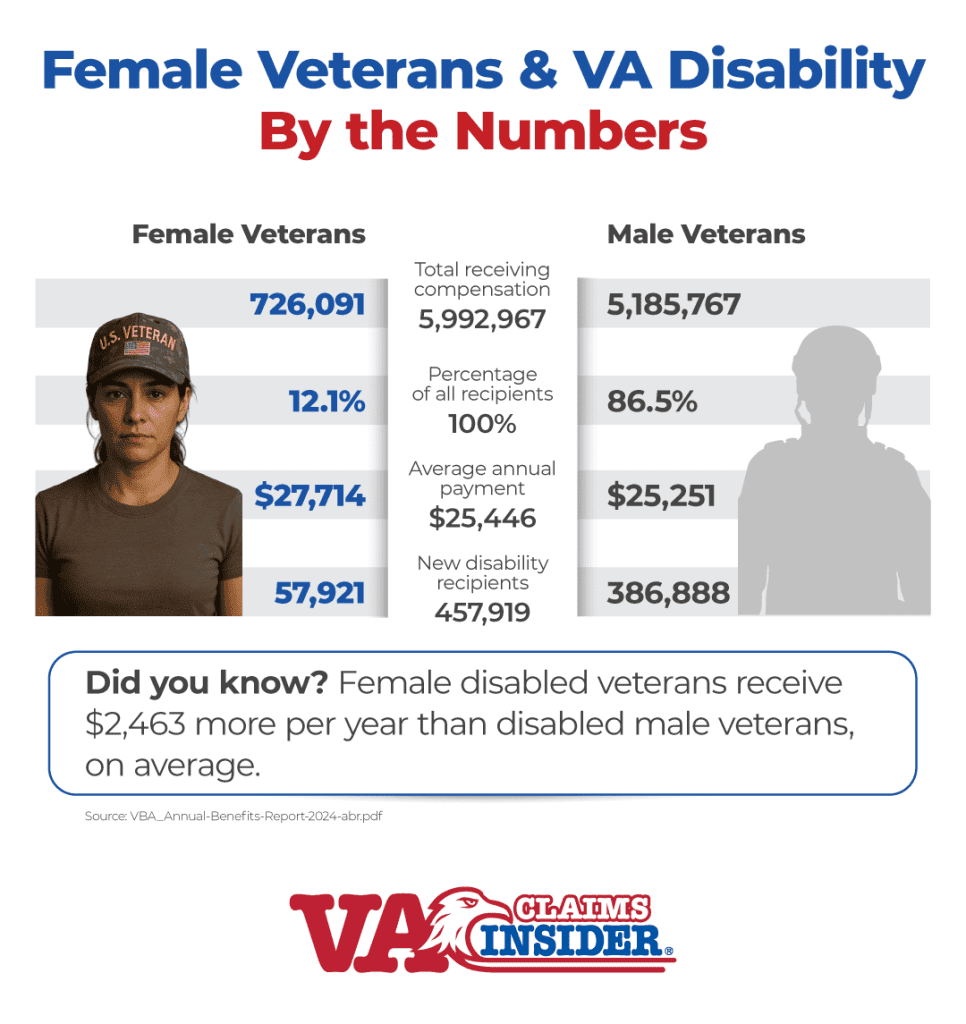
Most people are surprised to learn that there are more than 720,000 female veterans receiving benefits from the VA, let alone that their benefits reflect higher combined VA disability ratings on average.
But the numbers don’t lie. Female veterans are a significant and growing part of the VA disability compensation program.
Here’s a direct comparison from the VBA Report:
| Metric | Female Veterans | Male Veterans | All Recipients |
| Total receiving compensation | 726,091 | 5,185,767 | 5,992,967 |
| Percentage of all recipients | 12.1% | 86.5% | 100% |
| Average annual payment | $27,714 | $25,251 | $25,446 |
| New recipients in FY2024 | 57,921 | 386,888 | 457,919 |
Did you know?
Female disabled veterans receive $2,463 more VA disability compensation per year on average than their male counterparts. That adds up to tens of thousands of dollars over a lifetime. The reason isn’t preferential treatment; it’s due to the distribution of disability ratings, with more women in the higher 70–100% brackets.
Why Female Veterans Receive Higher Average VA Disability Payments: The VA Rating Distribution Breakdown
The VA assigns disability ratings in 10% increments, from 0% to 100%. Higher ratings mean higher monthly payments, with 100% currently starting at a $3,831.30 base rate per month for a veteran alone in 2025 (more than $45,000 annually, plus any potential special compensation).
While 100% VA ratings are overall disproportionate to lower ratings, female veterans tend to lean heavily toward the higher end of the scale.
| Combined VA Rating | Female Veterans (% of female recipients) | Male Veterans (% of male recipients) | Difference |
| 100% | 28.82% | 25.56% | +3.26 pts |
| 90% | 12.88% | 10.12% | +2.76 pts |
| 80% | 11.45% | 9.80% | +1.65 pts |
| 70% | 10.58% | 8.93% | +1.65 pts |
| 60% | 7.19% | 7.55% | -0.36 pts |
| 50% | 5.37% | 4.70% | +0.67 pts |
| 40% | 5.32% | 5.99% | -0.67 pts |
| 30% | 5.22% | 5.61% | -0.39 pts |
| 20% | 4.63% | 6.35% | -1.72 pts |
| 10% | 8.47% | 15.27% | -6.8 pts |
| 0% | 0.07% | 0.10% | -0.03 pts |
Critical insight: Female veterans are 3.26 percentage points more likely to be rated 100% disabled. Nearly 29 out of every 100 female compensation recipients are considered totally disabled by the VA, compared to just over 25 out of 100 males.
This shift toward higher ratings directly explains the $2,463 higher overall average annual payment in FY 2024. A larger proportion of female veterans have their full service-connected disabilities recognized at severe levels.
Why does this happen? Here are some possible contributing factors:
- Military Sexual Trauma (MST): MST can lead to post-traumatic stress disorder (PTSD), often combined with secondary conditions like depression, anxiety, and migraines.
While exact MST numbers aren’t broken out by gender in the report, MST is generally more prevalent among women veterans, and the VA has improved processing of these sensitive claims.
-
Related MST Guides: Veteran’s Guide to MST, and PTSD MST VA Ratings Guide
- Increased Combat and Deployment Exposure: Post-9/11 wars integrated women into combat roles more than ever before. Female veterans from the Gulf War era onward show higher average payments ($30,905 for GWOT-era females in some subsets), reflecting blast injuries, toxic exposures under the PACT Act, and the physical toll of prolonged deployments.
-
Related Guide: Gulf War and Post-9/11 Veteran Statistics
- More Comprehensive Claims Filing: Many female veterans work with advocates, veteran service organizations (VSOs), or 1-on-1 coaches to ensure that all conditions — primary, secondary, and gender-specific — are thoroughly documented. This leads to higher combined VA ratings.
What Conditions are Female Veterans Claiming Most?
Female veterans don’t just have higher VA ratings than their male counterparts; the types of conditions they’re service-connecting also differ. Here are some of the conditions most commonly claimed by female veterans, based on VBA data:
- Migraines: 4.3% of all service-connected disabilities in female veterans are migraines, nearly double the rate in males (2.4%). Migraines can be rated up to 50% ($1,000 or more per month) when attacks are very frequent, completely prostrating, prolonged, and productive of severe economic inadaptability.
- Gynecological Conditions: More than 216,000 gynecological disabilities are claimed by female veterans, including service-connected reproductive issues, ovarian cysts, endometriosis, and conditions secondary to trauma or hormone disruption.
- Mental Health: There are approximately 455,000 mental health disabilities claimed among female recipients, including PTSD, major depressive disorder, and anxiety. MST plays a major role here and can contribute to ratings between 70% and 100% for PTSD.
- Musculoskeletal Issues: Female veterans have musculoskeletal disabilities at rates similar to or higher than men in certain categories (more than 2.5 million total). Heavy rucks, body armor designed for male frames, and ill-fitting equipment cause unique patterns of back, knee, hip, and stress-fracture injuries.
Bottom line: Female veterans carry the same physical loads as men (70-plus-pound ruck sacks, Kevlar not contoured for female bodies), in addition to gender-specific conditions and the invisible wounds of MST. This combination stacks ratings higher.
The Growth Trajectory: More Female Veterans Are Coming
In FY2024 alone, 57,921 new female veterans began receiving compensation, making up 12.7% of all new recipients, consistent with their growing share.
Women now make up about 18% of the active-duty force and an increasing percentage of the reserves and National Guard, according to the Department of Defense’s 2023 Demographics Report. As post-9/11 veterans separate from service over the next decade, the female veteran population receiving benefits could reach closer to 1 million.
The gap is closing fast, and with the PACT Act opening toxic-exposure claims, more presumptive conditions can be evaluated for VA ratings for this cohort.
Unique Challenges Female Veterans Still Face

Higher average VA monthly compensation indicates progress, but it also reflects significant sacrifices and ongoing challenges.
Three persistent issues:
- Invisibility: Female veterans are often not recognized as veterans in daily life. The phrase “thank you for your service” is often directed to their male partner. At VA facilities, assumptions persist that veterans are male.
- Military Sexual Trauma: Rates remain disproportionately higher for women. Stigma still discourages reporting, but when claimed, MST is fully service-connectable, even without a police report, thanks to relaxed evidentiary standards.
- Ill-Fitting Equipment: Body armor, helmets, and packs historically designed for male anatomy cause higher rates of neck, back, and lower-extremity injuries. These are 100% claimable as service-connected.
What the Higher VA Compensation Really Means
- More female veterans (proportionally) have a 100% VA rating because their disabilities are more severe or more thoroughly documented.
- It reflects the cumulative impact of combat, MST, migraines triggered by PTSD, reproductive health issues, and injuries from gear that never fit right.
- Whether due to actual severity, better claims preparation, or VA’s improving acknowledgment of women-specific conditions, the data show their service exacted a heavier toll.
Resources Every Female Veteran Should Know
You’re not alone, and you don’t have to navigate this solo.
VA-Specific Resources
- Women Veterans Call Center: 1-855-VA-WOMEN (1-855-829-6636)
- Every VA medical center has MST Coordinators
Common Conditions Worth Considering
- Gynecological issues & reproductive trauma
- MST-related PTSD and secondaries (migraines, IBS, etc.)
- Musculoskeletal issues from ill-fitting gear
- Migraines, mental health, and toxic exposures under the VA PACT Act
Support Organizations
- Final Salute Inc. (assistance for homeless female veterans)
Conclusion
Female veterans are a growing and essential part of the veteran community — more than 726,000 women whose service, sacrifice, and recovery deserve full recognition. Their higher compensation isn’t about advantage; it’s evidence that the VA is beginning to acknowledge women’s unique experiences and the lasting toll of service.
If you’re a female veteran, now is the time to act. Whether you’re filing your first claim, appealing a denial, or seeking an increase, you’ve earned every benefit available to you.
Remember: The VA can’t recognize what isn’t claimed. Your service matters, your disabilities are real, and your VA benefits are waiting.
Want Expert-Level Support for Your VA Disability Claim? WE GOT YOUR SIX!

- VA Claims Insider is the #1 most trusted name in VA disability claims.
- Work directly with a VA claims coach who can educate you through the claims process.
- 25,000+ disabled veterans have served in our membership programs since 2016.
- 30% average rating increase for veterans who complete our #1-rated Elite program.
- 4.7/5.0 average rating out of 5,500+ total reviews; over 4,500 5-star reviews.
FAQs | Frequently Asked Questions
Do female veterans really get higher VA disability pay than men?
Yes, on average, female disabled veterans receive $27,714 annually, and male disabled veterans $25,251. The difference is due to a higher proportion of female veterans rated at 100% (28.82% vs. 25.56%).
Do PTSD and Military Sexual Trauma (MST) play a role in higher disability payments for female veterans?
MST is a major factor (often 70% to 100% for PTSD), but combat injuries, migraines, gynecological conditions, and equipment issues all contribute.
As a female veteran, can I claim injuries from ill-fitting body armor?
Yes. Musculoskeletal conditions caused by gear that is not designed for female anatomy can be service-connected.
Why are more female veterans getting VA benefits now?
Increased outreach, PACT Act toxic-exposure presumptives, better MST claim processing, and the post-9/11 generation separating.
Content Reviewed By

Quality Assurance Team
The Quality Assurance (QA) team at VA Claims Insider has extensive experience researching, fact-checking, and ensuring accuracy in all produced content. The QA team consists of individuals with specialized knowledge in the VA disability claims adjudication processes, laws and regulations, and they understand the needs of our target audience. Any changes or suggestions the QA team makes are thoroughly reviewed and incorporated into the content by our writers and creators.
About the Author

Katie McCarthy
Katie McCarthy is a writer and editor with experience in daily news and digital and print magazine publishing. She honed her editorial (and firearms) skills at Guns & Ammo before helping launch Black Rifle Coffee Company’s Coffee or Die Magazine as the managing editor. She holds degrees in English (BA) and public administration (MPA). Katie is a military spouse and word nerd who enjoys reading, hiking, camping, gardening, and spending time with her family.