
 go.vaclaimsinsider.com
Looking for Expert-Level VA Claim Answers? Schedule a Call
Veterans new to the VA claims process are often curious, “Are there any VA benefits that come with having a 10% VA disability rating?”
YES!
While a 10% rating may not seem like much, it can make a HUGE impact on your benefits and budget.
While you should never stop fighting until you are properly rated, several great benefits come with a 10% rating.
In this post, we’ll share the 8 BEST 10% VA disability benefits.
Let’s take a look.
Summary of Key Points
- A 10% VA disability rating provides monthly tax-free compensation: Veterans receive a fixed monthly payment, regardless of dependents, making it the lowest rating that pays cash benefits.
- Free healthcare and treatment for service-connected conditions: Veterans qualify for VA medical care, mental health services, and prescriptions related to their disability, often with little to no copay.
- Additional financial and practical benefits add significant value: These include travel reimbursement for medical appointments, exemption from VA home loan funding fees, and access to commissaries (tax-free shopping).
- Career and long-term support opportunities are included: Veterans may receive vocational rehabilitation (VR&E), federal hiring preference (10-point boost), and eligibility for VA life insurance programs.
Table of Contents

8 Benefits a 10% VA Rating Can Get You
You might not realize it, but 10 percent VA disability comes with access to many of the same benefits as a 100% rating.
VA Disability Compensation: How Much is 10% VA Disability Pay?
In 2026, a 10% rating earns you $180.42 per month.
Unlike other rating percentages, a 10% rating is not affected by family factors. No matter if you’re married or single or have a dozen kids, your monthly compensation is capped.
Pro Tip: Stay updated with the with the most current VA disability rates or estimate your potential VA compensation increase with our VA Disability Calculator.

Health Care and Medication
If you’re rated at 10%, that means the VA has determined your disability is service-connected.
Any veteran with a service-connected disability has access to free:
- Medical treatment for your service-connected disability
- Mental health services
- Readjustment counseling
10% VA disability could also get you assigned to VA healthcare priority group 3.
The VA priority group you’re placed in affects how much your copay is for inpatient and outpatient care and medication.
The table below shows copay rates for urgent care:
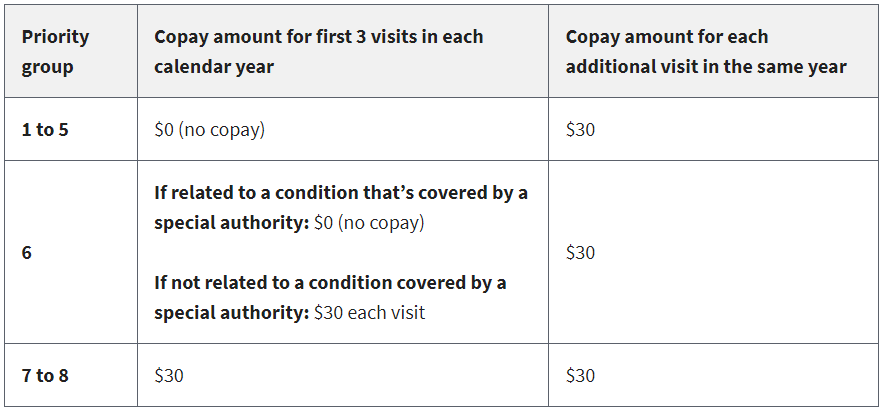
Figure 2. VA urgent care copay rates by priority group
NOTE: There is no copay for inpatient or outpatient care if you’re rated at 10% or higher.
For medication, anything your doctor prescribes to treat your service-connected disability is free. No copay is required. But you will have a copay for certain medications, such as:
- Medications your health care provider prescribes to treat non-service-connected conditions
- Over-the-counter medications (like aspirin, cough syrup, or vitamins) that you get from a VA pharmacy.
Travel Allowance
The VA Beneficiary Travel Program reimburses eligible veterans for travel to and from approved healthcare appointments. Currently, the VA pays 41.5 cents per mile, along with reimbursement for tolls, parking, and approved lodging or meals when applicable.
A deductible of $3 one-way (or $6 round-trip) may apply, up to a maximum of $18 per month. Eligibility depends on factors such as your VA disability rating, income level, and the purpose of your visit.
To be reimbursed for travel, you’ll need to file a claim through the Beneficiary Travel Self-Service System (BTSSS).
Be sure to file your claim within 30 days of your appointment.
Pro Tip: Hold on to your travel receipts and proof of attendance documents. You’ll be asked to submit these when you file your claim.
Vocational Rehabilitation and Employment (VR&E) Services
If you have a 10% VA disability or higher, you could also be eligible for VR&E services if your disability makes it difficult for you to work.
The VR&E program helps disabled veterans find employment options that fit their needs through training and reeducation. There are five VR&E tracks available to eligible veterans.
VR&E services include:
- An evaluation to help determine your abilities, skills, and interests for employment
- Vocational counseling and rehabilitation planning
- Job training, job-seeking skills, resume development, and other work-readiness assistance
- Assistance finding and keeping a job. This can include the use of special employer incentives and job accommodations
- On the Job Training, apprenticeships, and non-paid work experiences
- Post-secondary training at a college, vocational, technical, or business school
- Supportive rehabilitation services, including case management, counseling, and medical referrals
- Independent living services for Veterans unable to work due to the severity of their disabilities
VA Funding Fee Exemption
Nearly all veterans have access to one or more VA home loan programs. But one big benefit to 10% VA disability or higher is an exemption from the VA Funding Fee.
The VA Funding Fee is a one-time fee that veterans pay towards a VA loan used to buy, build, or improve a home. It’s meant to cover some of the costs of the loan since VA home loans don’t require a down payment.
VA Funding Fees are typically paid at closing and are a percentage of the amount of the loan. But with a 10% VA disability rating, you won’t have to worry about it.
VA Life Insurance (VALife)
This is a new program offered by the VA to any veteran with a service-connected disability, even if you’re rated at 0%.
The VA started taking applications for VALife on January 1st, 2023, and there’s no time limit to apply after getting your disability rating.
VALife is guaranteed-acceptance whole life insurance. According to the VA, if you’re eligible, you’ll be automatically accepted. You won’t have to prove you’re in good health. And coverage lasts for the rest of your life.
VALife comes with benefits such as:
- Up to $40,000 in whole life insurance coverage in $10,000 increments
- Cash value that starts to add up two years after your application is approved
Pro Tip: Keep in mind that coverage doesn’t start until two years after you apply, and you’re required to pay premiums during those two years.
Federal Employment Preference
10% VA disability also gets you a 10-point preference when applying to federal jobs.
This preference is applied by adding 10 points to your civil examination score, which could improve your ranking among the other candidates.
Commissary Access
If you have at least 10% VA disability, then you have access to on-post commissaries!
If you’re near a post, this could add a lot of green to your bottom line.
As you probably know from your time in the military, commissaries are tax-free. Not to mention they’re already normally cheaper than off-post grocery stores because commissary goods are sold at cost with just a 5% markup.

How to get a 10% VA Disability Rating
We’ve written several posts with detailed information on what it takes to be eligible for a VA rating and how to file a claim. But here are the basics:
First, you should meet ALL of these basic eligibility criteria:
- You have a current medical diagnosis of your disability
- You had an in-service event, injury, or illness that you believe caused or aggravated your condition
- You have evidence linking 1 and 2 (a nexus letter can help prove this)
If you meet ALL of these requirements, you should consider filing a VA claim for disability benefits.
The process for filing a claim is:
- Submit an intent to file. This will lock in your effective date.
- Gather your evidence. You’ll need things like doctor reports, medical records, a Nexus letter or an Independent Medical Opinion, and proof of service.
- File your claim. This can be done online, through the mail, or in person at a VA regional office.
- Hurry up and wait. The VA claims process currently takes 76.6 days, but the timeline changes regularly. For the most up-to-date processing times, visit the VA’s After You File page.
What Disabilities Get a 10% VA Disability Rating?
There are a few disability categories that get 10% ratings more often than others.
Some of these disabilities, such as tinnitus, are capped at 10%. That means it’s impossible to get a rating higher than 10% for tinnitus, no matter how severe your symptoms are.
Musculoskeletal
Based on the latest report from the Veterans Benefits Administration, the most prevalent service‑connected musculoskeletal conditions are:
- Limitation of flexion, knee — 894,994 veterans
- Lumbosacral or cervical strain — 667,100 veterans
- Limitation of motion of the arm — 510,591 veterans
Auditory
The most common auditory conditions:
- Tinnitus — 1,039,663 veterans
- Hearing loss — 294,342 veterans
- Labyrinthitis — 35,721 veterans
Neurological
According to the data, the most prevalent neurological conditions among all service‑connected compensation recipients are:
- Paralysis of the sciatic nerve — 569,691 veterans
- Migraines — 513,391 veterans
- Paralysis of the anterior crural nerve — 111,333 veterans
Deserve a Higher VA Rating?
Book a no-obligation VA Claim Discovery Call with an experienced team member. We’ll review your situation, spot what the VA may have missed, and help you map out a strategy to unlock the VA disability rating and tax-free compensation you’ve earned for your service. Click the red button below to book your call.
Conclusion
It’s true that the monthly compensation of a 10% VA disability rating pales in comparison to the monthly compensation at the 90% or 100% VA disability levels.
But in most cases, it’s still worth it to get your 10% VA rating — even if that’s just a stepping stone on your way to a higher rating.
While the 10% pay rate isn’t going to make you rich, the other benefits that come with your 10% rating can be life-changing. There’s also an opportunity for some veterans to receive back pay, which can be substantial.
Additionally, you can use your 10% VA rating to pursue secondary conditions, which could make you eligible for a higher VA rating and the additional benefits and compensation that come with it.
FAQs | Frequently Asked Questions
How much money do you get with a 10% VA disability rating?
Veterans typically receive a fixed monthly payment, which is currently $180.42 per month. This amount does not increase based on dependents.
Do I qualify for VA healthcare at 10%?
Yes. You’re eligible for VA health care, especially for your service-connected conditions, often with low or no out-of-pocket costs.
Do I have to pay the VA home loan funding fee with a 10% disability rating?
No. Veterans with at least a 10% disability rating are exempt from the VA funding fee, which can save thousands on a home purchase.
Can I increase my 10% VA disability rating?
Yes. If your condition worsens or you develop new service-connected conditions, you can file for an increased VA rating or submit new evidence.
Do I get additional benefits like education or job support with a 10% VA disability rating?
You may qualify for programs like Vocational Rehabilitation and Employment (VR&E), along with federal hiring preference.
Is a 10% VA rating considered permanent?
Not necessarily. The VA can reevaluate your condition over time unless your rating is classified as permanent and total (which is uncommon at 10%).
Author

Brian Reese
Brian Reese is a world-renowned VA disability benefits expert and the #1 bestselling author of VA Claim Secrets and You Deserve It. Motivated by his own frustration with the VA claim process, Brian founded VA Claims Insider to help disabled veterans secure their VA disability compensation faster, regardless of their past struggles with the VA. Since 2013, he has positively impacted the lives of over 10 million military, veterans, and their families.
A former active-duty Air Force officer, Brian has extensive experience leading diverse teams in challenging international environments, including a combat tour in Afghanistan in 2011 supporting Operation ENDURING FREEDOM.
Brian is a Distinguished Graduate of Management from the United States Air Force Academy and earned his MBA from Oklahoma State University’s Spears School of Business, where he was a National Honor Scholar, ranking in the top 1% of his class.