 go.vaclaimsinsider.com
Looking for Expert-Level VA Claim Answers? Schedule a Call
If you’re waking up to use the bathroom multiple times every night, you know the exhaustion: foggy mornings, short fuses, and the feeling that you’re never truly rested.
Many veterans assume it’s just aging or too much water before bed, but those midnight trips could actually qualify for a nocturia VA rating.
The VA rates nocturia under urinary frequency, not a separate diagnostic code, and thousands of veterans already receive 10%, 20%, or 40% for it every month.
Let’s make sure you’re one of them.
>> Learn about genitourinary VA ratings and more in our VA Disability Ratings Guide.
Summary of Key Points
- Nocturia VA ratings are 10%, 20%, or 40%, based on how often you void during the day or wake at night; proving frequency is key to higher compensation.
- Linking nocturia to service-connected conditions like sleep apnea (affecting 50% of OSA cases), PTSD, diabetes, or prostate problems may increase your chances for approval and extra monthly payments.
- Medical evidence, such as a voiding diary and/or findings from a C&P exam, can boost your rating, while a nexus letter can help establish service connection.
Table of Contents
What is Nocturia?
Nocturia means waking up at least once at night to urinate, with sleep before and after each episode. The VA considers two or more awakenings compensable and rates it under urinary frequency:
- 2 times per night → 10%
- 3 to 4 times per night → 20%
- 5+ times per night → 40% (max)
It’s often caused or aggravated by service-connected conditions like sleep apnea, PTSD, diabetes, prostate issues, or medications — making it fully ratable even without its own diagnostic code.
How the VA Rates Nocturia
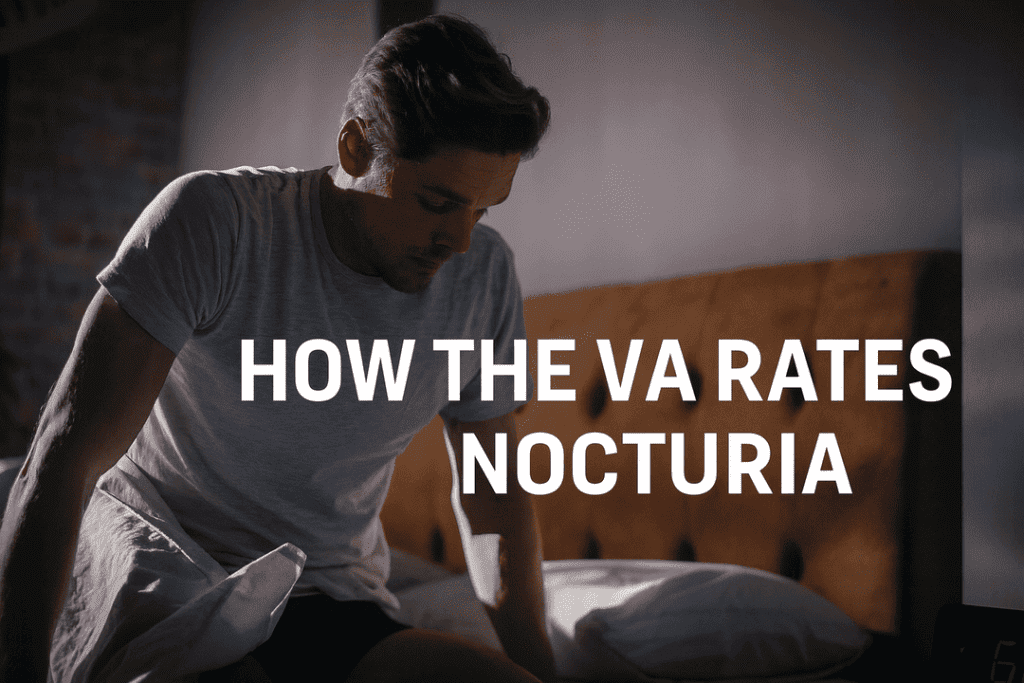
Nocturia doesn’t have its own spot in the VA Schedule for Rating Disabilities (VASRD). It’s rated under the genitourinary system’s “urinary frequency” criteria in 38 CFR § 4.115a. This means the VA evaluates based on the frequency of urination, which directly captures those disruptive night wakings.
Here’s how ratings are determined:
- 10% VA Rating: Daytime voiding interval between two and three hours, or; awakening to void two times per night.
- 20% VA Rating: Daytime voiding interval between one and two hours, or; awakening to void three to four times per night.
- 40% VA Rating: Daytime voiding interval less than one hour, or; awakening to void five or more times per night.
If incontinence plays a role (e.g., leakage requiring pads), ratings can climb to 60% under the same code, based on pad changes per day. It’s crucial to track your symptoms meticulously in a simple voiding diary. Documenting your fluid intake, output, and urinary frequency over two to three days could make or break your case.
Proving Service Connection
Service connection is the foundation of any VA claim. You’re required to prove your nocturia stems from military service to qualify for benefits. There are three main paths:
Direct Service Connection: Show that nocturia began or worsened during active duty. You’ll need a current diagnosis; service medical records noting urinary issues, exposure to toxins (e.g., burn pits linked to bladder inflammation), or in-service events like dehydration from field ops; and a nexus (link) statement from a qualified medical professional (or C&P examiner)
Secondary Service Connection: This is where many veterans win big by proving nocturia was caused or aggravated by an existing service-connected condition. Common primary conditions include:
- Sleep Apnea: Up to 50% of obstructive sleep apnea (OSA) sufferers experience nocturia due to oxygen drops triggering fluid shifts and bladder signals. If your apnea is rated at 50% (CPAP-required), adding nocturia will provide a combined boost.
- PTSD/Anxiety: Stress and sleep disturbances are associated with increased nighttime urination.
- Diabetes or Prostate Issues: Both conditions can cause nocturia, which may qualify for a VA rating if severe enough to meet urinary frequency criteria. A nexus letter stating “at least as likely as not” caused by your primary condition is crucial.
Service Connection by Aggravation: If a preexisting condition is aggravated or worsened by your service and can be service-connected, you can claim it as aggravated and be rated for the additional severity.
Nocturia VA Disability Rating Evidence Checklist
Filing without prep is risky. Here’s what you need:
- Current Diagnosis: Urology visit for nocturia confirmation. Rule out infections through urinalysis; if a sleep disorder is suspected, a sleep study may be considered.
- Voiding Diary: Log fluid intake, void times, and volumes for several days. There are apps that make it easy.
- Medica Nexus: This can be a nexus statement from a doctor or C&P examiner or a credible Nexus Letter.
While not required, the following can also help support your claim:
- Voiding Diary: Log fluid intake, void times, and volumes for several days (there are apps that make it easy) and take it with you to future medical exams.
- Buddy Statements: If you have friends or family who are aware of your condition, letters from them confirming your symptoms can support your claim.
- Lay Statement (VA Form 21-4138): Your words matter — detail sleep loss, fatigue, and daily impacts.
Conclusion
Nocturia isn’t just a nuisance; it’s a VA-ratable condition that can seriously affect your rest, mood, and long-term health. The VA rates it under urinary frequency (38 CFR § 4.115a) with ratings of 10%, 20%, or 40%, depending on how often you wake at night or how short your daytime voiding intervals are.
With the right medical evidence and strategy, a nocturia VA rating can compensate for your symptoms and recognize the impact of your service.
Ready to Maximize Your Nocturia VA Rating?
Join 50,000-plus veterans who’ve boosted their VA monthly compensation and benefits with VA Claims Insider. Book your no-obligation VA claim Discovery Call or call 855-728-0526.
Let’s turn those disruptions into dollars — your nights (and wallet) will thank you.
FAQs | Frequently Asked Questions
What’s the maximum VA rating for nocturia?
Up to 40% under urinary frequency for five-plus nightly voids (or hourly daytime). If leakage requires four or more pads daily, your nocturia VA rating can go up to 60%.
Can I claim nocturia secondary to sleep apnea?
Yes. A 2018 study shows approximately 50% of patients with sleep apnea also suffer from nocturia. A nexus letter can prove the nocturia is “at least as likely as not” connected to the sleep apnea, for which a 10%–40% rating could be assigned as a secondary condition.
How do I prove service connection for nocturia?
For a direct connection, you’ll need a current diagnosis, in-service records, and a nexus linking the two. For a secondary connection, you’ll need to link your nocturia to rated conditions like PTSD or diabetes with a doctor’s nexus. Diaries and lay statements strengthen it.
What if my nocturia claim is denied?
Appeal with a Higher Level Review (no new evidence, just new eyes), a Supplemental Claim (submit new evidence to strengthen your claim), or a Board Appeal.
Content Reviewed By

Quality Assurance Team
The Quality Assurance (QA) team at VA Claims Insider has extensive experience researching, fact-checking, and ensuring accuracy in all produced content. The QA team consists of individuals with specialized knowledge in the VA disability claims adjudication processes, laws and regulations, and they understand the needs of our target audience. Any changes or suggestions the QA team makes are thoroughly reviewed and incorporated into the content by our writers and creators.
About the Author

Brian Reese
Brian Reese is a world-renowned VA disability benefits expert and the #1 bestselling author of VA Claim Secrets and You Deserve It. Motivated by his own frustration with the VA claim process, Brian founded VA Claims Insider to help disabled veterans secure their VA disability compensation faster, regardless of their past struggles with the VA. Since 2013, he has positively impacted the lives of over 10 million military, veterans, and their families.
A former active-duty Air Force officer, Brian has extensive experience leading diverse teams in challenging international environments, including a combat tour in Afghanistan in 2011 supporting Operation ENDURING FREEDOM.
Brian is a Distinguished Graduate of Management from the United States Air Force Academy and earned his MBA from Oklahoma State University’s Spears School of Business, where he was a National Honor Scholar, ranking in the top 1% of his class.