
 go.vaclaimsinsider.com
Looking for Expert-Level VA Claim Answers? Schedule a Call
Veterans with service-connected agoraphobia may qualify for a 0%, 10%, 30%, 50%, 70%, or 100% VA disability rating under the General Rating Formula for Mental Disorders (Diagnostic Code 9412). Your rating depends on how severely agoraphobia affects your occupational and social functioning—not simply whether you have the diagnosis.
In this guide, you’ll learn how the VA rates agoraphobia, common symptoms, how to establish service connection, and what evidence can strengthen your VA claim.
Summary of Key Points
- Agoraphobia is generally rated under Diagnostic Code 9412 using the VA’s General Rating Formula for Mental Disorders.
- Ratings range from 0% to 100% depending on occupational and social impairment.
- Agoraphobia may qualify for direct or secondary service connection, often alongside panic disorder or PTSD.
- Strong medical evidence—including a diagnosis, treatment records, and a nexus when needed—can significantly strengthen your claim.
Table of Contents
Agoraphobia VA Rating Criteria

The VA rates agoraphobia under Diagnostic Code (DC) 9412 using the General Rating Formula for Mental Disorders. Like other anxiety disorders, your VA disability rating depends on the severity of your symptoms and, most importantly, how they affect your occupational and social functioning.
Agoraphobia may receive a 0%, 10%, 30%, 50%, 70%, or 100% VA disability rating depending on the medical evidence in your file.
| VA Rating | General Rating Criteria |
|---|---|
| 0% | A mental health condition has been diagnosed, but symptoms do not interfere with occupational or social functioning or require continuous medication. |
| 10% | Mild or transient symptoms that decrease work efficiency only during periods of significant stress, or symptoms controlled by continuous medication. |
| 30% | Occasional decrease in work efficiency with intermittent inability to perform occupational tasks due to symptoms such as anxiety, panic attacks (weekly or less), chronic sleep impairment, suspiciousness, or mild memory loss. |
| 50% | Reduced reliability and productivity caused by symptoms such as frequent panic attacks, impaired judgment, disturbances of motivation and mood, difficulty understanding complex commands, memory impairment, and difficulty maintaining work and social relationships. |
| 70% | Deficiencies in most areas—including work, family relations, judgment, thinking, or mood—due to symptoms such as near-continuous panic or depression, impaired impulse control, suicidal ideation, difficulty adapting to stressful circumstances, or inability to maintain effective relationships. |
| 100% | Total occupational and social impairment due to severe symptoms such as persistent delusions or hallucinations, grossly inappropriate behavior, persistent danger of harming yourself or others, severe memory loss, disorientation, or inability to perform activities of daily living. |
Unlike many physical disabilities, the VA does not rate agoraphobia according to a single symptom or test result. The rating is based primarily on the degree of occupational and social impairment caused by your overall mental health symptoms.
0%
A 0% rating may apply when agoraphobia has been formally diagnosed, but the symptoms are not severe enough to interfere with occupational and social functioning or require continuous medication.
A 0% rating does not provide monthly disability compensation, but it still establishes the condition as service-connected.
10%
A 10% rating may apply when mild or temporary symptoms reduce work efficiency and the ability to complete occupational tasks only during periods of significant stress.
It may also apply when symptoms are controlled by continuous medication.
30%
A 30% rating reflects occupational and social impairment with an occasional decrease in work efficiency and intermittent periods when the veteran cannot perform occupational tasks.
Possible symptoms include:
- Anxiety
- Depressed mood
- Suspiciousness
- Panic attacks occurring weekly or less often
- Chronic sleep impairment
- Mild memory loss
A veteran at this level is generally able to function independently and maintain normal routine behavior, self-care, and conversation.
50%
A 50% rating reflects occupational and social impairment with reduced reliability and productivity.
Possible symptoms include:
- Panic attacks occurring more than once per week
- Disturbances of motivation and mood
- Impaired judgment
- Memory impairment
- Difficulty understanding complex commands
- Difficulty establishing or maintaining work relationships
- Difficulty establishing or maintaining social relationships
- Abnormal or indirect speech patterns
- Flattened affect
For a veteran with agoraphobia, this level might involve frequent panic attacks, regularly missing work, avoiding crowded environments, or needing significant support to complete activities outside the home.
70%
A 70% rating reflects occupational and social impairment with deficiencies in most areas, including work, school, family relationships, judgment, thinking, or mood.
Possible symptoms include:
- Near-continuous panic or depression
- Suicidal ideation
- Obsessional rituals that interfere with daily activities
- Impaired impulse control
- Difficulty adapting to stressful circumstances
- Neglect of personal appearance or hygiene
- Inability to establish and maintain effective relationships
- Speech that is intermittently illogical, obscure, or irrelevant
- Difficulty functioning independently, appropriately, and effectively
A veteran at this level may rarely leave home, struggle to maintain employment, become socially isolated, or require help completing routine activities outside the home.
100%
A 100% rating requires total occupational and social impairment.
Possible symptoms include:
- Gross impairment in thought processes or communication
- Persistent delusions or hallucinations
- Grossly inappropriate behavior
- Persistent danger of hurting yourself or others
- Intermittent inability to perform activities of daily living
- Disorientation to time or place
- Severe memory loss
Agoraphobia alone does not automatically qualify for a 100% rating. The evidence must demonstrate total occupational and social impairment from the veteran’s overall service-connected mental health symptoms. The current rating formula and Diagnostic Code 9412 appear in 38 CFR § 4.130.
How the VA Determines Your Agoraphobia VA Rating
A diagnosis does not determine your rating by itself.
The VA reviews the frequency, severity, and duration of your symptoms and how those symptoms affect your ability to work, maintain relationships, function independently, and perform ordinary daily activities.
The symptoms listed under each percentage are examples rather than a checklist. You do not necessarily need to experience every listed symptom to qualify for a particular rating.
The central question is the overall level of occupational and social impairment caused by your condition.
What is Agoraphobia?
Agoraphobia is an anxiety disorder involving intense fear or anxiety about situations in which escape may feel difficult or help may not be available if panic-like or disabling symptoms occur.
Commonly feared situations may include:
- Public transportation
- Open spaces
- Enclosed spaces
- Crowded stores or public areas
- Standing in line
- Being away from home alone
- Driving in traffic
- Attending appointments or events
The condition is more than ordinary nervousness or discomfort.
A person with agoraphobia may avoid feared situations, endure them with severe anxiety, or require someone else to accompany them. In severe cases, the person may become largely unable to leave home.
For veterans, these symptoms can interfere with employment, medical appointments, relationships, shopping, travel, and other basic activities.
Common Signs and Symptoms of Agoraphobia
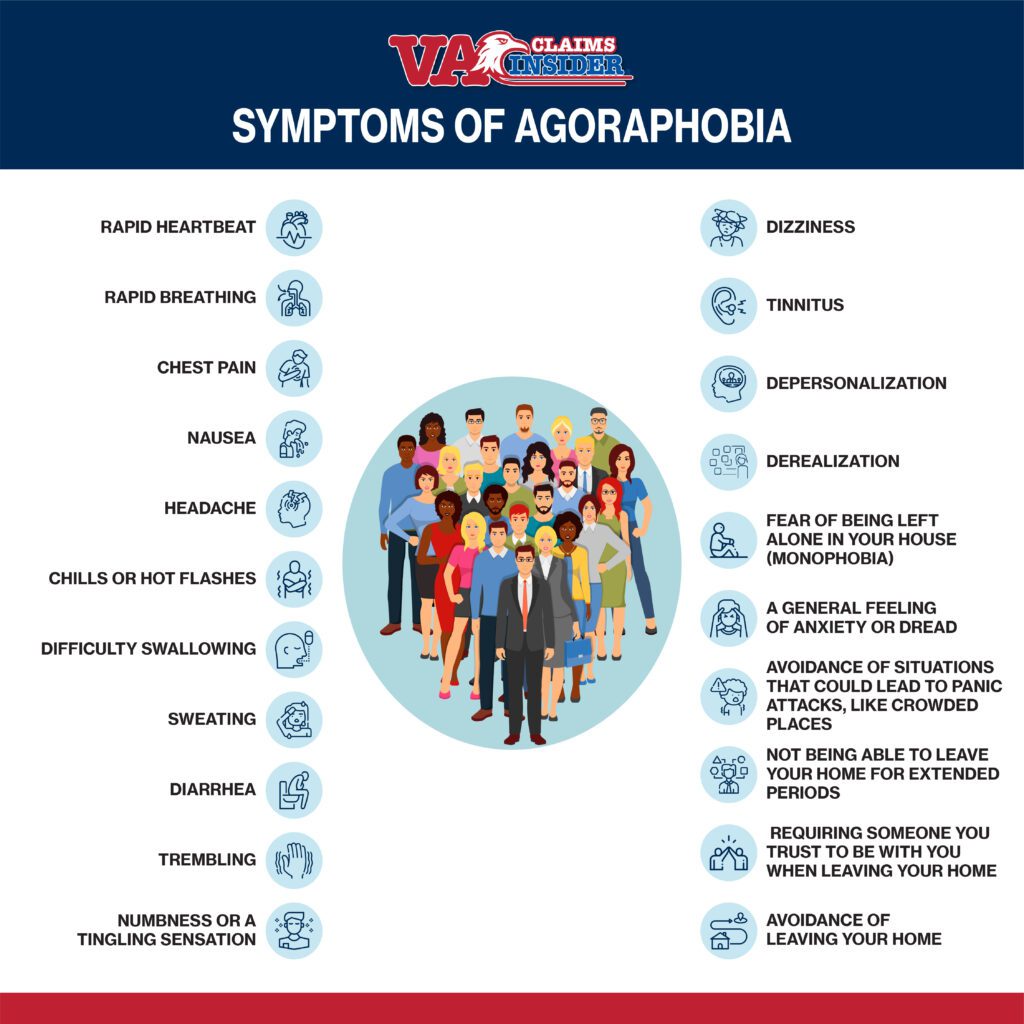
Agoraphobia affects each person differently, but common symptoms may include:
- Intense fear of leaving home
- Avoiding crowds or public places
- Fear of using public transportation
- Fear of driving or riding in a vehicle
- Anxiety in open or enclosed spaces
- Fear of being alone outside the home
- Needing a trusted person present when leaving home
- Panic attacks
- Rapid heartbeat
- Shortness of breath
- Chest discomfort
- Shaking or sweating
- Dizziness
- Fear of losing control
- Fear that escape will be difficult
- Social isolation
- Missed work or medical appointments
- Avoidance of ordinary daily activities
The VA is especially concerned with how these symptoms affect your occupational and social functioning.
For example, stating that you experience anxiety in stores is useful, but explaining that you abandon shopping trips, require your spouse to shop for you, or cannot enter a store without experiencing a panic attack provides a clearer picture of functional impairment.
How Agoraphobia and Panic Disorder Are Connected
Agoraphobia frequently occurs alongside panic disorder.
A veteran who experiences a panic attack in a crowded store, while driving, or on public transportation may begin avoiding that situation out of fear that another attack will occur. Over time, that avoidance can expand to additional locations and activities.
However, a person can have:
- Panic disorder without agoraphobia
- Agoraphobia without panic disorder
- Both panic disorder and agoraphobia
Veterans may also experience agoraphobia alongside PTSD, depression, generalized anxiety disorder, traumatic brain injury residuals, or other mental health conditions.
Does the VA Rate Panic Disorder and Agoraphobia Together?
Yes. The VA lists panic disorder and/or agoraphobia together under Diagnostic Code 9412.
In addition, the VA generally does not assign separate ratings for multiple mental health diagnoses when the symptoms and functional impairment overlap. Doing so could compensate the same manifestation twice.
Instead, the VA typically assigns one mental health rating based on the veteran’s total occupational and social impairment.
For example, a veteran diagnosed with PTSD, anxiety, panic disorder, depression, and agoraphobia may receive one combined mental health evaluation rather than four separate ratings.
The diagnosis used on the rating decision matters less than whether the VA has accurately evaluated the full severity of all service-connected symptoms.
How to Establish Service Connection
To receive VA disability compensation, you must first establish that your agoraphobia is connected to military service.
There are several potential paths.
Direct Service Connection
A direct service-connected claim generally requires:
- A current diagnosis of agoraphobia or panic disorder with agoraphobia
- Evidence of an event, injury, illness, or experience during military service
- A medical nexus connecting the current condition to military service
Potential in-service evidence could include:
- Service treatment records
- Mental health treatment during service
- Documentation of a traumatic incident
- Personnel records showing behavioral or performance changes
- Deployment or combat records
- Statements from fellow service members
- A credible personal statement
A veteran may still establish direct service connection even if the condition was not formally diagnosed during service, provided the evidence supports a connection between the current disability and military service.
Secondary Service Connection
Agoraphobia may also qualify as secondary to another service-connected disability if that condition caused or aggravated it.
Potential examples may include:
- Agoraphobia secondary to PTSD
- Agoraphobia secondary to panic disorder
- Agoraphobia aggravated by a service-connected traumatic brain injury
- Agoraphobia related to another service-connected anxiety condition
- Agoraphobia caused or aggravated by limitations from a physical disability
A secondary claim generally requires:
- A current diagnosis
- An existing service-connected disability
- Medical evidence showing that the service-connected disability caused or aggravated the agoraphobia
Under 38 CFR § 3.310, a disability that is proximately due to, caused by, or aggravated by a service-connected condition may qualify for secondary service connection.
How is Agoraphobia Diagnosed?
Agoraphobia is generally diagnosed by a qualified mental health professional after reviewing your symptoms, medical history, avoidance behaviors, and functional limitations.
The evaluation may address:
- The situations you fear or avoid
- How long the symptoms have been present
- Whether panic attacks occur
- Whether the fear is disproportionate to the actual danger
- How the condition affects work and relationships
- Whether another medical or mental health condition better explains the symptoms
- Whether medication, therapy, or other treatment has helped
The provider may also evaluate you for related conditions, including panic disorder, PTSD, depression, generalized anxiety disorder, or substance-use disorders.
Treatment may include psychotherapy, medication, or a combination of approaches. Seeking treatment can also create important medical documentation showing the history, persistence, and severity of your symptoms.
What Evidence Can Strengthen an Agoraphobia VA Claim?
The strongest evidence creates a consistent picture of your diagnosis, its connection to service, and its impact on your life.
Useful evidence may include:
Current Mental Health Diagnosis
A formal diagnosis from a qualified mental health professional establishes that you currently have the claimed condition.
Mental Health Treatment Records
Treatment notes may document:
- Panic attacks
- Avoidance behaviors
- Inability to leave home
- Social isolation
- Medication use
- Therapy participation
- Functional impairment
- Changes in symptoms over time
Medical Nexus Opinion
A nexus opinion may be important when the connection to military service or another service-connected disability is not already clear.
A strong opinion should explain whether the condition is at least as likely as not related to service or caused or aggravated by another service-connected condition.
It should also include a reasoned medical explanation rather than a brief unsupported conclusion.
Mental Disorders DBQ
A private or VA Mental Disorders DBQ can document:
- Diagnoses
- Symptoms
- Treatment history
- Occupational impairment
- Social impairment
- The examiner’s overall assessment
Personal Statement
Your statement can explain:
- When your symptoms began
- What situations you avoid
- How often panic attacks occur
- Whether you can leave home alone
- How the condition affects employment
- How it affects family and social relationships
- What happens on your worst days
Use specific examples rather than broad descriptions.
For example:
“I cannot go into crowded stores by myself. I have left full shopping carts behind because I felt trapped and believed I could not breathe.”
That gives the VA more useful information than simply writing, “Crowds make me anxious.”
Buddy and Family Statements
Statements from a spouse, relative, friend, coworker, or fellow veteran can describe changes they have personally observed.
They might discuss:
- Increasing isolation
- Missed work
- Cancelled plans
- Dependence on others for errands
- Panic attacks
- Difficulty traveling
- Inability to attend family activities
- Changes after a traumatic military event
Employment Evidence
Employment records may help show occupational impairment through:
- Excessive absences
- Reduced productivity
- Workplace accommodations
- Disciplinary actions
- Difficulty interacting with coworkers
- Inability to commute
- Job loss linked to symptoms
What to Expect at an Agoraphobia C&P Exam
The VA may schedule a Compensation and Pension exam to assess your diagnosis, service connection, or current symptom severity.
During the examination, the provider may ask about:
- Your military history
- Traumatic or stressful experiences
- When symptoms began
- Panic attacks
- Places or situations you avoid
- Treatment and medication
- Employment history
- Family and social relationships
- Substance use
- Suicidal thoughts
- Your ability to function independently
Be honest and specific.
Do not exaggerate your symptoms, but do not minimize them either. Veterans often say they are “fine” or “doing okay” out of habit, even when their condition causes serious limitations.
Explain how you function over time, including your worst periods—not just how you happen to feel on the day of the examination.
What Happens if the VA Denies Your Agoraphobia Claim?
A claim denial does not necessarily mean your condition is invalid or that your case is over.
Read the decision letter carefully to determine why the claim was denied. Common reasons may include:
- No current diagnosis
- No verified in-service event
- No medical nexus
- An unfavorable C&P opinion
- Insufficient evidence of functional impairment
- Evidence that did not support the claimed rating
- Conflicting medical evidence
Under the current VA decision-review system, the three primary options are:
Supplemental Claim
A Supplemental Claim allows you to submit new and relevant evidence that the VA did not previously consider.
This may be appropriate when you have:
- A stronger nexus opinion
- New treatment records
- An updated diagnosis
- A private DBQ
- New lay evidence
- Records addressing the stated reason for denial
Higher-Level Review
A Higher-Level Review asks a senior VA reviewer to reconsider the existing record.
You cannot submit new evidence in this lane. It may be appropriate when you believe the VA made a factual or legal error based on evidence already in the file.
Board Appeal
A Board Appeal sends the case to a Veterans Law Judge at the Board of Veterans’ Appeals.
The available Board dockets determine whether you can submit evidence or request a hearing.
VA currently identifies the Supplemental Claim, Higher-Level Review, and Board Appeal as the principal decision-review options.
The right lane depends on why the VA denied the claim and whether you have additional evidence to submit.
Building a Stronger Agoraphobia VA Claim
Agoraphobia can affect nearly every part of a veteran’s life—from employment and relationships to medical care and basic activities outside the home.
To receive the proper agoraphobia VA rating, your evidence must show more than a diagnosis. It should clearly document how frequently your symptoms occur, how severe they are, and how they interfere with occupational and social functioning.
A strong claim may include:
- A current diagnosis
- Relevant treatment records
- A detailed personal statement
- Supporting lay statements
- A properly completed DBQ
- A credible medical nexus opinion when needed
VA Claims Insider helps veterans better understand the VA disability claims process and develop the strategy, education, and medical evidence needed to pursue the benefits they deserve.
About VA Claims Insider

- VA Claims Insider is the #1 name in VA disability claims.
- Work directly with a VA claims coach who can educate throughout the claims process.
- 50,000+ disabled veterans have served in our membership programs since 2016.
- 33% average rating increase for veterans who complete our Elite program.
- 4.6/5.0 average rating out of 7,000+ total reviews; over 5,500 5-star reviews.
FAQs | Frequently Asked Questions
What VA rating can you receive for agoraphobia?
Agoraphobia may receive a 0%, 10%, 30%, 50%, 70%, or 100% VA disability rating. The percentage depends on the degree of occupational and social impairment caused by the veteran’s overall mental health symptoms.
What diagnostic code does the VA use for agoraphobia?
The VA lists panic disorder and/or agoraphobia under Diagnostic Code 9412. The condition is evaluated using the General Rating Formula for Mental Disorders.
Is agoraphobia considered a VA disability?
Yes. Agoraphobia may qualify for VA disability compensation when it is properly diagnosed, service-connected, and causes ratable occupational or social impairment.
Can agoraphobia be secondary to PTSD?
Potentially. A veteran may qualify for secondary service connection when medical evidence shows that service-connected PTSD caused or aggravated the agoraphobia.
The VA will generally evaluate overlapping PTSD and agoraphobia symptoms under one overall mental health rating rather than assigning separate ratings for the same impairment.
Can panic disorder and agoraphobia receive separate VA ratings?
Usually not when the symptoms overlap. Panic disorder and agoraphobia are listed together under Diagnostic Code 9412, and the VA generally assigns one mental health evaluation based on the veteran’s total occupational and social impairment.
Is agoraphobia a permanent disability?
Agoraphobia may be long-lasting, but the diagnosis alone does not establish that the VA considers the disability permanent.
Whether a rating is considered static or permanent depends on the veteran’s medical history, prognosis, rating status, and whether improvement is reasonably expected.
Can agoraphobia qualify a veteran for TDIU?
Potentially. If service-connected agoraphobia prevents a veteran from securing or maintaining substantially gainful employment, the condition may support entitlement to Total Disability Based on Individual Unemployability, provided the applicable requirements are met.
What should I do if my agoraphobia claim was denied?
Review the decision letter to identify the missing or disputed element. Depending on the circumstances, you may file a Supplemental Claim with new and relevant evidence, request a Higher-Level Review, or appeal to the Board of Veterans’ Appeals.
Content Reviewed By

Quality Assurance Team
The Quality Assurance (QA) team at VA Claims Insider has extensive experience researching, fact-checking, and ensuring accuracy in all produced content. The QA team consists of individuals with specialized knowledge in the VA disability claims adjudication processes, laws and regulations, and they understand the needs of our target audience. Any changes or suggestions the QA team makes are thoroughly reviewed and incorporated into the content by our writers and creators.
About the Author

Brian Reese
Brian Reese is a world-renowned VA disability benefits expert and the #1 bestselling author of VA Claim Secrets and You Deserve It. Motivated by his own frustration with the VA claim process, Brian founded VA Claims Insider to help disabled veterans secure their VA disability compensation faster, regardless of their past struggles with the VA. Since 2013, he has positively impacted the lives of over 10 million military, veterans, and their families.
A former active-duty Air Force officer, Brian has extensive experience leading diverse teams in challenging international environments, including a combat tour in Afghanistan in 2011 supporting Operation ENDURING FREEDOM.
Brian is a Distinguished Graduate of Management from the United States Air Force Academy and earned his MBA from Oklahoma State University’s Spears School of Business, where he was a National Honor Scholar, ranking in the top 1% of his class.