Looking for Expert-Level VA Claim Answers?📱Call Us Now! 737-295-2226
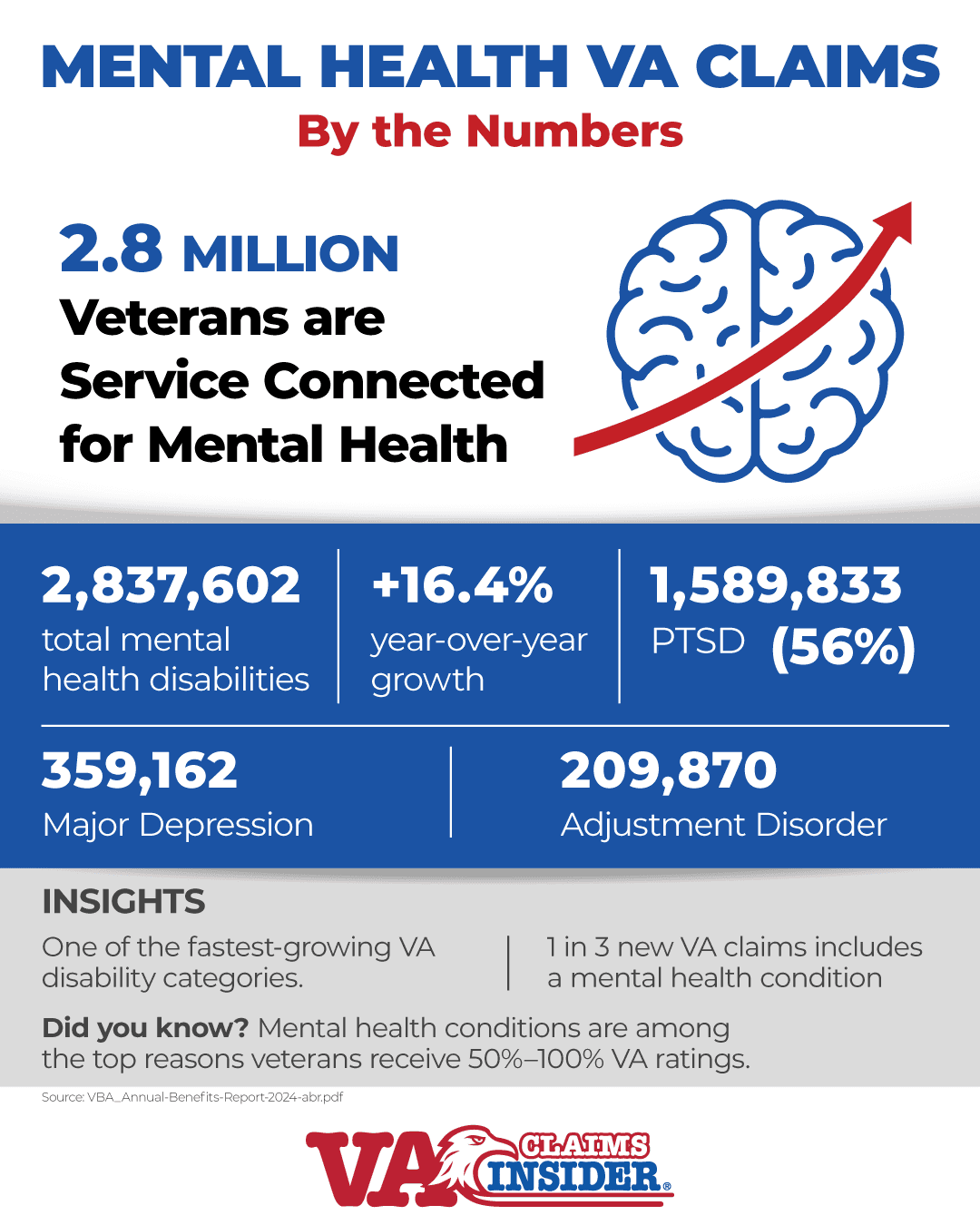
Over 2.8 million veterans are now service-connected for mental health conditions, according to the latest data from the Veterans Benefits Administration (VBA). That figure reflects a double-digit increase from the prior year, making VA mental health claims one of the fastest-growing disability categories in the system.
While post-traumatic stress disorder (PTSD) remains the most common—with roughly 1.59 million service-connected veterans—conditions like depression and adjustment disorder continue to rise as awareness improves and stigma fades. Mental health now accounts for nearly 7% of all VA service-connected disabilities, a record high.
In this post, we break down the latest VA mental health claim statistics, highlight which conditions are surging, and explain what this trend means for veterans who still haven’t filed.
Summary of Key Points
- Mental health is now one of the largest and fastest-rising VA disability categories. More than 1.59 million veterans are rated for PTSD alone, which is the only mental health condition in the VA’s overall Top 10 disabilities.
- Veterans mental health claims jumped 77% since 2020, and 163,644 new mental health ratings were granted in FY 2024 alone, showing that the stigma around mental health is lifting.
- A single PTSD or mental health rating commonly falls between 50% and 70%, with annual compensation varying by year and dependents.
Table of Contents
Mental Health VA Claims: By the Numbers

Since 2020, new VA mental health claims have jumped 77%, from 92,172 to 163,644. There was a 16.4% increase in new VA mental health claims in FY2024 alone. Total service-connected mental health disabilities have risen from 2,019,718 to 2,837,602, an increase of more than 817,000 in four years.
Every one of those new service connections represents a veteran who finally pursued the rating they deserve.
| Fiscal Year | New VA Mental Health Claims Granted | Year-Over-Year Growth |
| 2020 | 92,172 | — |
| 2021 | 100,253 | +8.8% |
| 2022 | 122,242 | +21.9% |
| 2023 | 140,556 | +15.0% |
| 2024 | 163,644 | +16.4%️ |
PTSD Dominates: 1.6 Million Veterans and Counting
PTSD is the clear leader with 1,589,833 service-connected veterans (56% of all mental health disabilities) and 81,968 new PTSD service-connected disabilities in FY2024. It’s the only mental health condition in the VA’s top 10 overall disabilities, sitting at No. 6, just behind hearing loss.
This aligns with broader National Institute of Health data showing PTSD lifetime prevalence among U.S. veterans at 7% (vs. 6% in civilians). Rates are even higher among combat-exposed groups like Iraq and Afghanistan veterans.
VA mental health conditions like PTSD are rated using the General Rating Formula for Mental Disorders (38 CFR § 4.130), with possible percentages of 0%, 10%, 30%, 50%, 70%, or 100%. A 0% rating pays no compensation; however, a PTSD rating between 10% and 100% for a single veteran with no dependents can result in monthly payments ranging from $180 to $3,939 (tax-free) in 2026. The VA rating for PTSD is based on how it affects occupational and social functioning.
Beyond PTSD
While PTSD accounts for most VA mental health service-connected disabilities, major depressive disorder (359,162 veterans) and chronic adjustment disorder (209,870) round out the top three.
Anxiety disorders, panic disorder, and bipolar disorder also appear frequently, and most veterans carry two or three separate mental health diagnoses. It’s important to note, however, that you can only be rated by the VA for one mental health condition.
Top 3 Mental Health Conditions
- PTSD: 1,589,833 (56% of mental health claims)
PTSD can be caused by combat and combat-related trauma, Military Sexual Trauma (MST), training accidents, noncombat trauma, or any in-service stressor. Learn more about PTSD VA Ratings.
- Major depressive disorder: 359,162 (12.7%)
While it’s often secondary to PTSD, major depressive disorder can be a primary service-connected condition if you experience chronic depression from experiences during service. Learn how the VA rates Depression.
- Chronic adjustment disorder: 209,870 (7.4%)
This refers to the persistent difficulty in adjusting after service and during the transition to civilian life. Chronic adjustment disorder often looks like ongoing anxiety and stress, irritability, and isolation. It’s often comorbid with other conditions. Learn more about Adjustment Disorder VA Ratings.
Did You Know? The “Top 3” account for 76.1% of all mental health disabilities. Other commonly service-connected mental health conditions include generalized anxiety disorder and panic disorder when clearly linked to service.
Why the Numbers Are Exploding
The four main causes for the surge:
- There’s been a break in the stigma. Younger veterans and online communities have made it normal to talk about mental health.
- Post-9/11 combat veterans are now filing in large numbers after more than 20 years of war.
- MST claims are easier to file and no longer require a report from the time of service; “markers” like behavioral changes suffice. The VA saw an 18% rise in MST claims in FY2024 due to outreach.
- The PACT Act encouraged comprehensive claims, which include both physical and mental health conditions.
-
“If you have issues with your mental or physical health, don’t let others persuade you it’s not important. Get it documented.” — Navy veteran
Mental Health Affects All Eras and Genders
Vietnam veterans are still filing VA mental health claims more than 50 years later, including 383,961 with PTSD.
GWOT veterans already have 714,245 PTSD ratings, and the numbers keep climbing.
Female veterans file at slightly higher rates, largely due to MST, but 2.36 million male veterans also carry mental health ratings. VA data shows 24% of female vs. 14% of male VA users were diagnosed with PTSD in FY2024.
How the VA Rates Mental Health
The VA recognizes 31 mental disorders for rating purposes out of nearly 300 listed in the DSM-5, focusing on the most common conditions that impact military veterans.
VA mental health ratings are 0%, 10%, 30%, 50%, 70%, or 100%, based on the General Rating Formula for Mental Disorders (38 CFR § 4.130).
The average VA rating for a mental health condition is 70% (awarded to more than 1 million veterans), followed closely by 50%. Together, 50% and 70% account for nearly two-thirds of all compensated mental health claims.
Note: The Proposed VA mental health rating changes would shift to a “Five Functional Domains” model, potentially leading to higher ratings. Claims filed before the effective date of the changes to the rating schedule would be grandfathered in under the existing rules if beneficial to the veteran.
Related: Full VA Mental Health Ratings Chart Explained!
What Mental Health Claims Are Actually Worth in 2026
Mental health claims aren’t just about validation; they’re about getting real financial support for real disabilities that affect your life. Here are some examples of real VA monthly payment amounts (2026 rates for a veteran with no dependents):
- 10% mental health VA rating = $180.42
- 30% mental health VA rating = $552.47
- 50% mental health VA rating = $1,132.90
- 70% mental health VA rating = $1,808.45
- 100% mental health VA rating = $3,938.58
Plus, you may have potential secondary conditions. If PTSD (70%) leads to IBS (30%), migraines (30%), and depression (50%), your combined VA rating could be 90%. That could bring your VA compensation up to $28,347.60 annually for a veteran with no dependents. Calculate My Combined VA Rating
Related: 2026 VA Disability Rates (2.8% COLA) | OFFICIAL Pay Chart & Pay Dates
How to File a Winning Mental Health Claim (Step-by-Step)
To receive a mental health VA rating, you must prove service connection. Even if you didn’t experience a full mental health episode during service, you could still establish a link to in-service symptoms or behavioral changes that a medical professional can relate to your current diagnosis.
- Prove Service Connection
Proving direct service connection requires meeting all three criteria commonly referred to as the Caluza Triangle:
- A current medical diagnosis
- Evidence of an in-service event, injury, disease, or aggravation
- A medical nexus (the link between the condition and your service) via competent medical evidence
- Document Current Symptoms & Functional Impact
How does your condition affect work, marriage, parenting, or socializing? Be brutally honest.
- File your Claim
- Use VA Form 21-526EZ online at VA.gov. Upload everything up front.
- Ace Your C&P Exam: Talk about your worst days, not your best. The examiner only sees you for 30–60 minutes. See related: 10 Expert Tips to Dominate Your C&P Exam!
Pro Tip: The VA rates mental health on occupational and social impairment, not the current diagnosis label. Two veterans with PTSD can receive 30% or 100% based purely on how it impacts daily life.
Critical: VA mental health ratings are based on symptom severity and functional impact, not the current diagnosis itself. Two veterans with PTSD can have different ratings based on how it affects their lives.
Common Mental Health Claim Mistakes
- Minimizing symptoms (“I’m managing okay”)
- Filing only for PTSD and ignoring secondaries
- Thinking you needed combat to qualify
- Waiting decades (Vietnam veterans are winning claims right now)
- Avoiding treatment because you’re afraid it makes you look “fine.” Treatment records strengthen claims. Get the help you need.
The Hidden Power of VA Secondary Conditions
Mental health isn’t just one condition. For example, PTSD often leads to three to five secondary conditions.
PTSD commonly contributes to:
- Migraines
- Irritable bowel syndrome (IBS)
- Erectile dysfunction (ED)
- Sleep apnea
VA secondary conditions can significantly increase your combined VA rating and monthly compensation. As with service connecting a primary condition, VA guidelines require a medical nexus showing the secondary condition is “proximately due to or aggravated by” PTSD.
Mental Health Resources for Veterans
Veterans Crisis Line: Dial 988 then Press 1 (24/7, confidential)
VA Mental Health: From general mental health information to dedicated pages for PTSD and MST, the VA has a wealth of information available.
Make the Call Campaign: This is a state-level campaign in Virginia, but the information (and goal) applies nationwide.
Also check out VA Claims Insider’s blog: Suicide Prevention Resources for Veterans
Conclusion
The stigma surrounding mental health is lifting, and VA mental health claims are reflecting that trend. The VA currently recognizes 2,837,602 mental health disabilities of all compensation recipients, including 163,644 new service-connected mental health conditions and 1,589,833 veterans with service-connected PTSD. These aren’t just numbers; they’re proof that the silence is ending.
If you’re struggling, know that you’re not alone, you’re not weak, and it’s not too late to claim your VA disability compensation and benefits.
Want Expert-Level Support for Your VA Disability Claim?

- VA Claims Insider is the #1 most trusted name in VA disability claims.
- Work directly with a VA claims coach who can educate you through the claims process.
- 25,000+ disabled veterans have served in our membership programs since 2016.
- 30% average rating increase for veterans who complete our #1-rated Elite program.
- 4.7/5.0 average rating out of 6,000+ total reviews; over 5,000 5-star reviews.
FAQs | Frequently Asked Questions
How long do I have to file a mental health claim after leaving the military?
There is no deadline for filing disability claims after leaving service. Vietnam veterans are still winning PTSD claims more than 50 years later. You can file tomorrow, next year, or in 20 years — and, if approved, backpay starts from the date you submit your intent to file (or the date you became ratable).
Do I need to have been in combat to get service-connected for PTSD or other mental health conditions?
No, combat is not required to connect your mental health condition to service. Military Sexual Trauma (MST), training accidents, hazing, fear of hostile activity, personal assaults, terrorist attacks, or even peacetime stressors can all qualify. The VA only needs a credible stressor or event that happened during service, a current diagnosis, and a medical nexus linking the two.
Can I get VA compensation for depression or anxiety if I already have a PTSD rating?
Yes, but only one mental health rating is allowed at a time. The VA combines all psychiatric symptoms (PTSD, depression, anxiety, etc.) and gives you a single rating based on overall occupational and social impairment. However, you can get separate secondary ratings for physical conditions caused by your mental health (migraines, IBS, erectile dysfunction, sleep apnea, etc.).
How much does a typical PTSD or mental health rating pay in 2026?
The average VA rating for all mental conditions is 70%. A 70% VA rating for a single veteran with no dependents $1,808.45/month, which $21,701.40 per year. That is tax-free income, which increases based on the number of dependents you have. Here’s a full breakdown of the 2026 disability pay rates.
Will going to VA therapy or taking psychiatric medication hurt my disability rating?
No, it actually usually helps. Treatment records prove your condition is ongoing and severe. The VA wants you to get help; seeking treatment does not reduce your rating. In fact, veterans who avoid treatment often receive lower ratings due to lack of evidence.
Content Reviewed By

Quality Assurance Team
The Quality Assurance (QA) team at VA Claims Insider has extensive experience researching, fact-checking, and ensuring accuracy in all produced content. The QA team consists of individuals with specialized knowledge in the VA disability claims adjudication processes, laws and regulations, and they understand the needs of our target audience. Any changes or suggestions the QA team makes are thoroughly reviewed and incorporated into the content by our writers and creators.
About the Author

Katie McCarthy
Katie McCarthy is a writer and editor with experience in daily news and digital and print magazine publishing. She honed her editorial (and firearms) skills at Guns & Ammo before helping launch Black Rifle Coffee Company’s Coffee or Die Magazine as the managing editor. She holds degrees in English (BA) and public administration (MPA). Katie is a military spouse and word nerd who enjoys reading, hiking, camping, gardening, and spending time with her family.