
 go.vaclaimsinsider.com
Looking for Expert-Level VA Claim Answers? Schedule a Call
If you’re dealing with chronic red, irritated eyelids, crusting along your lashes, and a constant gritty or burning sensation, you may have blepharitis. And if you can connect it to your military service, you may be eligible for compensation.
Here’s the part that gets confusing: There is no specific diagnostic code labeled “blepharitis” in the VA Schedule for Rating Disabilities. So how does the VA assign a VA disability rating?
In this post, we’ll discuss the blepharitis VA rating, what evidence matters most, and what steps you should take when filing a claim.
Summary of Key Points
- Blepharitis is chronic eyelid inflammation that can cause redness, crusting, burning, light sensitivity, and irritation; in some cases, it may contribute to dry eye symptoms.
- There is no specific “blepharitis” diagnostic code in the VA Schedule for Rating Disabilities. The VA rates it by analogy under eye conditions, which can range from 0% to 60%.
- Strong medical documentation — including records of active inflammation, frequency of flare-ups, continuous treatment, and any impact on vision — is critical to securing the correct blepharitis VA rating.
Table of Contents
What Is Blepharitis?
According to the National Eye Institute, blepharitis is inflammation of the eyelids, typically occurring where the eyelashes grow.
It often affects both eyes and may be chronic (long-term), with periodic flare-ups.
Related: Review other eye and vision conditions and our complete VA Disability Rating Guide.
Common symptoms include:
- Red, swollen eyes or eyelids
- Crusting or flakes around the lashes
- Burning or stinging sensation
- Itching
- Light sensitivity
- Watery or dry eyes
Is Blepharitis the Same as Dry Eye?
No, but they’re related.
- Blepharitis = inflammation of the eyelids
- Dry eye syndrome = dysfunction of the tear film
Blepharitis can cause or worsen dry eye because clogged oil glands disrupt the tear film’s stability.
If your current primary diagnosis is dry eye, read our post on the VA rating for dry eye syndrome. These are medically distinct conditions and may be evaluated differently depending on your documented symptoms.
How Does the VA Rate Blepharitis?
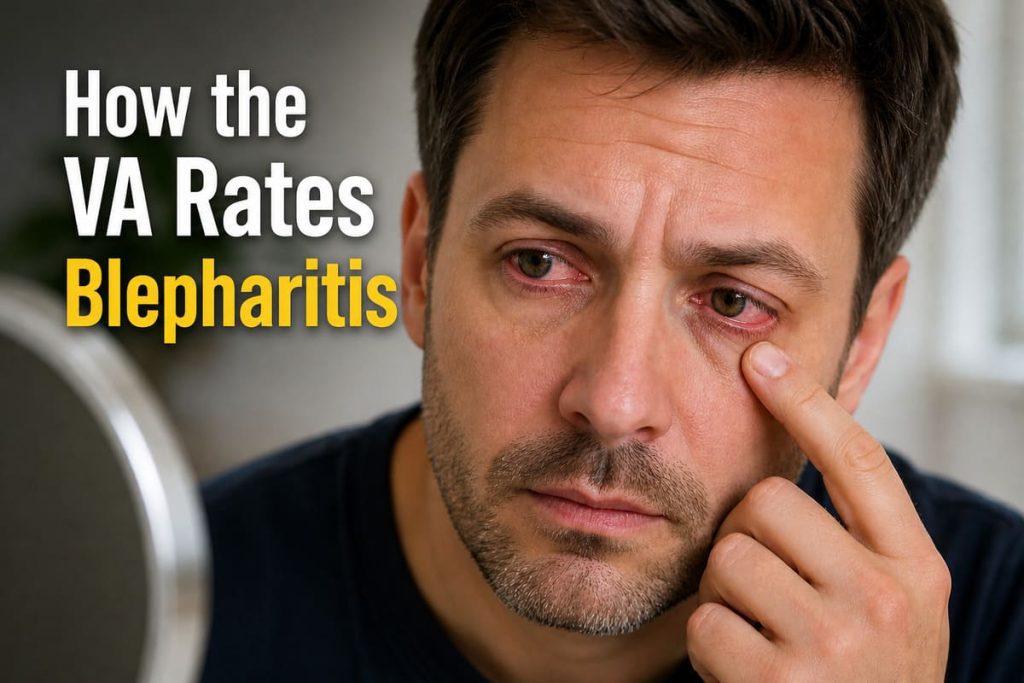
Because blepharitis does not have its own diagnostic code, the VA evaluates it by analogy under eye conditions in 38 CFR § 4.79.
General Rating Formula for Diseases of the Eye
Evaluate on the basis of either visual impairment due to the particular condition or on incapacitating episodes, whichever results in a higher evaluation
| VA Rating | Criteria |
| 60% | With documented incapacitating episodes requiring 7 or more treatment visits for an eye condition during the past 12 months |
| 40% | With documented incapacitating episodes requiring at least 5 but less than 7 treatment visits for an eye condition during the past 12 months |
| 20% | With documented incapacitating episodes requiring at least 3 but less than 5 treatment visits for an eye condition during the past 12 months |
| 10% | With documented incapacitating episodes requiring at least 1 but less than 3 treatment visits for an eye condition during the past 12 months |
| Note (1): For the purposes of evaluation under 38 CFR 4.79, an incapacitating episode is an eye condition severe enough to require a clinic visit to a provider specifically for treatment purposes | |
| Note (2): Examples of treatment may include but are not limited to: Systemic immunosuppressants or biologic agents; intravitreal or periocular injections; laser treatments; or other surgical interventions | |
| Note (3): For the purposes of evaluating visual impairment due to the particular condition, refer to 38 CFR 4.75-4.78 and to § 4.79, diagnostic codes 6061-6091 | |
What Does “Rated by Analogy” Mean?
Under 38 CFR § 4.20, when a condition is not specifically listed, the VA rates it under a diagnostic code (DC) for a closely related disease or injury with similar symptoms and functional impact.
For blepharitis, the VA may rate it based on:
- Active inflammation
- Visual impairment (if present)
- Frequency and severity of symptoms
- Need for continuous medication or treatment
- Impact on visual acuity or visual fields
Common Analogous Ratings for Blepharitis
Chronic Conjunctivitis (DC 6018)
If your blepharitis presents with active redness, swelling, discharge, or irritation, the VA may rate it similarly to chronic conjunctivitis:
- 10% for active conjunctivitis with objective findings
- If inactive, the VA rates based on residuals (such as visual impairment and disfigurement)
If there are no compensable residuals, a 0% rating may be assigned.
Disorders of the Lacrimal Apparatus (DC 6025)
If your primary issue involves tear dysfunction requiring ongoing treatment, the VA may evaluate by analogy under disorder of the lacrimal apparatus:
- 10% for unilateral (one eye) lacrimal disorder
- 20% for bilateral (both eyes) lacrimal disorder
This may apply when blepharitis significantly affects tear production or drainage.
Visual Impairment Ratings
If blepharitis leads to measurable vision loss, the VA evaluates:
- Visual acuity
- Visual field loss
- Muscle function impairment
Higher ratings are possible if documented testing shows compensable visual impairment.
However, mild blepharitis without vision loss is typically evaluated at 0% or 10%, depending on whether it is active and symptomatic.
What Is the Highest Blepharitis VA Rating Possible?
There is no fixed “maximum” blepharitis rating because it depends entirely on:
- The diagnostic code used
- Severity of symptoms
- Whether vision is impaired
Cases without significant visual impairment generally fall within the 0% to 10% range. Higher ratings generally require documented visual deficits under the visual impairment tables.
Can I Get Rated for Blepharitis and Dry Eye Syndrome?
The VA cannot compensate for the same symptom twice.
So, if blepharitis and dry eye syndrome produce identical symptoms, the VA cannot assign separate ratings for the same functional impairment.
Separate ratings are possible only if symptoms are medically distinct and independently ratable. Proper documentation from your eye specialist is critical here.
How to Establish Service Connection for Blepharitis
Before the VA assigns a rating, you must establish service connection.
Direct Service Connection
You must show:
- A current diagnosis of blepharitis, and
- An in-service event, illness, injury, or aggravation, and
- A medical nexus linking the condition to your service.
Examples may include documented eye infections, environmental exposures, or eyelid inflammation during service.
Secondary Service Connection
Blepharitis may be secondary to another service-connected condition, such as:
You’ll need medical evidence, like a nexus letter, stating the primary service-connected condition caused or aggravated the blepharitis.
What Evidence Strengthens a Blepharitis VA Claim?
The VA relies heavily on medical documentation.
Strong evidence includes:
- A current diagnosis from an optometrist or ophthalmologist
- Treatment records documenting flare-ups
- Notes showing active inflammation
- Records demonstrating continuous medication or lid hygiene treatment
- Visual acuity or field-testing results
- A nexus opinion for service connection
If the VA schedules you for a compensation and pension (C&P) exam, be prepared to describe:
- The frequency of your flare-ups
- The severity of your symptoms
- The impact of your condition on daily activities
How to File a Blepharitis VA Disability Claim
You have several options when filing for VA disability for blepharitis.
The easiest way to file a VA claim is online, but you can also download VA Form 21-526EZ and submit it through the mail, by fax, or in person at a regional office.
Conclusion
If you’re suffering from blepharitis and want to file a VA disability claim, here’s the bottom line:
- There is no standalone blepharitis diagnostic code.
- The VA rates it by analogy under the eye schedule.
- Active symptoms, medical documentation, and service connection are critical.
- Mild cases may receive 0%, while active or functionally impairing cases may qualify for compensable ratings.
If you’re dealing with chronic eyelid inflammation, don’t assume it’s too minor to matter. What matters is how it’s documented and how it impacts your functioning.
Understanding the criteria — and aligning your medical evidence with those criteria — is the key to getting the correct blepharitis VA rating.
YOU SERVED. YOU DESERVE.

Do you have the VA rating you were given … or the VA rating you actually deserve?
Because getting a decision from the VA does not always mean you got the right decision from the VA.
If you are rated anywhere from 0% to 90% and feel stuck, frustrated, underrated, denied, or overlooked, I am speaking directly to you.
And if you have never filed because you thought other veterans deserved it more, because you got denied before, or because you assumed it was too late, do not let those myths make your decision for you.
At VA Claims Insider, we help underrated disabled veterans create real-life change by getting the VA rating and compensation they deserve!
Here’s a sliver of what you get when you join us:
- A Veteran Coach by your side, so you never have to fight the VA alone.
- A smarter, personalized strategy for your claim.
- Better VA disability education, so you know what to do next.
- Stronger private medical evidence (DBQs, Nexus Letters, Mental Health Evaluations, and more) at members-only rates to support the rating you deserve.
- And a proven battle plan toward VA claim victory.
But maybe you’re wondering: Will this actually work for me?
That is a fair question.
- At VA Claims Insider, we have helped 50,000+ veterans fight for the VA disability benefits they earned.
- Our internal data shows an average *33% VA rating increase for veterans who complete our Elite program.
- Our internal data also shows veterans in our programs get their claims approved *25% faster on average than the VA’s published average claim-processing timelines.
- Veterans in our community have left 7,000+ total reviews, with a 4.6 out of 5 average rating.
- More than 5,500 reviews are 5 stars ⭐⭐⭐⭐⭐, and 92% of all veteran customer reviews are either 4 or 5 stars.
*Based on VA Claims Insider internal data for veterans who completed the Elite program. Average results shown; individual results vary. No guaranteed outcome or faster claim processing.
If you are ready for a better battle plan, a smarter strategy, and the right path to the VA rating and compensation you deserve, we’ve got your six.
📅 Schedule a Call or click the red button below to get started:
FAQs | Frequently Asked Questions
Does blepharitis qualify for VA disability?
Yes, if it is service-connected and produces documented functional impairment.
What is the typical blepharitis VA rating?
Cases without notable vision impairment are typically rated at 0% or 10%, depending on whether the condition is active and symptomatic. However, diseases of the eye can be rated from 0% to 60%.
Can I receive separate ratings for blepharitis and dry eye?
Possibly, but only if the symptoms are medically distinct and do not violate the anti-pyramiding rule (you can’t get rated multiple times for the same symptoms).
Can blepharitis cause higher ratings?
Yes, if it results in measurable visual acuity loss, visual field defects, visual muscle dysfunction, or other compensable visual impairment.
Content Reviewed By

Quality Assurance Team
The Quality Assurance (QA) team at VA Claims Insider has extensive experience researching, fact-checking, and ensuring accuracy in all produced content. The QA team consists of individuals with specialized knowledge in the VA disability claims adjudication processes, laws and regulations, and they understand the needs of our target audience. Any changes or suggestions the QA team makes are thoroughly reviewed and incorporated into the content by our writers and creators.
About the Author

Brian Reese
Brian Reese is a world-renowned VA disability benefits expert and the #1 bestselling author of VA Claim Secrets and You Deserve It. Motivated by his own frustration with the VA claim process, Brian founded VA Claims Insider to help disabled veterans secure their VA disability compensation faster, regardless of their past struggles with the VA. Since 2013, he has positively impacted the lives of over 10 million military, veterans, and their families.
A former active-duty Air Force officer, Brian has extensive experience leading diverse teams in challenging international environments, including a combat tour in Afghanistan in 2011 supporting Operation ENDURING FREEDOM.
Brian is a Distinguished Graduate of Management from the United States Air Force Academy and earned his MBA from Oklahoma State University’s Spears School of Business, where he was a National Honor Scholar, ranking in the top 1% of his class.