 go.vaclaimsinsider.com
Looking for Expert-Level VA Claim Answers? Schedule a Call
Most veterans spend years focused on their own disability rating and never plan for what happens to their family if a service-connected condition eventually takes their life.
That’s understandable. It’s not a comfortable thing to think about.
But the VBA data shows a sharp, specific surge in survivor claims that makes this worth a second look, particularly for veterans with a 100% VA rating or Permanent & Total, and for spouses who may not know DIC exists until they need it.
This article walks through what Dependency and Indemnity Compensation (DIC) is, what the numbers actually show about survivor benefits, why the surge is likely happening now, and what it means for military families planning ahead.
Summary of Key Points
- New VA DIC statistics show DIC recipients rose 20.7% year-over-year in FY2025 — from 46,153 to 55,700
- New surviving-child DIC recipients rose 45% — the sharpest increase of any survivor category
- New surviving-spouse DIC recipients rose 19.8%, from 44,255 to 53,019
- Total DIC payments reached $11.51 billion in FY2025, reaching 549,324 surviving family members nationwide
- The surge likely reflects delayed deaths from service-connected conditions among veterans of the PACT Act era, though the VBA data does not break out cause of death by category
Table of Contents
What is DIC?
Dependency and Indemnity Compensation (DIC) is a tax-free monthly benefit paid to eligible surviving spouses, children, and in some cases dependent parents of a veteran who died from a service-connected condition, or who was rated Permanent & Total for a qualifying period before death. It is separate from — and in addition to — any life insurance or Social Security survivor benefits a family may receive.
This article focuses on what’s new: the trend data behind the recent surge, not the eligibility mechanics themselves.
>> For a full breakdown of eligibility rules and current payment rates, see VA Dependency and Indemnity Compensation (DIC) Explained and the current VA DIC rates.
The 2025 Surge, By the Numbers
According the VBA, new DIC (Dependency and Indemnity Compensation) claims rose 20.7% in 2025, from 46,153 to 55,700 new recipients. New surviving-child claims jumped even more sharply (up 45%), from 1,750 to 2,537. New surviving-spouse claims rose 19.8%. Altogether, DIC paid out $11.51 billion to 549,324 surviving family members nationwide in FY2025.
-VA Claims Insider
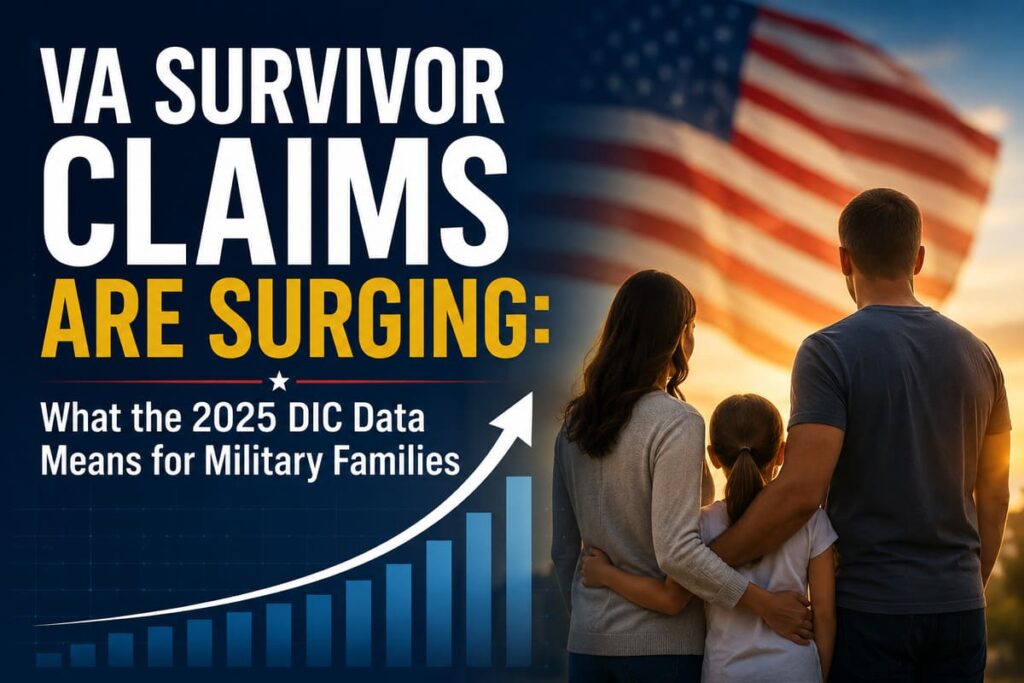
The VBA data shows survivor claims growing meaningfully faster than veteran compensation claims overall. Here’s the year-over-year comparison across the three new-recipient categories the report tracks:
| Category | FY2024 New Recipients | FY2025 New Recipients | YoY Change |
| Surviving spouses | 44,255 | 53,019 | +19.8% |
| Surviving children | 1,750 | 2,537 | +45.0% |
| Total new DIC recipients | 46,153 | 55,700 | +20.7% |
Total DIC payments across all recipients — new and existing — reached $11.51 billion in FY2025, covering 549,324 people nationwide. That total sits alongside, but separate from, the $174.05 billion the VA paid in veteran disability compensation the same year.
Why the Surge is Likely Happening Now
The VBA report doesn’t break down DIC claims by cause of death, so any explanation of why the numbers moved this much has to be stated as informed interpretation rather than proven fact. That said, the timing lines up with a plausible explanation: the PACT Act, signed in August 2022, dramatically expanded the list of presumptive conditions connected to burn pit and other toxic exposures.
Veterans who developed cancers, respiratory disease, and other serious conditions tied to those exposures are now several years into that presumptive-connection window — long enough for some of the most severe cases to result in death from a service-connected condition. If that dynamic is a meaningful driver, DIC claims tied to toxic-exposure conditions would be expected to keep climbing for at least the next several years as the PACT Act cohort ages.
The sharper jump in surviving-child claims (45%, versus 19.8% for spouses) is worth noting on its own. It suggests a meaningful share of the veterans behind this surge died relatively young, while their children were still dependents — consistent with service-connected conditions cutting lives short well before typical retirement age, rather than age-related decline among an older veteran population.
What This Means for Veterans and Their Families
- If you’re rated 100% or Permanent & Total: your survivors are likely already eligible for DIC in the event of your death, but eligibility rules are specific about cause of death and duration of rating. Confirm your P&T status is documented and that your dependents are correctly listed on your VA award — this is the paperwork that determines how quickly a claim can be processed.
- If you’re a spouse or dependent: DIC is not automatic. It requires a claim to be filed, generally with a death certificate, the veteran’s service and medical records, and evidence connecting the cause of death to a service-connected condition if the veteran wasn’t already rated 100% or P&T for the required period.
- If your loved one’s death may be connected to toxic exposure: conditions added under the PACT Act may qualify even if the veteran never filed a disability claim during their lifetime. This is one of the more commonly missed DIC eligibility paths.
For the full eligibility framework, current payment rates, and other benefits available to surviving families, see the best VA survivor benefits and the complete guide to Permanent & Total VA disability, which explains how P&T status connects directly to survivor eligibility.
>> View the Full Guide to VA Survivor Benefits: DIC, Pension, Eligibility, and How to Apply
Conclusion
DIC claims grew faster than almost any other category in 2025 — a 20.7% jump in new recipients, driven even more sharply by a 45% increase in surviving children. Whatever the exact cause, the trend points toward more military families needing to navigate this benefit, often for the first time, without much warning.
Understanding DIC eligibility and getting your own P&T status and dependent records in order now is one of the more overlooked but consequential pieces of planning a veteran and their family can do.
FAQs | Frequently Asked Questions
What is DIC and who qualifies?
Dependency and Indemnity Compensation is a tax-free monthly benefit for eligible surviving spouses, children, and dependent parents of a veteran who died from a service-connected condition, or who was rated Permanent & Total for a qualifying period before death.
How much have DIC claims grown recently?
New DIC recipients rose 20.7% in 2025 compared to 2024 — from 46,153 to 55,700 — according to the VA’s FY2025 Compensation Report.
Why are new surviving-child DIC claims growing faster than spousal claims?
2025 data shows new child DIC recipients up 45%, more than double the 19.8% growth rate for new surviving spouses. This likely reflects a meaningful share of the underlying veteran deaths occurring at a younger age, while children were still dependents.
Is DIC compensation taxable?
No. Like VA disability compensation, DIC payments are not subject to federal income tax.
Can a family receive DIC if the veteran never filed a disability claim?
Yes, in some cases. If the cause of death can be connected to a service-connected condition — including conditions presumptively connected under the PACT Act — a family may be eligible for DIC even if the veteran never received a VA disability rating during their lifetime.
How do I file a DIC claim?
DIC claims are filed with VA Form 21P-534EZ, along with the veteran’s death certificate, service records, and medical evidence connecting the cause of death to military service where the veteran wasn’t already rated 100% or P&T for the required period. A Veterans Service Organization can help prepare and file the claim at no cost.
If you’re a veteran rated 100% or approaching it, making sure your Permanent & Total status is properly documented is one of the most direct ways to protect your family’s future eligibility for these benefits.
What We Believe
Our WHY
We believe millions of veterans feel overlooked, lowballed, denied, or lost in the VA claims process.
Our purpose is to help underrated disabled veterans rated 0% to 90% create real life change by pursuing the VA disability benefits they legally, morally, ethically, and medically deserve.
We are INSIDERS.
Our HOW
We make the VA disability process easier through expert-level education, proven resources, and veteran-to-veteran support.
You are never alone in this fight.
Our flagship program, VA Claims Insider Elite, connects each veteran with an expert-level Veteran Coach who guides them through our proprietary 8-step process.
That process is built around our SEM Method:
Strategy + Education + Medical Evidence = VA Rating You Deserve!
Our WHAT
We help underrated disabled veterans rated 0% to 90% win, service connect, and increase their VA rating through a smarter strategy, better education, and stronger medical evidence.
YOU SERVED. YOU DESERVE.

Do you have the VA rating you were given…or the VA rating you actually deserve?
Because getting a decision from the VA does not always mean you got the right decision from the VA.
If you are rated anywhere from 0% to 90% and feel stuck, frustrated, underrated, denied, or overlooked, I am speaking directly to you.
And if you have never filed because you thought other veterans deserved it more, because you got denied before, or because you assumed it was too late, do not let those myths make your decision for you.
At VA Claims Insider, we help underrated disabled veterans create real life change by getting the VA rating and compensation they deserve!
Here’s a sliver of what you get when you join us:
- A Veteran Coach by your side, so you never have to fight the VA alone.
- A smarter, personalized strategy for your claim.
- Better VA disability education, so you know what to do next.
- Stronger private medical evidence (DBQs, Nexus Letters, Mental Health Evaluations, and more) at members-only rates to support the rating you deserve.
- And a proven battle plan toward VA claim victory.
But maybe you’re wondering: Will this actually work for me?
That is a fair question.
- At VA Claims Insider, we have helped 50,000+ veterans fight for the VA disability benefits they earned.
- Our internal data shows an average *33% VA rating increase for veterans who complete our Elite program.
- Our internal data also shows veterans in our programs get their claims approved *25% faster on average than the VA’s published average claim-processing timelines.
- Veterans in our community have left 7,000+ total reviews, with a 4.6 out of 5 average rating.
- More than 5,500 reviews are 5 stars ⭐⭐⭐⭐⭐, and 92% of all veteran customer reviews are either 4 or 5 stars.
*Based on VA Claims Insider internal data for veterans who completed the Elite program. Average results shown; individual results vary. No guaranteed outcome or faster claim processing.
If you are ready for a better battle plan, a smarter strategy, and the right path to the VA rating and compensation you deserve, we’ve got your six.
📅 Schedule a Call or click the red button below to get started:
About the Author

Eric Webb
Eric has written and worked in the field of Veterans Disability since 2020 and enjoys writing educational content for the veteran population. His prior work has been published in the Official Journal of the American College of Sports Medicine (ACSM). He holds a Degree in Health and Exercise Science.